
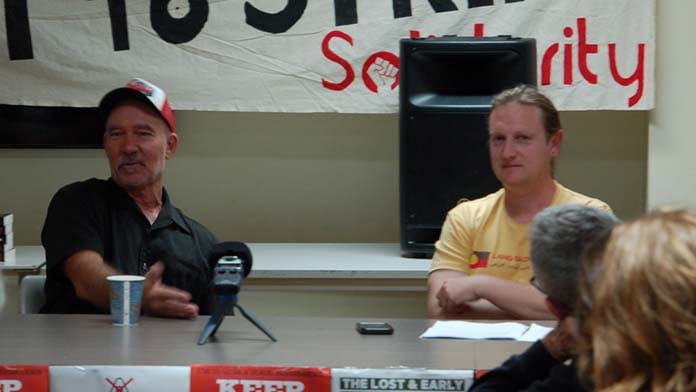
Paddy Gibson spoke to Stephen Gapps about his research on Indigenous resistance and his new book Uprising at this year’s Keep Left event
Paddy: Stephen is one of many historians who are studying the brutal process of genocidal violence that accompanied colonisation. We know from recent research that in Queensland alone we can now account for more than 60,000 Aboriginal people killed in frontier violence.
Australian capitalism was built on the violence that was unleashed on Aboriginal people.
The frontier was a pastoral, capitalist enterprise. The model for taking most of the continent was killing any Aboriginal people who resisted the flooding of their lands with stock to establish massive pastoral capitalist empires.
The rulers of Australia and the pastoral capitalists overseeing this knew what they were doing.
In 1849 the Sydney Morning quoted colonial politicians in NSW who said that “the Blacks interfere with the profits of grazing and this is a sufficient reason why they should be shot down like kangaroos, or be dosed with arsenic like native dogs”.
It’s very often believed that this violence was inflicted on a passive Indigenous population. Nothing could be further from the truth. This was counter-insurgency warfare meted out against people that were resisting with everything that they had.
It is the scale, the coordination of Aboriginal people in that process of resistance, and the sophistication of that resistance that shines through in Stephen’s work.
Stephen has written three books. The Sydney Wars covers the wars on the Sydney basin, Gudjarra, the Wiradjuri war of resistance in the 1820s as the colonists established themselves beyond the Blue Mountains in Bathurst and surrounds.
The final book, Uprising, looks at a huge area of the colonial frontier stretching from northern Victoria all the way through to southern Queensland, where there was fierce military confrontation through 1838 to 1844.
Can you discuss the militarised nature of the initial colonisation in Sydney and how Aboriginal resistance made this necessary?
Stephen: The early colony in Sydney was a military-led process. So the first building in Sydney was a redoubt, or fort. The first building in Parramatta was a redoubt.
In most country towns between Sydney and Melbourne along the old Hume Highway, the first buildings were military outposts, which were then transformed into police stations. That whole landscape of NSW is underpinned by military origins.
There’s been hundreds of books written on early colonial Sydney and most of them have avoided the resistance warfare.
Up until 1789 initial curiosity and friendly relationships were developing but those quickly turned into conflict as it was obvious that the colonists were going to stay.
The military was very overstretched initially. The British military forces in Australia were always thin on the ground. Back in Britain they had local militias. So they replicated that in the colony as needed.
The Parramatta militia and volunteers were set up in 1804, in response to the Castle Hill convict rebellion. There were others set up in 1816, in response to the conflict in the south of Sydney that ends in massacre.
This changes once pastoralism explodes across the Blue Mountains so that squatters and stockmen are informal militias.
A lot of the violence is disconnected from the state. It happens where a squatter teams up with another squatter, grabs a few stockmen around different stations with muskets and horses.
The only way they can get to Aboriginal warriors, who know the terrain, is to look for fire smoke at night, wait a few hundred metres away until dawn, and attack. The state turns a blind eye to it, because by the 1830s, wool is critical to the expansion of the colony.
In 1838, there is finally a trial and seven men are hanged for killing Aboriginal people. But it continues on afterwards, in silence.
Paddy: The coordination involved in Aboriginal resistance is one of the defining aspects of your research. You confront the myth that resistance was simply opportunistic or haphazard, rather than planned.
One of the most memorable examples for me was in your book about the First Wiradjuri War when you talk about the time in 1822 when a decision was obviously taken to wage war against the whites in the area.
At that moment, every single Wiradjuri person who’d been cooperating with the pastoral industry, working on a station or acting as a guide, left. Could talk about the scale of the coordination that you just discovered?
Stephen: Straight after they leave the settlements, [Aboriginal warrior] Windradyne leads a series of attacks. There’s attacks all around the central west, from Oberon to Blayney to Mudgee. That ends only after martial law and Windradyne coming to Parramatta to sue for peace.
When I looked at the Bathurst War, the First Wiradjuri War, I found there was a second Wiradjuri War down near the Murrumbidgee River. That was just one of a series of conflicts between [the area] around Melbourne, where the Kulin nation are, right up to the Darling Downs near Toowoomba.
I came across references by contemporaries calling it a general uprising right along the frontier almost from Melbourne to Brisbane.
How coordinated was it between Wiradjuri, Gomeroi, Jagera in Queensland? We don’t know. It seemed like they were all coordinating, but European observers didn’t know.
Military historians have claimed Aboriginal groups couldn’t communicate across hundreds of kilometres. But we now know there were communication networks between different nations.
We know trade networks extended right across Australia.
Stories of resistance would have been relayed over those distances while those events were going on. We know of a few examples where Aboriginal people in Queensland were performing stories about a victory that they had over whites in a battle.
The stories of the destruction of land, the incursions of sheep and cattle, the terrible effects on Aboriginal women, the loss of food supplies must have been told and alliances formed.
I’ve come across several examples of groups putting aside traditional enmity and uniting to fight the colonisers.
Paddy: I think another important feature of your work is the way you demonstrate the commercial interests that lay behind pastoral expansion, and how these influenced colonial governance.
In Gudyarra you talk about a decisive moment in the war with the Wiradjuri in 1824, when the stockholders of NSW convened in Sydney and petitioned the Governor for decisive action after two years of warfare.
Can you discuss some of the developments in pastoral capitalism. What was going on with the regulation of land and the development of the pastoral economy?
Stephen: In the mid-1830s, you had settled districts outlined. Beyond that, you had to have a licence to travel. But there were so many cattle and sheep that squatters went beyond the settled districts to find good grazing grass. They were continually moving on to find new grasslands and waterways.
To do that, you need a serious amount of money. By 1836, wool hit the highest price ever because of various factors around the world. Wool is the perfect commodity for Australia [to export], where it can take six months to get it to England.
You could make a ton of money within a year or two. That drove a huge immigration push for people with money to come out to the colonies to make fortunes.
The authorities needed to control it somehow, so they start to issue pasturing licences. Then these licensees become leaseholders of a few thousand acres with the view that hopefully in a few years time, they’d get freehold title to the property—all driven by the relatively cheap investment in wool.
Paddy: It’s striking that many of the Aboriginal combatants in the resistance were people who had extensive experience in colonial society, who’d worked on stations and grown up with whites their whole lives.
The Sydney Wars were still raging in the 1810s, decades after colonisation began, the Wiradjuri, the Ambēyaŋ, the Gomeroi, were all still fighting 20 years after initial engagement with the colonists. What impact did that have on the conflict?
Stephen: Previous historians tend to say Aboriginal people are only using traditional warfare tactics against firearms and horses.
In fact, Aboriginal people had highly adaptive societies. They took on new technologies really quickly. This happens with colonial resistance warfare as well. One example around Sydney is that glass is being used to make spearheads very quickly.
Firearms are taken up in the 1830s extensively by Aboriginal people. Often they were first given to them to go hunting and bring back lyrebird feathers to sell in London. This was occurring particularly in Melbourne.
They changed their tactics as well. At the battle of Meewah, One Tree Hill in Brisbane, drays were going with wool from the Darling Downs into Brisbane and being shipped out down one windy road. Multuggerah’s warriors build a palisade and then pushed logs across the road to stop the drays. The drays were fenced in and they speared them all.
So they’re using techniques that they used to build houses and to corral animals as a military tactic.
Paddy: There were also some examples of cooperation of non-Indigenous people in the Aboriginal resistance. This was a real source of anxiety for the colonial authorities. Can you speak about some examples?
Stephen: This was seen as a real threat because, in the colonial authorities’ minds, white people working with Aboriginal warriors would teach them how to do things.
In the 1790s escaped convicts go and fight with Pemulwuy’s warriors. The response is immediate. There were Irish convicts who had been involved in other rebellions. [The thought is that] if they team up with these warriors the authorities would be in serious trouble. This happens again and again.
There’s a huge fear of bushrangers teaming up with warriors. They institute the Vagrancy Act in 1836 to say you can’t live in Aboriginal lands outside the settled districts. But there’s many examples of ex-convicts who go and live with Aboriginal people and resurface later on.