

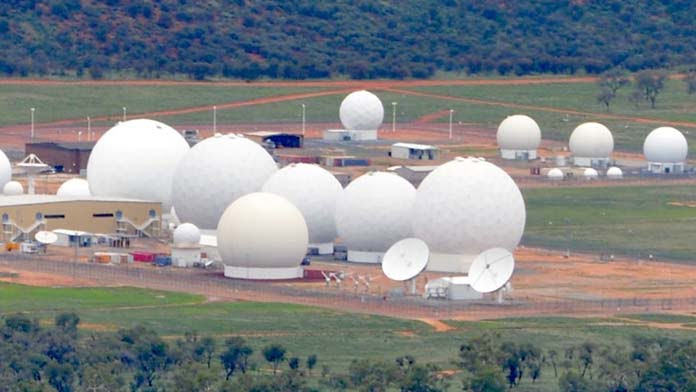
The expansion of US bases here locks Australia in as a key part of the US’s military machine, and its strategy for war with China, writes Tom Fiebig
In the red desert of the Northern Territory, on unceded Arrernte land about 18 kilometres from Alice Springs, sits one of the most important military installations in the world. Pine Gap, established by the CIA in 1966, has been described by defence analysts as “America’s most valuable intelligence site outside US soil”.
This is no exaggeration. The US maintains more than 750 foreign military bases across the globe, with around 173,000 troops deployed in 159 countries. Yet even among this sprawling imperial infrastructure, Pine Gap stands out.
One analyst bluntly stated that the US military would be “useless” without access to its Australian bases.
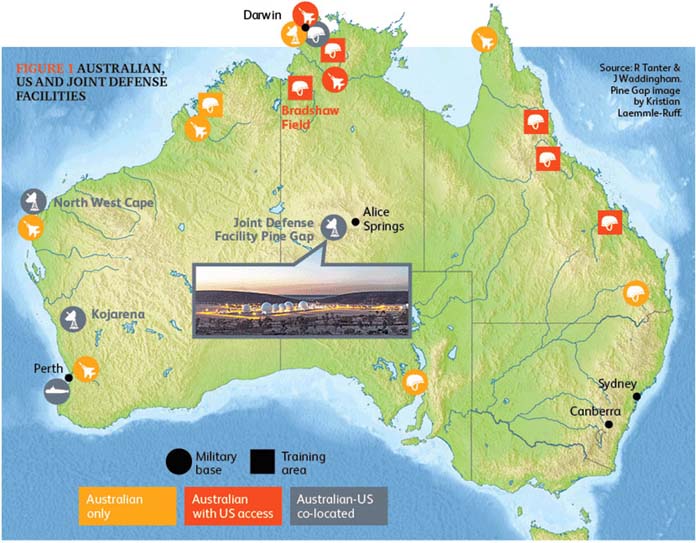
This reality exposes the lie that Australia is merely a passive or reluctant partner in US wars. From Pine Gap to North West Cape, from Darwin to Amberley, Australia is being integrated ever more deeply into the US war machine—as Washington prepares for potential conflict with China.
Pine Gap: cornerstone of US imperial power
Pine Gap is nominally a “joint” facility, run by both the Australian and US governments. In practice, it functions as a critical node in US global surveillance, intelligence gathering and war-fighting.
The base is studded with 45 satellite dishes hidden beneath white radomes. According to former MI5 head Sir Richard Dearlove, Pine Gap is “a sophisticated listening post—and a lot else besides”. Its importance, he said, lies above all in providing “Western coverage of China”.
This is not simply about espionage. As revealed in documents leaked by whistleblower Edward Snowden, Pine Gap plays a direct role in US military operations. Journalist Peter Cronau reported in 2017 that signals intercepted at Pine Gap can be transformed into precise geolocation data and transmitted to US forces in near real time. This data has been used to locate targets for special forces operations and drone strikes.
During the so-called “war on terror”, US drone strikes killed tens of thousands of civilians across Afghanistan, Iraq, Pakistan and Yemen. Pine Gap’s intelligence was central to making this possible.
Over the past decade, Pine Gap’s capabilities have expanded dramatically. Ten new satellite antennas have been installed, significantly enhancing the base’s capacity to monitor missile and rocket launches. According to academic Richard Tanter, these systems can collect detailed information on the location, size, speed, trajectory and target of missiles, forming a core component of US nuclear war-fighting strategy.
One of Pine Gap’s largest radomes provides “battlefield surveillance capability” that allows the monitoring not only of military communications, but also of personal phones and civilian data. These tools were refined in the brutal wars in Iraq and Afghanistan.
Pine Gap intelligence has almost certainly been shared with the Israeli Defence Forces during Israel’s genocidal assault on Gaza. Pine Gap’s satellites are well-situated to tracking the launch sites of rockets fired from Gaza, making Australia complicit in Israel’s war crimes.
As Tanter has argued, Pine Gap’s role in intelligence gathering for US and Israeli wars means Australia is “essentially complicit with whatever the end result is”.
Recent upgrades to Pine Gap also expand its second, even more dangerous purpose. The base plays a key role in detecting the thermal signatures of missile launches, feeding data from US early-warning satellites directly into American nuclear command systems.
This gives the US advance warning of an enemy nuclear strike and the capacity to launch a so-called “second strike”—a retaliatory nuclear attack that would guarantee mass destruction.
Australian and US leaders claim this makes the world safer by “deterring” China. But by hosting Pine Gap, Australia paints a giant target on itself. In any conflict between the US and China, facilities like Pine Gap would be among the first targets for Chinese missiles or cyberattacks.
Rather than protecting ordinary people, this role in US nuclear strategy makes Australia less safe.
As Tanter notes, Pine Gap “will play an irreplaceable role in US military operations from Africa to the Pacific—both conventional and nuclear”. That is precisely why it should be dismantled.
North West Cape
Pine Gap is not the only US base in Australia. At North West Cape near Exmouth in Western Australia stands another crucial installation.
Thirteen towers, each 300 metres tall, support a vast array of antennas originally built in the 1960s as a submarine communications facility. Using very low frequency signals, the base can communicate with nuclear-armed submarines without them surfacing.
Though nominal control was transferred to the Australian Navy in 1992, North West Cape has operated as a joint US-Australia facility since 2008. Between 2008 and 2010 it was upgraded with an advanced space radar and space telescope.
These upgrades have transformed it into a key site for “space situational awareness”—the ability to track and potentially target satellites. In any future conflict, this could draw Australia directly into space warfare, including attempts to blind Chinese communications and missile systems.
Kojarena and the Five Eyes
A third major facility, the Australian Defence Satellite Communications Station at Kojarena in Western Australia, forms part of the global “Five Eyes” intelligence alliance linking Australia, the US, Britain, Canada and New Zealand.
Commissioned in the late Cold War, Kojarena was designed to intercept satellite communications across Asia, including those of China, Russia and North Korea. It contributes to the US-led global surveillance system known as Echelon.
This network has been used to track military targets—such as Osama bin Laden in the 1990s—but also to conduct mass surveillance of civilians. In 2007, Australia agreed to expand Kojarena into a fully joint facility, granting the US access in exchange for satellite funding and intelligence sharing.
US “pivot to Asia”
In 2011, US President Barack Obama announced the “pivot to Asia”. Under the Gillard Labor government, Australia agreed to host rotating deployments of US Marines and aircraft in the Northern Territory.
Since then, the US military presence has steadily increased. As of 2024, the number of US marines deployed to Darwin has risen to 2500. Here they conduct exercises and train with the Australian Defence Force for about six months. Nuclear-capable US B-52 bombers now regularly land at the RAAF Darwin base.
In 2020, Prime Minister Scott Morrison committed $1.1 billion to expand RAAF base Tindal near Katherine. ABC’s Four Corners has seen Pentagon tender documents which show that extensive upgrades to Tindal are planned, including the construction of a squadron operations facility, a maintenance centre, aircraft parking, fuel dump and ammunition depot.
The planned upgrades would allow a squadron of six US B-52 bombers to have a permanent presence in Australia. More than half of the US’s currently deployed B-52s are nuclear capable.
In late 2024 US B-2 bombers used Australian airspace and likely refuelling aircraft based here en route to an attack on Yemen.
At the most recent AUSMIN talks in December between Australian and US ministers, the US announced plans to scope infrastructure upgrades at the Amberley air force base near Brisbane and to expand logistics and infrastructure development for marines to operate near Darwin, and to pre-position Osprey aircraft there too.
In 2018 Prime Minister Malcolm Turnbull announced plans to make Australia a major arms exporter. Morrison then committed to massive military expansion, including the $368 billion AUKUS submarine deal. Labor under Anthony Albanese has continued this agenda, announcing a $30 billion nuclear submarine construction yard in Adelaide.
US nuclear submarines will use the HMAS Stirling naval base in WA from 2027, as well as the new Henderson shipyards nearby, before they eventually host AUKUS nuclear submarines alongside a new East Coast submarine base.
Joint exercises such as Talisman Sabre, held every two years, now involve tens of thousands of troops from nearly 20 countries.
US forces train alongside Australian troops across the continent—from Townsville to Amberley to South Australia—integrating command systems, logistics and strike capabilities.
Defence spending is now $59 billion a year—double what it was 25 years ago. This is preparation for war.
Australia’s military build-up
Australia has historically relied on imperial patrons—first Britain, then the US—to enforce its regional interests.
Australian troops have joined every major US war, from Vietnam to Iraq and Afghanistan, as a down payment for protection and influence.
At the same time, Australia has acted as a brutal sub-imperial power in its own right—exploiting the Pacific, bullying Timor Leste, spying on Indonesia and warehousing refugees on Nauru.
Trump’s 2025 National Security Strategy makes clear that the US intends to “contain” China through military “overmatch”. But Washington cannot do this alone. It demands that allies like Australia shoulder more of the burden.
Australia’s ruling class is also seeking closer alignment with Japan and other regional powers.
In August 2025, Australia’s Defence Minister Richard Marles signed a $10 billion deal with Japan to acquire 11 Mogami class frigates for the Royal Australian Navy.
The Australian Strategy Policy Institute, a ruling class thinktank, argues that an even closer “Australia-Japan defence alignment [is] central to maintaining a free and open Indo-Pacific by deterring China in the region”.
Rival imperial blocs are hardening, arms races accelerating and the risk of catastrophic war growing.
None of this serves the interests of working people in Australia, China or anywhere else. The drive to war is rooted in a global system of imperialist competition and capitalist crisis.
To stop it, we need a movement capable of breaking Australia’s alliance with US imperialism, halting Australia’s independent military build-up—and ultimately overthrowing the system that produces endless war.