
Greg Adler came into left-wing politics in the late 1960s, at a time of great political turmoil in Brisbane. The reactionary Bjelke-Petersen government had moved to shackle the unions and crush dissent, provoking a series of mass protests. In 1969, Greg joined the Revolutionary Socialist Alliance, part of which went on to join the Socialist Labour League (SLL).
He moved to Sydney in the early 1970s to work as a journalist on Workers News and he became deeply involved in the Palestinian struggle, working closely with the United Palestinian Workers. He followed developments in the Middle East and was also an astute observer of the Australian political scene and the trade union movement.
In May 1979, Greg was sent to Baghdad to cover a women’s conference. In his reports for Workers News he duly followed the SLL position, also that of the Australian government, of supporting the Saddam Hussein regime. However, the visit led him to question the SLL’s capitulation to the national bourgeois regimes and within months he was driven out of the organisation.
He set about training as a lawyer and, eschewing more profitable options, chose to work in the under-paid and over-worked legal aid system in order to defend the most oppressed sections of society. His commitment and determination was expressed in a Sydney court appearance when he was looking so ill that the judge asked him if he was able to continue. “Yes, Your Honour,” came Greg’s immediate response.
He welcomed the 1985 expulsion of Gerry Healy from the International Committee, the SLL’s parent organisation, and returned to active left-wing politics, joining the Workers League and writing for Socialist Press. He was an active participant in Socialist Alliance but became increasingly critical and resigned in 2005, later contributing to online discussions on OzLeft and Marxmail.
He remained a staunch trade unionist and a committed socialist, writing in 2005, “I am confident that we are entering a very important period in the fight for socialism with the immediate campaigns around the anti-union laws, the so-called anti-terror laws and the continuing campaign against the imperialist invasion of Iraq.”
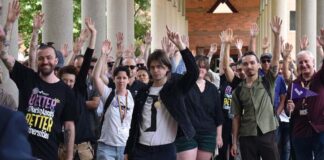
Some of his best writing was in describing workers in action: “May Day in Brisbane [2006] drew a record crowd of 35,000 unionists and supporters in a march through the heart of the city to the big showground venue for a rally cum carnival of opposition to the anti-union, anti-working-class legislation that has been brought in by the federal Liberal government. The crowd was 15,000 larger than had been predicted by organising officials. Unionists came out decked in T-shirts bearing slogans attacking the legislation and supporting the fight to protect workers’ rights and union rights. Bright banners and loud chanting marked the long and cheerfully determined march.”
Greg’s public face of a hard-edged polemicist with a sharp pen belied a surprisingly cultured, sensitive and generous side to his personality. His life was a principled and determined fight for justice and socialism, sometimes to his own detriment, and his death is a loss to the workers’ movement.
By Phil Sandford, Derek Mortimer, Ken Davis