
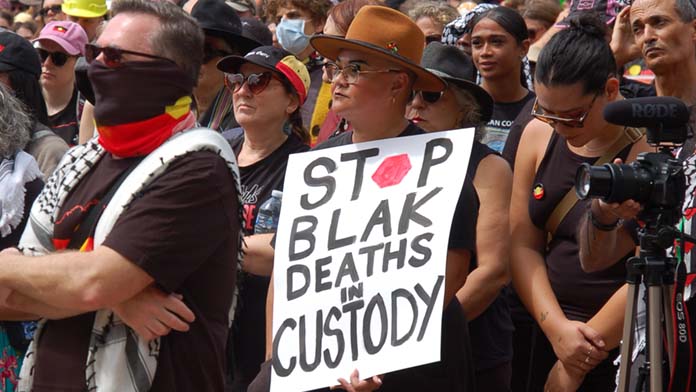
In a shocking racist attack on Aboriginal people and supporters, a far-right terrorist targeted the Boorloo (Perth) Invasion Day rally on 26 January with a home-made bomb. It thankfully failed to explode.
Police found chemicals used to make explosives at the man’s home and confirmed that if this bomb had detonated it could have caused a “mass casualty event”.
But the contrast between a racist attack on an Indigenous protests –which has received very little media coverage or condemnation from politicians—with the hue and cry over anything deemed to be antisemitic is startling.
This time there have been no demands from the mainstream media that the attack be labelled as “terrorism”.
There have been no demands to get to the bottom of his racist motivations, no efforts to examine his social media feed to see whether he was radicalised by racist diatribes from One Nation politicians, whether he has a history of voting Liberal or has been influenced by any religious teachings or the Murdoch media.
Only on 5 February did WA Police announce that the bomber would be charged as a terrorist.
The truth is that anti-Aboriginal racism is not news—it is far too accepted.
The incident demonstrates the urgency of countering the casual, and not so casual, mainstream anti-Indigenous racism and the growing threat of the far right.
The largely indifferent response of the media and political leaders to the attack is compounding anger and grief in Indigenous communities. That the media didn’t even draw the connection between the attack and the racist March for Australia rallies that were happening on the same day compounds the media’s racism and hypocrisy.
The man responsible is in custody but has only been charged so far with “intent to harm” and “possession of explosives under suspicious circumstances”, though police now say they are considering terrorism charges.
The attacker’s identity has been suppressed by the courts, due to the claim that because “a class of people was the target of the alleged offences” his safety in prison could be compromised.
Channel 9 reported that he “saluted” the magistrate, indicating open Nazi sympathies.
Fabian Yarran, a Nyoongar rally organiser, said that despite being traumatised by the attack, he would not be deterred from continuing to demonstrate:
“We can’t let the hateful people win, we need to push on for our ancestors, for our people and for who we are as a people.”
Polarisation
Anti-Indigenous racism has surged in the period following the defeat of the Voice to Parliament referendum.
The Albanese government has allowed this to happen and in fact encourages such ideas with its own racist policy agenda.
This includes quarantining the Centrelink payments of Indigenous people in northern Australia and presiding over the sharpest increase in prison numbers in history.
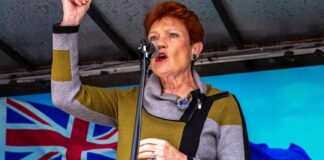
Anti-Indigenous racism is now being turbo-charged with the rise of One Nation, reaching a fever pitch in the lead up to 26 January with conservative politicians attacking plans to march on Invasion Day.
The City of Perth cancelled its annual Survival Day Birak Concert under pressure from the hard right, instead funding a nationalist festival sponsored by Gina Rinehart.
Despite this, Invasion Day rallies across the continent were some of the biggest in history, with tens of thousands of people turning out. These numbers need to be harnessed into continued campaigning to defeat racist policies and confront the growing far right.
Racist rallies
The day also saw another round of the racist March for Australia rallies, targeting both migrants and Indigenous people. These were smaller than previously but still attracted around 2000 racists in both Sydney and Melbourne.
Nazis from the National Socialist Network (NSN) have been prominent at their marches from the beginning. But it was more obvious than ever this time. A number of the rallies featured placards to “Free Joel Davis”, an NSN member arrested after telling other Nazis to “rhetorically rape” an MP who condemned the group.
In Sydney, organiser “Bec Freedom” admitted she had allowed Nazis to act as marshalls, describing them as “good people who are fighting for our country”.
The disbanding of the NSN, in an effort to avoid jail time under new laws banning “hate groups”, has also increased the immediate threat of violence and terrorism from its former members.
One former member of the NSN, Brandan Koschel, was arrested at the Sydney rally after an openly antisemitic speech where he declared “the Jew is our greatest enemy” and praised NSN leader Thomas Sewell.
The Nine Papers reported last week on the scale of the connections between NSN members and Nazi groups overseas with a history of terrorism. Members of groups such as Terrorgram and National Action have shared material with NSN members including instructions on how to carry out violent attacks.
It reported that in an online chat room, “Among the swastikas, racism and rape jokes, pictures of the Christchurch mass murderer Brenton Tarrant are now appearing,” in a coded message advocating racist terrorism.
The Lakemba mosque in Sydney also received a letter threatening an attack a few days before Invasion Day.
The ban on the NSN, however, is not going to see the group disappear. Its leaders have already promised to set up a registered political party as a front for the group.
The surge in racism following the Bondi attack promoted by politicians and the mainstream media has only fuelled its anti-migrant politics. One Nation is rising in the polls and Anthony Albanese’s response will be to pander further to anti-migrant racism.
We can’t rely on Labor and the political mainstream to stop the rise of the far right. We need a united anti-racist movement that is both able to counter their lies about migrants, their antisemitism and their racism against Indigenous people, and willing to oppose them on the streets.
By Paddy Gibson