

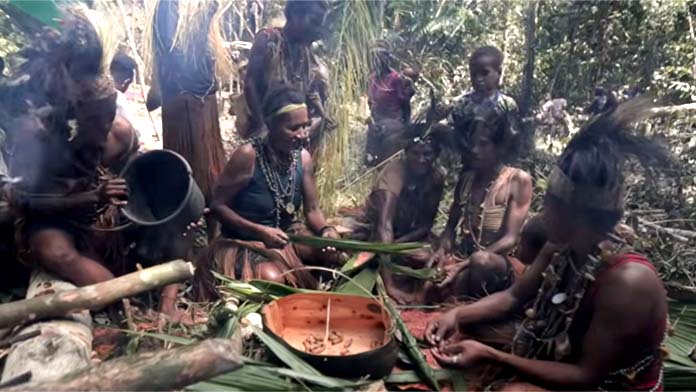
Maeve Larkins spoke to two members of Yayasan Pusaka Bentala Rakyat, an activist group based in West Papua, about the Indonesian government’s National Strategic Project (PSN) in Merauke, a region in the south of West Papua. The project is deforesting up to three million hectares of Indigenous land to establish agricultural estates growing rice, sugar cane, corn, palm oil and livestock.
Indonesia has occupied West Papua since 1969, orchestrating a vote (the so-called “Act of Free Choice”) to claim the population wanted integration with Indonesia. The Indonesian government has taken control of West Papua’s mining resources and brought in hundreds of thousands of transmigrants from Java to settle there. Indigenous Papuan rights are frequently overruled in the interests of major corporations, and military repression of Papuans is frequent.
In the first half of this year, over 30 Papuans have been killed by the Indonesian military and police, adding to a total death toll at least 100,000 Papuans since Indonesia took control of the province. West Papuans continue to fight for independence.
Papuan opposition to the PSN is the focus of the new documentary, Pig Feast: Colonialism in our time, which now has over 13 million views on YouTube, and has been screened over 1500 times across Indonesia and internationally. The film is now being repressed by Prabowo’s government in Indonesia, including being banned in several location across Indonesia by local government officials.
To protect the interviewees identities, we have anonymised them as “A” and “B”.
Q: How has the Indonesian government’s National Strategic Project (PSN) impacted Indigenous Papuan communities?
A: The PSN has been devastating in Merauke. It threatens our community, especially our ancestral lands. Most of us are relying on these lands, because we got our food and water from the forest.
So, the PSN threatens our lives, especially the most vulnerable—the children and women. It’s why we are being forced to leave, because they are destroying our land.
But it doesn’t just affect the Indigenous community. The transmigrants who live here are also affected. It causes their crops to fail and it causes flooding in their rice fields.
We have also lost a lot of our traditional materials. We rely on our rituals, but when the PSN started to destroy the forests, we have lost them. And, when they are lost, people lose their culture and they lose their identity.
When the PSN started, it also affected people’s health. When the dry season comes, the air becomes polluted with dust. So it affects the whole community in Merauke.
B: The PSN is not just an infrastructure, food security or energy project. It’s much more than that. It is part of a long-running project of the Indonesian government to transform Indigenous land in West Papua into an extractive industrial zone.
Q: What sort of repression do opponents of the PSN face?
A: There have already been many protests by Indigenous communities across Papua against the PSN, for example, in Sorong, Manokwari and Boven Digoel. There have been so many protests and rallies that the Indigenous peoples have now been banned from protesting.
We’ve also tried to take our protests to the House of Representatives, but so far, we’ve had no positive responses.
If we stand against the project, we are called separatists and we are intimidated by the military and by the private companies themselves. Like Mama Yasinta, who has now been kidnapped.
[Yasinta Moiwend, known as “Mama Yasinta”, is an Indigenous Papuan activist who spoke against the PSN in the documentary Pig Feast and who has publicly campaigned against the PSN since 2024. In late May, she was reportedly abducted, threatened and taken to Jakarta, where she appears to have been coerced into filing a police report against the documentary director Dhandy Laksono and Indigenous lawyer John Teddy Wakum, for allegedly using footage of her in the film without her permission. Posts from her social media account since the abduction demand the film screenings of Pig Feast are stopped. Her family, friends and lawyers have been unable to get in touch with her directly. ML]
I’ve just visited Mama Yasinta’s family. They told me that the Indonesian army is now demanding identification from them so they can frame Mama Yasinta as supporting the PSN. The military has set up a military post in the village of Anam for the construction of a 135km road. Another Papuan activist from the movie is being reported to the police for blocking access to his ancestral lands.
B: The kidnapping of Mama Yasinta is very similar to what Indonesian governments have done in the past to Papuans.
This kind of repression is not normal for other infrastructure projects across Indonesia.
In five years, there will be 500 Indonesian military battalions across West Papua. There are already 83,000 military and police stationed in West Papua—one soldier for every 103 Papuans.
They claim they need to be there to combat armed separatists but they also admit that there are only around 1500 guerrillas with just over 350 firearms between them across the entire province.
Q: The Australian government trains the Indonesian military and police and provides a lot of support to Indonesia’s government. What message do you have for Australians about this?
A: We really need Australians’ support. There has to be a campaign from the Australian community that puts the focus on West Papua, and which pushes their government to stop supporting the private companies that are investing in Indonesia, specifically in West Papua.
Australian companies are supporting sugar cane plantations in Merauke. There are currently two operating here but soon there will be seven. And the Australian government trains the military who act as the security of the plantations and the PSN.
To set up the PSN, the soldiers have built many military posts, within Merauke and along the border with Papua New Guinea. They surveil the Papuan civilians and threaten the girls, especially the communities that reject the PSN.
We do not reject “development”, we ask that our rights as land owners be respected. So far, the government has not recognised us as the owner of the land, even though in Indonesia’s 1945 Constitution, article 18 B, recognises customary law, they do not recognise the existence of the Papuan land owners, and so the government views the forests and the swamps as just unused and vacant land even though we maintain the land as our main source of food. It is also a place to live for endemic animals including birds of paradise, cassowary, wallaby, kangaroo and cuscus.
B: We have to ask for accountability. For everything the Australian government is doing to support the Indonesian military and police, we have to make sure that it is based on human rights principles.
The solidarity we have received from Australia means a lot to us. We need Australians to monitor their own government and hold them to account.
Q: What is the importance of solidarity, from Indonesians and internationally, with West Papua?
A: Before Pig Feast, it was only very small groups in Indonesia that were aware of the PSN. There have now been over 1500 screenings of Pig Feast across Indonesia, and 13 million views on YouTube.
This has been really important, to get more support and spread awareness about the issue and to break through propaganda from the Indonesian government.
Unfortunately, many Indonesians are still very racist. They are told that Papuans are “uncivilised” people, and so they believe the government when they say “development” is the only way to bring “civilisation” to the Papuans.
Another challenge is that anyone in Indonesia who opposes the government is labelled as a criminal, a terrorist or a Communist.
So, I think it’s really important that we keep spreading awareness and educating people.
B: It is very good that there is some solidarity that is growing with West Papua internationally and within Indonesia, but it is not enough.
Papuans want our rights respected, but this isn’t happening. We are similar to Aboriginal people. When we lose our land, our forests, we lose our identity. We believe that if we lose our ancestral lands, we are no longer Papuan.
But, if only Papuans speak up about their land, it will not be enough. We need support and solidarity, not only from Indonesia but across the world.