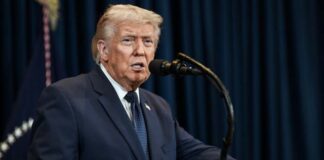

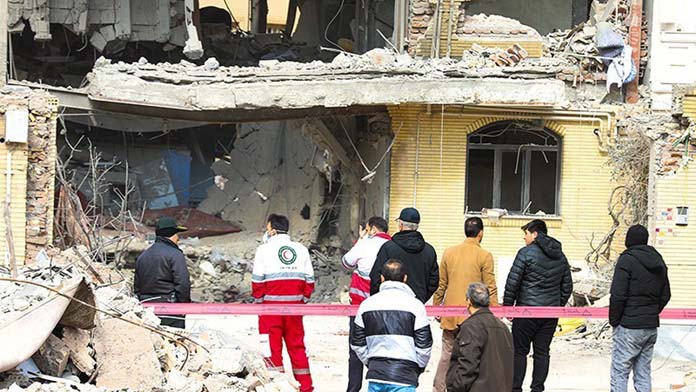
Donald Trump has denounced the Iranian government as “evil”. But US bombing and war will not bring democracy to Iran.
The Iranian regime is brutal and authoritarian. Many times the people of Iran have risen up against the theocracy. In 2022 the Woman, Life, Freedom protests erupted across Iran after the death in custody of Mahsa Amini, a young Kurdish woman, who was arrested by the religious police for not wearing her hijab properly.
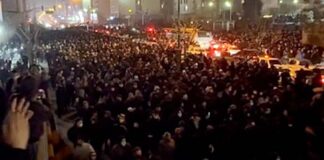
In January this year, the regime massacred as many as 30,000 people after mass protests took to the streets calling for the overthrow of the regime. Trump said he was going to help but there was no help.
Now that Trump and Israel have started bombing he is calling on Iranians to rise up. But Trump can’t be trusted. Trump says he wants “regime change” but he has called on “the IRGC and Iranian police to join ‘Iranian patriots’ to change the government”. But the IRGC (Revolutionary Guards) are the elite troops who killed protesters in early January.
Imperialism
Trump has no concern for democracy or the Iranian people, he simply wants the kind of regime change that the US forced on Venezuela. This has left the regime intact and seen a new leader take over who is more compliant with the US.
In Iran too, Trump just wants a compliant regime. Trump says he wants the Kurds in the north to take up arms against the Iranian regime. But only last month Trump announced the withdrawal of the last US troops in northern Syria to allow the Syrian government to take control over the Kurdish autonomous area.
The US wants to boost its own power and make the Middle East safe for US imperialism. It has approved and enabled Israel’s genocide in Gaza. It is backing Israel’s bombing of Lebanon.
US imperialism has never brought peace and democracy. The US talked about bringing democracy to Iraq when it invaded and occupied the country to topple Saddam Hussein in 2003.
But there is no democracy in Iraq. The country was left in ruins, with hundreds of thousands of deaths in violence resulting from the war and bitter sectarian divisions stirred up by the US in its attempt to control the country through divide and rule.
The US and its western allies (including Australia) invaded Afghanistan in 2001 with promises to bring liberation. But their brutal occupation boosted support for the Taliban, who eventually drove out the US 20 years later.
US President George Bush Senior called on the Kurds and Shia in southern Iraq to rise up against Saddam Hussein in 1991 but then did nothing when they did revolt and were suppressed by Saddam.
The Iranian regime must be overthrown. But real change will only come from the independent struggle of the Iranian people themselves.
Some say that the Iranian regime is too repressive for ordinary people to topple it. But brutal dictatorships have been brought down by popular revolt many times in the past.
Last year mass protests as part of so-called Gen Z revolts brought down governments in Nepal, Bangladesh and Madagascar. In 2011 the wave of Arab revolutions toppled dictatorships in Tunisia and Egypt.
The Stalinist dictatorships in Eastern Europe came down in 1989 as a result of popular revolt, with the Berlin Wall demolished by ordinary people in East Germany.
Iran has its own history of mass revolt. In 1979 Iran witnessed one of the most far-reaching popular revolutions of recent decades, overthrowing the dictatorship of Shah Reza Pahlavi. The Shah ran a brutal regime, with a notorious secret police force, SAVAK, that tortured and imprisoned opponents of the regime.
His regime too was prepared to shoot protesters off the streets, killing hundreds at a time.
But opposition groups continued to organise against the regime. When mass demonstrations erupted again in June 1978 it led to repression that fuelled further protests.
Crucially this triggered oil workers’ strikes, shutting down the industry the government relied on for revenue. When these spread across the country, it signalled the end of the regime.
Islamic clerics led by Ruhollah Khomeini managed to put themselves at the head of the movement and establish an Islamic regime, repressing workers and the left and crushing the hopes for democracy and liberation.
But the outcome of any mass revolutionary movement is not decided in advance. This depends on the strength of socialist and working class organisation.
It is only the struggles of ordinary people in Iran against the regime that can win real freedom.
By Ian Rintoul and James Supple