

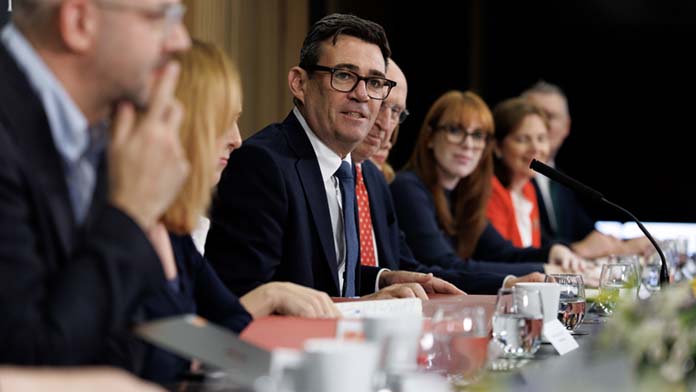
Newly installed British Labour Prime Minister Andy Burnham is talking left in an effort to revive the party’s fortunes. This has delivered a small boost in the polls, but will it last?
Burnham replaced the unpopular Keir Starmer and has denounced the “four decades of neoliberalism that began in the 1980s”. He has promised measures to reduce bus fares and electricity bills and to end rough sleeping.
The UK, like Australia, is suffering a severe cost-of-living crisis, with high inflation, soaring rents and house prices, and stagnant wages.
Burnham’s focus on living costs has resonated. For the first time since early 2024, Labour is ahead in the polls.
Starmer won office in 2024 promising to break with years of austerity. But it was not long before he announced cuts to disability benefits and the winter fuel allowance while retaining the Conservatives’ two-child benefit cap.
Starmer’s failure to tackle the cost-of-living crisis opened political space for the far-right Reform UK Party to blame migrants and refugees. Instead of challenging Reform’s scapegoating, Starmer echoed it.
In his infamous “Island of Strangers” speech, he claimed immigration had “damaged” Britain and placed excessive pressure on housing and public services. This too, mirrors Anthony Albanese’s response to One Nation.
It failed to halt Labour’s collapse and instead legitimised Reform’s arguments. Reform surged in last year’s local elections, winning about 600 new council seats. Labour also lost support to the Greens, driven by opposition to Labour’s support for Israel’s war on Gaza, the banning of Palestine Action and Labour’s anti-migrant rhetoric.
With Starmer’s approval ratings at record lows, commentators were openly speculating about the end of the two-party system and Nigel Farage becoming Britain’s next Prime Minister.
Makerfield
Burnham resigned as an MP in 2017 to become Mayor of Greater Manchester, allowing him to distance himself from the factional warfare that destroyed Jeremy Corbyn’s leadership.
As mayor, Burnham promised to end rough sleeping, donating 15 per cent of his salary to a homelessness fighting fund. He also brought Greater Manchester’s buses and trams back under public control.
While Labour declined across many of its traditional northern strongholds, Burnham comfortably won two further mayoral elections, giving him an independent political base.
He won a convincing victory in the Makerfield parliamentary by-election, winning support for his pledge to challenge Starmer for the leadership. Labour’s vote increased by 10 per cent and Starmer soon resigned.
Manchesterism
Burnham describes his political philosophy as “Manchesterism”, promising the “end of neoliberalism” through what he calls “business-friendly socialism”.
In reality, Manchesterism is a repackaged version of the “Third Way” politics promoted by Tony Blair and Gordon Brown, which was meant to combine free-market capitalism with social justice. Their rule ended in tears with Blair being forced to resign because of plunging popularity and Brown being thrashed at the next election.
Burnham served as a minister under both Blair and Brown and was never at odds with their priorities. He also voted to send British troops to the very unpopular Iraq war (a decision he now says he regrets).
The problem for Burnham, as it was for Blair and Brown, is that free market capitalism and social justice are incompatible.
Blair and Brown governed during a period of stronger global economic growth, which gave them revenue to fund some reforms without seriously challenging corporate power. That balancing act collapsed after the 2007 global financial crisis.
Today the world economy is weaker and Western imperialism is in deep crisis, producing growing political instability. Burnham is Britain’s seventh Prime Minister in a decade.
His cost-of-living measures are nowhere near enough. His energy price cuts, for example, will save households on average just $85 a year. Even if he succeeds in reducing rough sleeping, it addresses only one aspect of Britain’s housing crisis. Around 400,000 people, roughly half of them children, are homeless.
Addressing these crises requires taxing big business, increasing wages, expanding public housing and cutting military spending. Burnham is not prepared to do this because he wants to reassure corporate Britain that Labour is “pro-business”.
His cabinet appointments underline that priority. He has retained prominent right-wing ministers, while promising continued high military spending and signalling support for further North Sea oil and gas extraction.
Burnham may temporarily revive Labour’s fortunes but his unwillingness to confront the interests of big business means the social crisis that fuelled Reform’s rise will remain.
The changes needed to defeat both austerity and the far right won’t be led from Westminster. There will have to be a push from below from Labour’s rank-and-file, trade unionists and the wider social movements for priorities that put people before profit.
By Mark Gillespie