

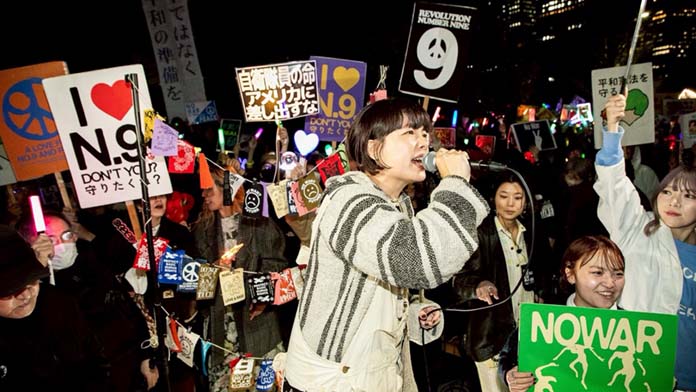
Japan is witnessing its largest wave of anti-war protests in decades as the government pushes up military spending in an effort to back US threats against China.
Tens of thousands have demonstrated to defend the post-war “pacifist” constitution against proposed changes.
On 3 May, Constitution Memorial Day, more than 50,000 people rallied in Tokyo, with other protests held nationwide. These followed protests in April which drew more than 30,000 outside the national parliament.
Large protests are relatively rare in Japan. The scale of the recent demonstrations is therefore significant, showing the deeply-held anti-war sentiment.
Pacifism
New Prime Minister Sanae Takaichi won a landslide victory in the February general election. Since then, her conservative Liberal Democratic Party (LDP) has moved to expand defence spending, relax restrictions on weapons exports and deepen military ties with the US and its allies.
Military spending has been rising for the last decade and jumped by almost 10 per cent last year, with further increases planned.
Takaichi also wants to push ahead with constitutional reform to end the restrictions on Japan’s military under Article 9 of the constitution. Opposition to this has been the central reason for the protests.
Japan’s constitution renounces war and prohibits Japan from maintaining armed forces capable of waging it. Enacted in 1947 during the post-Second World War US occupation, Article 9 was conceived as a response to the devastation of Japan’s wartime expansion and defeat.
It has been widely regarded as a foundational commitment to peace, shaping Japan’s self-image as a nation that turned decisively away from militarism. However, in practice it has been increasing subverted over time. Japan has built up a substantial military since the 1950s by labelling them Self-Defence Forces, and in 2004 sent troops to support the US in Iraq, saying they would be limited to non-combat roles.
In 2015 it passed legislation allowing “collective self-defence”, allowing Japanese forces to join wars in defence of its allies.
As the pro-US imperialist magazine Foreign Affairs put it, “Stigma around defence production has been eclipsed by concern over Chinese aggression and fear that the rules-based order is showing cracks.”
Many demonstrators argue that rewriting Article 9 would end what remains of Japan’s pacifist framework and allow a further expansion of the government’s militarist agenda.
The LDP’s success also takes place against a backdrop of rising nationalist and anti-immigration sentiment. Support has grown for “Japan-first” policies, pushing anti-immigration politics into the mainstream.
Despite all this, formal constitutional change remains unlikely in the near term. Revising Article 9 would require a two-thirds majority in both houses of parliament and a national referendum.
The government has justified its khaki agenda by pointing to rising tensions with China, North Korea’s nuclear missile program and broader geopolitical instability. Its Defence Minister declared bluntly at the recent Shangri-La Defence Summit in Singapore that, “China’s external approach and military activities are matters of serious concern for Japan and the international community.”
Japan is a key US ally that the US wants to draw further into its plans to contain China. A recent fact sheet published by the White House encouraged Japan to “rapidly strengthen its own defence capabilities, increase its defence budget, and continue partnering with US forces in Japan and the region”.
This militarisation reflects within a wider trend towards arms buildup across the Indo-Pacific. Japan’s rearmament is part of intensifying imperialist competition centred on containing China’s rise.
Australian ties
Australia has become a key partner in Japan’s evolving militarisation. Defence Minister Richard Marles has said Japan is more closely aligned on defence policy with Australian than any other partner.
One indication is Federal Labor’s decision to buy an initial three Japanese-built Mogami-class frigates. This multi-billion-dollar deal is the largest Japanese military export deal in post-war history.
Australia’s deepening defence partnership with Japan is part of efforts to strengthen military ties and capabilities among US allies in the region against China. Takaichi has also signed a new defence pact with Indonesia and deepened military ties with the Philippines and Vietnam.
The Japanese government has pledged to work to increase military co-operation across the region and “to ensure each country has the capability it needs” through establishing a weapons industry to help arm US allies.
But Japan’s protest movement represents a hopeful and significant counter current.
We need to build a similar movement here to oppose increased defence spending, scrap the AUKUS pact and end Australia’s growing role in US war plans against China.
By Caitlin Boyce