
The royal commission into antisemitism has continued to call witness after witness conflating opposition to Israel and Zionism with antisemitism. This is designed to undermine the widespread support for Palestine built up since 2023.
Antisemitism envoy Jillian Segal, for instance, suggested the ABC and SBS need an oversight committee specifically to monitor their reporting on Israel.
She pointed to the use of Gaza Health Ministry figures of at least 73,000 dead since October 2023, saying they were “grossly inflated”. Yet UN bodies and even officials from the Israeli military accept the figure as broadly accurate.
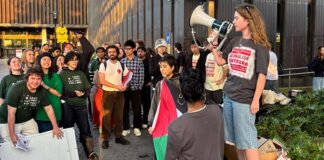
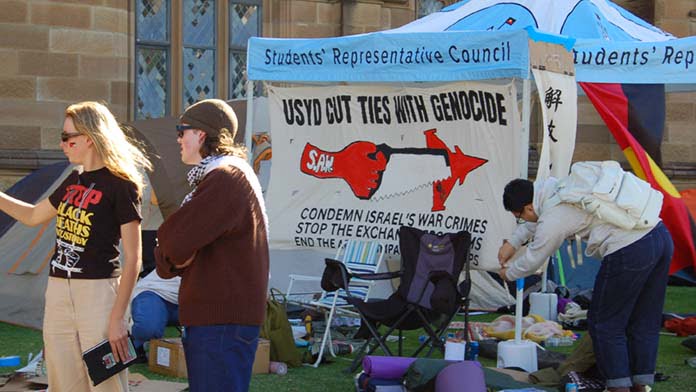
Much of the discussion on universities focused on student protests and the Gaza solidarity encampments of 2024.
Crackdown
Shamefully, the vice-chancellors from ANU and Sydney University accepted that student protests for Palestine were somehow illegitimate or antisemitic, agreeing that they should have cracked down harder to end the encampments.
Sydney Uni’s Mark Scott testified that the only reason he had not done so was that his “single goal in mind” was ending the encampment without physical violence, but said “our Jewish students and staff paid a price for that” and apologised.
Acting Provost Joan Leach suggested that ANU’s efforts “to bring the encampment to a close peacefully, without violence” might now appear “naïve or inadequate”.
Despite this, Leach admitted that the “eight students accused of misconduct” during the ANU encampment faced “no allegations of antisemitism”. Melbourne Uni VC Glyn Davis also admitted that he was “not aware of any complaint of antisemitism” during its encampment.
Davis said a poster criticising the university’s “academic ties to Israeli universities” was antisemitic, saying it implied “Jewish universities” are responsible for genocide.
But Israeli universities are targeted not because they are Jewish but because of their direct links to the IDF. The Hebrew University of Jerusalem, for instance, trains soldiers to work in Israel’s Military Intelligence Directorate.
One of the few direct claims of antisemitism associated with the protests came from ANU student Liat, who testified to being called a “baby killer” and “genocide supporter.”
Joan Leach said the remarks were antisemitic, “Because it was asking her, as a member of the Jewish community, to take responsibility for something very many miles away.”
But the student admitted she was a prominent pro-Israel activist on campus who helped organise a counter-demonstration against the encampment and made a point of wearing a badge supporting Israeli hostages.
In other words, she was more than likely accused of being a “genocide supporter” not because she is Jewish but because she was publicly supporting Israel’s genocide.
Psychosocial hazard
The royal commission accepted evidence that pro-Palestine protests made Jewish supporters of Israel “feel unsafe”, despite no evidence of any actual threat.
Mark Scott argued the encampment harmed the “psychosocial” safety of Jewish students and staff, and that he learnt later “just how menacing and threatening” they found it.
This means, as Louise Adler from the anti-Zionist Jewish Council of Australia has argued, that the individual “feelings and anxieties” of supporters of Israel “are established as reality”.
Adler wrote that the royal commission simply accepted this as evidence of “lived experience” that could not be scrutinised, so that there was no attempt to examine whether “a witness might be ideologically motivated or prone to exaggeration”.
The feelings of Palestinian and Arab students anxious about families facing death from Israel’s bombs did not get the same weight.
One of the few exceptions to all this was the testimony from Yasmine Johnson of Students for Palestine, who is Jewish.
She defended the encampments saying, “We had reached a point in 2024 where Israel had begun to systematically ethnically cleanse Palestinians, to blockade food and water, and we felt there had been no action by the Australian government to do anything about this.
“The universities themselves maintained ties with weapons companies doing research and development, but in some cases also investing in these weapons companies. And [we felt] that we had to do something more.”
But the royal commission essentially ignored the past three years of Israel’s genocidal actions—even though it is not possible to understand why there has been a surge in criticism of Israel otherwise.
The royal commission is preparing the way for more restrictions on free speech and on the Palestine movement, both at universities and elsewhere.
The movement’s response must be to step up opposition to Australia’s complicity with the genocide, the use of the IHRA definition of antisemitism and to campaign to break all ties with Israel.
By Finnian Colwell