
In September the UK government announced new sanctions on goods exported from Israeli settlements in the West Bank, alongside 11 other governments. Shamefully, Anthony Albanese has refused to adopt similar sanctions.
The joint statement led by France, the UK and Canada says the sanctions are a response to the “unprecedented levels of settler violence and settlement expansion”.
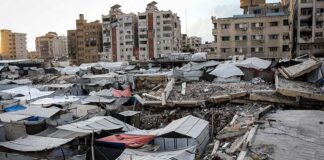
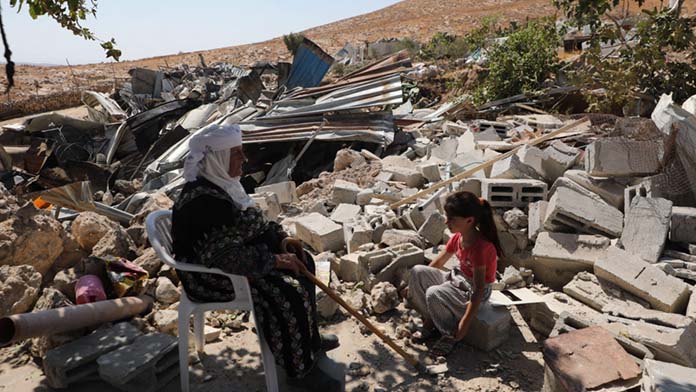
According to the Palestinian Wall and Settlement Resistance Commission, during the first six months of 2026 there were 11,074 Israeli military and settler attacks against Palestinians, their land and property.
The statement also cited the Israeli government’s decision to publish tenders for the E1 settlement project as a reason for action. The E1 project is designed to sever the West Bank in two and make any Palestinian state physically impossible. Israeli authorities finalised issuing of tenders for 3401 settlement units in September.
The sanctions on exports from the settlements are nowhere near what is needed to end Israel’s impunity. But they are a sign of the intense pressure on Western leaders from the Palestine solidarity movement.
The Albanese government must be pressured to adopt them as part of the wider fight to cut every tie with the Israeli terror state.
Albanese’s shameful refusal
Albanese’s refusal to adopt these minor sanctions exposes his recognition of a Palestinian state last year as a hollow attempt to deflect growing anger over Israel’s genocide.
Foreign Minister Penny Wong said Israel’s actions are “extinguishing the possibility of a two-state solution”. Yet her government refuses to take even the most minimal action.
This is entirely consistent with the Albanese government’s attempt to silence the Palestine solidarity movement to cover up its complicity. Throughout the year the farcical Royal Commission has been used to desperately try and smear and repress support for Palestine.
Meanwhile, Australia has continued to export F-35 fighter jet parts and armoured steel to Israel and ship Australian-made explosives to a US factory that arms the genocidal state.
Sanctions on settler exports, but not on the Israeli state
During his sanctions announcement UK Foreign Secretary Ed Miliband decried the “ethnic cleansing of Palestinians in areas of the West Bank perpetrated by settler terrorists”.
But on their own the UK sanctions are nowhere near what is needed given the magnitude of Israel’s crimes.
The UK has announced a ban on imports of goods produced in illegal settlements. But according to Al Jazeera imports from settlements into the UK amount to perhaps only 0.1 per cent of the roughly $11.4 billion annual trade between the UK and Israel. The UK government also said it won’t introduce legislation for six to nine months.
Despite their weakness, the UK government sanctions give further legitimacy to the idea that Israel must face material consequences for its actions. And settlement trade is not insignificant when considered in its totality.
Researchers at Global Echo estimate exports from the settlements to Europe alone are worth $560 million annually. It would be a win to see this trade stopped dead.
The UK Labour government’s move is a sign it is under real pressure from the Palestine solidarity movement. Hundreds of thousands of voters deserted Labor under previous leader Keir Starmer and for huge numbers of them Palestine was a big factor.
Miliband even conceded in one interview that, “Gaza mobilised a whole generation of people and those people were right, not wrong.”
But when announcing the UK sanctions Miliband made a point of saying, “I wholeheartedly oppose the boycott, divestment, sanctions or BDS campaign.”
The announcement was also accompanied by declarations about the need to defend the “two state solution”.
But the two state solution has always been a fraud that allowed Israel to continue its expansion while Western leaders could claim to support an eventual Palestinian state on a fragment of their own land.
The Palestine solidarity movement here must seize on the UK’s sanctions announcement to demand Albanese not only adopt sanctions on settlement exports, but far more sweeping, comprehensive sanctions on the Israeli terror state.
It is also essential to build boycotts and protest to sever the supply chains of genocide everywhere the government fails to act, from the weapons exports to academic boycotts.
In Australia settlement brands like King Solomon Dates sit on the shelves of outlets like Harris Farm. The movement must fight to see them removed, just as apartheid South Africa faced a boycott of its agricultural exports like oranges.
Israel must be made into a global pariah as part of the fight for a free Palestine, from the river to the sea.
By Adam Adelpour