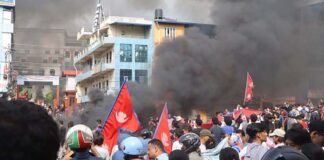


Gen Z revolts are sweeping the Global South as people take to the streets against corruption and deprivation.
The first Gen Z uprising was in Kenya last year.
Since then Peru, Morocco, Nepal, Indonesia, the Philippines, Madagascar, East Timor, Tunisia and Algeria have all seen mass street demonstrations, in some cases toppling leaders and forcing significant concessions.
Young people’s prominence in the protests is no surprise. In Indonesia half the population of 280 million is under 30. Young people struggle to find jobs.
The legacy of colonial exploitation has been entrenched by neoliberalism, driving many countries deeper into the fold of a globalised, market economy with institutions like the IMF demanding the reorientation of economies towards exports.
In 2024, the IMF offered Kenya’s President William Ruto an emergency loan of $941 million. But this was conditional on raising taxes on basic goods, triggering the first wave of protest in Kenya.
Slowing economic growth in the Western world and in China is deepening the crisis. Trump’s tariffs have heavily impacted export-focused economies. David Leonardi, boss of a textile factory in West Java, has laid off more than 1000 people. “If these tariffs continue, we’ll be facing a 20 to 30 per cent decline in exports to the US,” he told the ABC.
Class divide
In late August, “After the protests started [in Jakarta] the police ran over Affan Kurniawan, a motorcycle delivery driver,” Neysia from the Socialist Youth Organisation in Indonesia told Solidarity. This police brutality alongside revelations of politicians pocketing huge new housing allowances fuelled wider protests.
Kurniawan was among the 56 per cent of workers in Indonesia employed in the exploitative informal sector, with some people working 15-18 hours a day. Yet the four richest men in Indonesia have more wealth than the poorest 100 million.
In Nepal and Philippines too, the behaviour of the “Nepo Kids”, often the children of politicians who flaunt their wealth online, was a catalyst.
While social media provides a platform to organise and share information, the Gen Z rhetoric surrounding the uprisings risks trivialising these movements. It can invoke a caricature of naïve young people impulsively taking to the streets in response to social media posts.
This ignores the conditions which are driving masses of people of all ages to resist. Ordinary people are collectively raging against corrupt elites who hoard enormous wealth, in an outpouring of class anger.
State repression has been a characteristic of each of the uprisings.
In Madagascar the crackdown turned deadly, with at least 22 people killed. President Andry Rajoelina fled the country after failing to satisfy the demands of the movement.
The elite army unit once allied to the president, CAPSAT, defected and declared it would join forces with the protesters against the government. Military leader Michael Randrianirina seized control.
This is one example of the way the movements risk being co-opted by reformist politics that offer no way out of the crisis.
Randrianirina named businessman Herintsalama Rajaonarivelo as prime minister. The BBC reports the protest leaders rejected the appointment as made “without consultation” and “run[ning] contrary to the desired structural change” the movement was seeking.
Like Madagascar, the Philippines is one of the most vulnerable countries in the face of intensifying climate disaster. This year has seen severe storms and flooding.
There has been rage as politicians were discovered diverting bags filled with cash meant for flood control projects into their own pockets.
Across the Arab world the memory of the 2011 revolutions persists. Despite the brutal counter-revolution, the prospect of revolt remains.
The Middle East and North Africa have the highest rate of youth unemployment in the world. Nearly one-quarter of people aged between 15 and 24 are out of work.
A new uprising has rocked Morocco since late September. Graduate unemployment is approaching 20 per cent and nearly one-fifth of women in labour force are unemployed.
Concessions offered by the royal cabinet, increasing the health and education budget by 16 per cent, came alongside a dozen decade long prison sentences for activists.
Insaf Elouarda, a 21-year-old student from Marrakech, said that, “People are in the streets for many of the same reasons as 2011” stressing the budget increases are little more than “a cosmetic upgrade to a broken system.”
The uprisings are extraordinary in scale and militancy. But the movements, so far dominated by the informal working class and unemployed, need to draw in the social power of organised workersto pose an alternative to simply replacing one face of the system with another.
There are embryonic examples of this happening. In Dar es Salaam, Tanzania, the organisation representing informal minibus workers entered an alliance with the transport union.
Last month a general strike in southern Tunisia brought the city of Gabes to a standstill. Tens of thousands were demanding the closure of a phosphorus plant which has caused widespread cancer and respiratory illnesses alongside destroying ecosystems.
The Global South is bearing the brunt of an accelerating ecological, economic and imperialist polycrisis.
We need to stand in solidarity with all those across the world struggling against the brutality of the system.
By Liam McMullen