
Ian Rintoul looks at the campaign of defiance that ended Joh Bjelke-Petersen’s ban on street marches in Queensland and draws lessons for the Palestine movement today
Almost 50 years ago, on 4 September 1977, Queensland Premier Joh Bjelke-Petersen launched one of the most serious attacks on democratic rights in Australian history, declaring, “The day of the political street march is over. Don’t bother applying for a permit. You won’t get one. That’s government policy now.”
There was no debate in parliament. The ban was rubber-stamped by his cabinet and put to state parliament two weeks later. But between September 1977 and August 1979, a right to march movement, initially called the Civil Liberties Co-ordinating Committee, rose to challenge the ban.
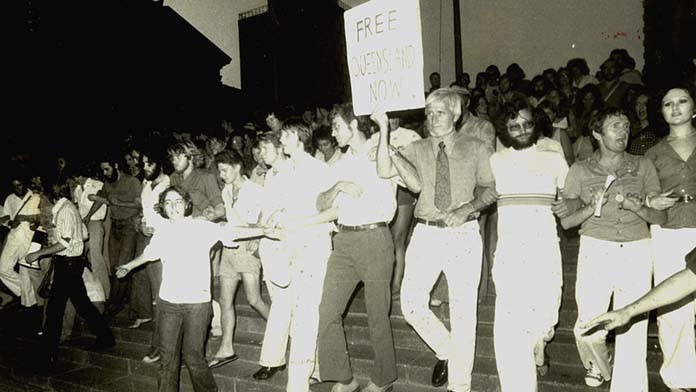
There were at least 29 organised rallies and marches, many more pickets of government offices, disruption of press conferences, protests at watch-houses and court hearings and protests outside the Boggo Road prison. There were over 3000 arrests of more than 2000 people.
Three days after Petersen’s ban, the first attempted march from the University of Queensland (UQ) was blocked by hundreds of police. The march proceeded on the footpath to join a mass union rally in support of Ted Zaphir, a union organiser facing criminal charges as part of Bjelke-Petersen’s anti-union offensive to break the closed shop (compulsory 100 per cent membership).
On 22 September, after a march from UQ was again blocked and forced to march on the footpath to the city, 21 people were arrested trying to march from King George Square to Parliament.
The first debates in the campaign were over what strategy was needed to defeat the ban.
The Communist Party argued the fight against the ban was a diversion. They said the campaign should hold town hall meetings to build up public support and subsume itself into the movement against uranium mining, which was seen as more acceptable and more popular.
The other main force on the left, the Socialist Workers Party (a predecessor to today’s Socialist Alliance), also argued for a lowest-common-denominator approach, opposing defiant marches and arguing to keep the demands at a civil liberties level that would not alienate anyone.
SWP members were forbidden to march and be arrested; their speakers at rallies urged demonstrators to “go home, you have made your point”.
Others similarly argued that the campaign had to avoid confrontation with the police in order to win public opinion, that the campaign shouldn’t fall into the government’s trap.
Bjelke-Petersen wanted confrontation for a law-and-order election campaign in the upcoming state election, they said.
But on 22 October, 5000 people rallied against uranium mining. The attempt to march saw 418 people arrested in what is still the biggest mass arrest in Australian history. Like the police attack at the anti-Herzog rally in Sydney, the rally had an electric effect much wider than the demonstrators themselves.
The campaign called for a rally and march for 11 November, the day before the state election. Both the ALP opposition and Queensland’s peak union body, the Trades and Labor Council (TLC), opposed the rally and march, yet more than 2500 people, including Labor Party members and unionists, assembled and marched. Some 197 people were arrested, the majority blue-collar workers.
Far from alienating public opinion the angry rallies produced a historic 10 per cent swing to the ALP in the Brisbane area.
The infamous Queensland gerrymander of electorates meant that the National Party was guaranteed to be returned to government. This meant that an electoral strategy, that so often derails campaigns, of subordinating the struggle to getting a Labor government elected, was ruled out. The right to march campaign had to mobilise sufficient political and industrial weight to defeat Petersen.
The state Labor Party was weak in any case. State Labor politicians were banned from attending the rallies. Ed Casey, a right-wing Labor figure who replaced Tom Burns as leader in November 1978, was famous for declaring that Labor “would not win government from the back of a paddy wagon”.
But thousands of Labor members and voters were well to the left of the Labor leaders and ready to fight.
In mid-1978, the increasing discontent with the cowardly stance of the Labor leaders led to the formation of a Socialist Left around Senator George Georges, who initiated a new series of meetings of what was now called the Civil Liberties Campaign Group.
This injected new forces and enthusiasm for the defiant strategy of the right to march campaign.
Role of the radical minority
The right to march movement produced a political ferment not seen since the movement against the Vietnam War.
As one socialist recalled, “The small Brisbane left suddenly found itself in organising meetings of hundreds which went on until the middle of the night, and it was able to mobilise thousands of people—all in the course of a few weeks.”
The first protests were rallies at UQ but from October 1977 the rallies were called in King George Square in the city centre, followed by attempted marches into the city streets. Thousands of police were brought from across the state to enforce Petersen’s bans.
The Civil Liberties Co-ordinating Committee that had been formed in the days after the ban was declared became a hot bed of democratic discussion and organisation. It went from meeting on campus to meeting in Trades Hall.
International Socialist members (as Solidarity was then called) argued that by “pursuing a militant course—marching and if necessary getting arrested—the issue could become a focal point for anti-government sympathies”.
Debates on whether to organise illegal marches preceded every rally until March 1978, with the resistance to marching steadily losing ground. Proposals to march were debated and put to democratic votes at the rallies themselves. Repeatedly the rallies voted to march and face arrest.
Between October 1977 and March 1978, more than 100 rank-and-file and union meetings were addressed by Right to March speakers.
By 3 December 1977, growing rank-and-file agitation from union members had pushed the TLC (which had endorsed the anti-uranium 22 October rally) into calling a delegates meeting. That meeting voted decisively for the TLC to explicitly endorse the proposed rally and illegal march. Two hundred and four were arrested on the day.
The radicalisation driven by the campaign could be seen on May Day 1978. About 20,000 marched, but the 12,000-strong Red Contingent led with Right to March and anti-uranium slogans was bigger than the 8000 in the official union contingents.
The rallies in 1978 took on an increasing class character. In August, the TLC combined an anti federal budget rally with a right to march protest.
Then, in December 1978, a maritime union mass meeting called on the TLC to call a rally and march in the name of the unions, for a weekday, 7 December. A subsequent proposal was carried calling for the TLC to call on affiliates to stop work to attend the rally.
In a desperate move to stall the growing movement, Bjelke-Petersen offered the unions a permit to march if the rally was held on a Saturday. But under pressure from the maritime unions, the right to march movement and the emerging Socialist Left led by Senator Georges, the unions refused the government’s political bribe and marched without a permit.
Federal Labor politicians, and a vice-president of the ACTU, John Ducker, led the march into the police lines. Three hundred and eighty-three people were arrested, over 70 per cent of them blue-collar workers.
The writing was on the wall for Bjelke-Petersen’s ban. Maritime workers threatened to strike if any of their members were held in the watch-house. A two-day strike by seafarers had forced the release of two union members who had gone to jail rather than pay fines for marching.
In August 1979, the police refused a permit for a Hiroshima Day march. However, within days, a permit was granted for a march on Nagasaki Day. It was the first police-authorised protest march since September 1977.
The movement had not brought down Bjelke-Petersen, one of the campaign’s aspirations, but in a major victory over the authoritarian premier it had broken the ban on street marches.
Lessons for today
The arguments for defying the law and looking to the power of organised workers were crucial for the struggle for the right to march.
Just as activists almost 50 years ago defied the ban on street marches, we need to stand up to the attempts to intimidate people out of joining political protests today, even if it means breaking the law and organising acts of mass civil disobedience.
The police actions in Sydney have radicalised wide sections of the community. It was bad enough that Albanese and Minns seized on the Bondi massacre to welcome Herzog and normalise genocide, but the police brutality has dramatically shown that more radical action is needed if we are going to end our own governments’ complicity.
The system that enables the genocide is now trying to silence the Palestine movement and drive it off the streets.
In three states, government are introducing laws to outlaw the slogans that they regard are the biggest threats to their own complicity with the genocide.
The movement needs to orient towards the growing minority that is willing to defy the ban on protests and deepen the resistance.
Workers do not have the right to strike that they had in 1977. That also must be fought for. Cinema workers on Melbourne used OH&S laws to refuse to be part of screening the Pauline Hanson film.
Organising rank-and-file teachers, university workers and public servants will be crucial to opposing codes of conduct, bans on wearing keffiyehs and definitions that equate anti-Zionism with antisemitism—measures that governments are imposing to keep the Palestine out of the workplace.
Thousands more people recognise that there is an imperialist system that maintains Israel’s genocide and occupation of Palestine. Defiance beat back Bjelke-Petersen in 1977; defiance will again be key to the movement to beat back the state and federal governments’ offensive against the Palestine movement today.