
Mark Gillespie explains why Donald Trump wants regime change in Cuba and why we should oppose the US’s plans, without pretending Cuba was ever socialist
Raúl Castro, the 94-year-old former Cuban president, has been indicted by the US government for murder and conspiracy relating to the 1996 shooting down of two aircraft operated by Brothers to the Rescue.
The move increases pressure on an already besieged Cuban government.
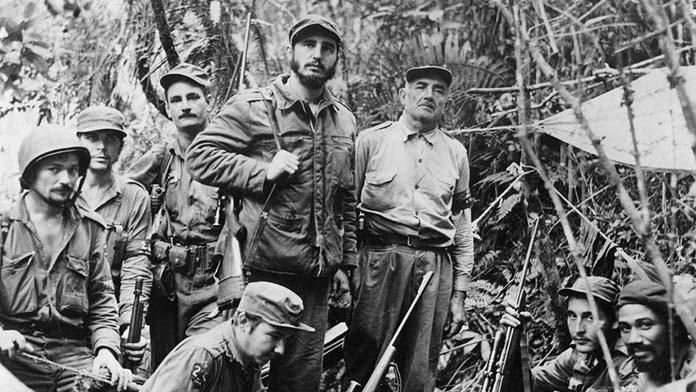
Alongside his brother Fidel Castro, Raul was a leader of the 1959 revolution that overthrew a US-backed dictatorship and remains a symbol of Cuban sovereignty.
Trump has called Cuba a “failed nation” and has openly stated his desire for regime change. It will not be lost on Cuba’s leaders that Trump used a federal indictment as justification for the removal of Nicolás Maduro, Venezuela’s president and a close ally of Cuba.
A near-total oil embargo was imposed by the US on Cuba following Maduro’s removal. Only one shipment of oil has reached the island since January, contributing to what the UN has described as a “humanitarian crisis”.
The healthcare system is under severe strain, fuel shortages have disrupted transport and agriculture, schools have closed to conserve energy and many people are relying on wood fires to cook.
The US has also increased military pressure through intelligence-gathering flights around the island. The indictment and oil embargo come on top of more than 60 years of sanctions and hostility directed at Cuba.
Castro’s indictment relates to the 1996 destruction of two Brothers to the Rescue aircraft.
Although it presented itself as a humanitarian organisation assisting Cuban refugees, the group repeatedly violated Cuban airspace and was founded by José Basulto, a former CIA operative and Cuban exile who has boasted about his involvement in efforts at sabotage and armed attacks against the Cuban government.
After repeated warnings to both the organisation and the US government, Cuban fighter aircraft shot down two of its planes.
This was a justifiable act of self-defence against US imperialism, which has sought to overthrow the Cuban government since the 1959 revolution.
US imperialism and Cuba
For over 200 years the US has considered Latin America its backyard, claiming the right to intervene whenever it wants. It has intervened hundreds of times through CIA operations, blockades, annexations, coups and military invasions.
Its aim, as expressed in the 1823 Monroe Doctrine, was to keep rival powers out of the Western Hemisphere and ensure regional governments aligned with its interests.
The US always saw Cuba, strategically situated between the Gulf of Mexico (renamed the Gulf of America by Trump) and the Caribbean Sea as central to its interests and on a couple of occasions during the 19th century tried to buy it from the declining Spanish empire.
The US invaded Cuba in 1898 during its War of Independence against Spain, claiming to support Cuban liberation. However, after Spain’s defeat, the US refused to withdraw until Cuba accepted the Platt Amendment.
This gave Washington extensive influence over Cuban affairs, restricted Cuba’s ability to conduct an independent foreign policy, granted the US the right to intervene militarily and secured land for US military bases. The naval base at Guantánamo Bay remains in US hands today.
Cuba went from direct rule by Spain to indirect rule by the US. US troops were back again in 1906 to quell political unrest and again in 1917, this time to protect American-owned sugar plantations.
The former US ambassador to Cuba, Earl Smith, outlined the extent of US control, “Until Castro, the US was so overwhelmingly influential in Cuba that the American ambassador was the second most important man … sometimes even more important than the [Cuban] president.”
By the 1950s US corporations dominated much of the Cuban economy, controlling major interests in sugar, utilities, mining and tourism.
Cuba was highly unstable during this period, vacillating between corrupt presidential elections highly influenced by foreign interests and bouts of authoritarian rule.
In 1952 Fulgencio Batista seized power in a military coup, suspended constitutional rights and ruled through repression. Batista made a deal with US gangster Meyer Lansky, allowing the American mafia to operate a gambling, vice and hospitality empire in Havana in return for kickbacks and bribes.
While rich elites in Havana enjoyed luxury cars and glamorous casinos, rural Cubans lived in deep poverty. Most rural homes had dirt floors, no running water and no electricity, while medical care and schools were completely unavailable to the poor.
But it wasn’t just workers and peasants who opposed Batista. Students, intellectuals and other middle layers seeking democracy and a genuinely independent capitalist state were also alienated.
By 1958 even Washington had concluded Batista could no longer maintain stability. However, attempts to find a moderate alternative came too late.
Batista’s soldiers fled rather than fight Fidel Castro’s small guerrilla army, which took power with massive popular support from wide sections of society.
Initially, the US recognised the new Cuban government, hoping it would moderate its nationalist program. However, Castro’s reforms, particularly the Agrarian Reform Law, threatened the interests of Cuban landowners and US corporations operating in Cuba.
Tensions escalated when Cuba nationalised US-owned oil refineries that refused to process Russian crude oil. The US responded by cancelling Cuba’s preferential sugar quota, prompting further nationalisations of US-owned property and investments on the island.
The US then sponsored the Bay of Pigs Invasion in 1961, carried out by Cuban exiles.
Mass mobilisation under Castro’s leadership helped defeat the invasion, strengthening the revolution domestically and transforming Cuba into an international symbol of anti-imperialist resistance. The failed invasion accelerated Cuba’s alliance with Russia.
Cuba’s open defiance and its alignment with Russia made it a strategic challenge to US interests and every US administration since has sought to reverse this. They want to see Cuba returned to the US neo-colonial state that existed before the 1959 revolution.
Trump, driven by US global competition with China, now sees the opportunity to bring down this symbol of defiance and do what no other US President has been able to achieve.
Cuba today faces its deepest crisis in decades. Following the collapse of the Eastern Bloc in the early 1990s, the country lost most of its trading partners and Russian subsidies. GDP contracted dramatically and living standards fell sharply.
Beginning in the 2000s, trade with Venezuela became a crucial lifeline. Venezuela supplied Cuba with oil, food and other resources in exchange for Cuban doctors, teachers and technical personnel to help with Venezuela’s social programs. Trump’s removal of Maduro has effectively severed this relationship and intensified Cuba’s economic difficulties.
Socialists must oppose US imperialism and defend Cuba against attempts at recolonisation. A victory for the US would not make the world safer or more democratic. It will only encourage the US to bully other countries and will demoralise those who want to resist Trump’s reactionary agenda, both at home and abroad.
Cuba and socialism
While acknowledging Cuba’s revolution did bring in genuine social reform for workers and much of Cuba’s problems today stem from the heavy US sanctions, socialists need to be careful not to fall into the trap of seeing Cuba as some sort of socialist utopia.
The revolution in Cuba was not a socialist revolution. Fidel Castro and many of his core followers were originally members of the reformist and left-wing populist Ortodoxo Party and looked to José Martí (Cuba’s George Washington), not Marx, as their “inspirer”. Even five months after the revolution Castro was insisting, “Our revolution is not red but olive green.”
The working class also did not play a leading role in the revolution. While there were strikes supporting Castro’s guerrillas and the guerrillas enjoyed enormous popular support, there were no institutions of mass democracy, equivalent to the Russian Soviets of 1917, that gave workers control of the revolution.
Decision-making remained concentrated in the rebel army command, Castro’s inner circle and later the top-down Cuban Communist Party. Cuba’s workers learned that the revolution was officially socialist only when Fidel Castro publicly declared it in 1961.
This was not the “self-emancipation of the working class” central to Marxism.
Castro did align Cuba with the so-called “socialist” bloc and followed their economic model. The whole economy was nationalised under one-party rule. But the “socialist” bloc was socialist in name only.
The genuine workers’ revolution in Russia in 1917 was long defeated. The revolutionary wave that followed the Russian revolution failed to break through and Russia’s workers were isolated and exhausted. Stalin, supported by a bureaucratic layer, destroyed the last bastions of workers’ democracy and turned Russia into a bureaucratic state capitalist state that competed with the West.
Cuba, too, became state capitalist, dominated by its own bureaucratic ruling class that suppressed independent trade unions and banned unauthorised strikes, while living a life of relative privilege.
Following the collapse of the Eastern Bloc, this bureaucratic elite began opening up the economy to market forces and foreign investment, particularly in the tourist sector, creating even starker class divisions. The government is investing vastly more in business services, real estate and hotel construction than in agriculture, education, and health combined.
This class tension exploded into widespread protests in July 2021 that spread to over 50 cities. Cuba’s workers have two layers of oppression, US imperialism and their own ruling class.
Cuba’s fate remains unclear. The Cuban government, led by President Miguel Díaz-Canel, is prepared to negotiate and make further concessions. But sacrificing Raul Castro, who he described as a “hero”, is too much.
The US will be looking for an alternative within the government like they did in Venezuela, but like in Iran, that might prove to be difficult.
Riots linked to extensive blackouts are a sign of desperation. If the Cuban regime implodes amid unrest due to the oil shortage, there would be nothing progressive about its fall.
In this crisis socialists must oppose US imperialism and demand “hands off Cuba”. At the same time we need to avoid being apologists for the weak and besieged Cuban ruling class.