

Julie Monteiro looks at the how anti-imperialist politics and a focus on building working class support were key to the success of the movement against the Vietnam War
The genocide in Gaza has produced support for Palestine at a scale never seen before. People have mobilised in their hundreds of thousands in response.
We are at a point now where the rallies are smaller and people seem more fearful of being repressed for speaking up about Palestine. How do we reignite the fight to cut ties and our government’s complicity?
The Vietnam War movement is talked about to this day as a militant and fierce struggle against the Australian government’s conscription of young men to fight the war.
The high point of this was the Moratoriums.
The first Moratorium in May 1970 drew about 200,000 people onto the streets, rallying behind the slogan “Stop work to stop the war”. The Moratoriums were more than just street marches, they were also strikes. They were held on weekdays and between half and two-thirds of the marchers were workers, who either had to strike or leave work to attend.
Five thousand Melbourne Uni staff and students marched from the campus to join the first Moratorium, over a third of the number of students enrolled full-time at the uni.
But this could not have happened without the previous five years of organising led by students and left-wing unions.
Two more Moratoriums followed. They showed how strike action could paralyse society through stopping business as usual to demand an end to the war. This struck a deep fear in the government that unless troops were withdrawn, strike action could become more widespread. In December 1971 the Liberal Prime Minister announced all Australian troops would be withdrawn from Vietnam.
This holds lessons for today’s movement for Palestine.
The Australian Government supports Israel today for a similar reason to why it sent troops to fight alongside US soldiers in Vietnam. Australia sees support for US imperialism as a way of ensuring Australian domination of the local region and advancing its broader imperialist interests.
Its backing for Israel is not mainly a result of Zionism but its support for US imperialism.
Albanese backed Trump’s bombing of Iran and provides intelligence to the US and Israel through Pine Gap. This is why we need to build anti-war and anti-imperialist politics within the Palestine movement, to not simply show solidarity with Palestine but to break Australia’s support for US imperialism.
It wasn’t inevitable that there would be mass opposition to the Vietnam War or conscription—it had to be built through consistent campaigning.
At the start the war was popular in Australia. When conscription was announced most people supported it as necessary to fight the spread of communism in the region, and many young men enthusiastically registered for National Service.
There was only a small minority who opposed conscription and Australia’s involvement in Vietnam. Organisations like the Youth Campaign Against Conscription was set up at the University of Sydney and spread to other campuses across the country, as well as Save Our Sons, initiated by mothers who were opposed to the conscription of their sons for the slaughter in Vietnam.
There were also individuals who publicly refused conscription to Vietnam on a moral basis, and some were imprisoned for doing so.
There was also early opposition to the Vietnam War in the more left-wing unions. The Waterside Workers Federation staged a 24-hour strike in Sydney in opposition to the introduction of conscription. The Seamen’s Union later refused to crew the Boonaroo, which was chartered by the federal government to transport stores and equipment to Vietnam.
However, other unions failed to support this action and the seafarers were forced to back down. At this stage the anti-war movement was too small to support workers’ industrial action in the face of opposition from senior union officials.
Ebbs and flows
The movement went through lulls where the struggle was lower.
One of these was after the defeat of the Labor Party in the federal election of 1966, after it ran on a platform of opposition to the Liberals’ conscription for the war in Vietnam.
While the loss had a demoralising effect on the wider movement, it also showed that electoral campaigning would not end the war in the immediate future. As a result, more organisations focused on mobilising against the war on the streets.
In the year following the elections, student activists in the Labor Club at Monash Uni felt the anti-war movement had run out of ideas—so they decided they would collect funds for the Vietnamese National Liberation Front (or the Viet Cong). This really set things off.
The media, the Liberal government and the Labor opposition all condemned the action, calling it treason as it meant supporting the enemy. The Monash Vice-Chancellor banned the collection and the student council called a student general meeting to dissociate the Monash student body from it.
But when 1000 students turned up to the meeting a majority voted to defend the Labor club’s right to collect the funds and opposed the ban on fundraising.
The government moved to outlaw any aid to the NLF, but this repressive move galvanised the anti-war campaign. The decision to raise funds for the NLF forced the movement to confront the issue of whether it was just fighting for Australian troops out of Vietnam or whether it supported the Vietnamese resistance against US imperialism. This helped deepen the politics of the movement and shift the whole campaign to the left.
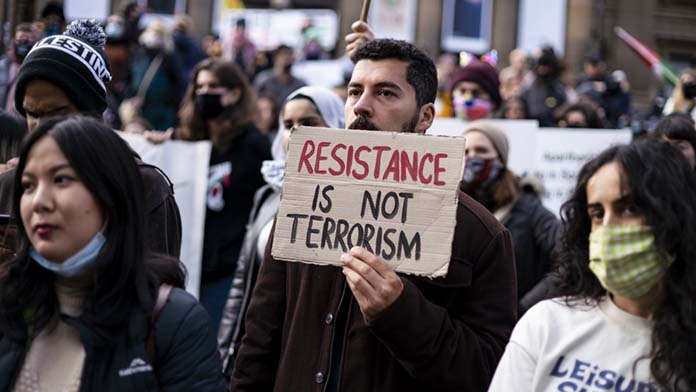
There are parallels with the question of supporting Palestinian resistance today. The insistence that the Hamas attack on 7 October was terrorism has been used by the government and media to justify Israel’s genocide in Gaza as part of its “right to defend itself”.
Supporting Palestinians’ right to resist, and pointing the finger at Israel’s occupation as the source of the problem, makes it clear why Israel and its Western imperialist supporters are responsible.
The antisemitic Bondi attack has been weaponised to smear the Palestine movement. The Queensland government has banned Palestine slogans “From the river to the sea” and “Globalise the Intifada” as hate speech. The NSW and Victorian governments want to follow.
The Palestine movement has to defend both these slogans and refuse to be scared into silence or to concede that the movement is in any way to blame for antisemitism.
Dealing with repression
The Vietnam War movement also faced serious repression. It was made illegal under Commonwealth law to advocate refusing to register for the draft. In Melbourne students started a campaign of defiance, handing out “Don’t register” leaflets in the CBD.
The student militancy pushed academics and left-wing politicians including Labor MP Jim Cairns to join them. Eventually more than 500 people were handing out illegal leaflets and over 100 were arrested. Brewery workers threatened strike action in solidarity. This defeated the ban on leafleting and saw more people publicly advocate defying the draft.
The Palestine movement has to stand up to repression, too.
We need to cut all the ties with Israel, from weapons research in our universities to our government allowing the supply of F-35 fighter jet parts. This requires working class support and an effort to build towards the kind of strike action seen in the Moratoriums, despite far lower levels of union strength and the current anti-strike laws.
The first step towards this is for the Palestine movement to orient to workers and trade unions. There’s a lot of pessimism in the movement that the unions are too conservative and unwilling to fight for Palestine.
But at the start of 2024 there were rank-and-file groups for Palestine across the union movement. But too often sections of the Palestine movement have simply denounced the unions instead of seizing on opportunities to deepen union support and the involvement of rank-and-file union members.
The Maritime Union respected a community picket at Webb Dock in Melbourne in early 2024 preventing work on Israeli-owned ZIM ships, with union members refusing to cross the picket line for four days.
Even after workers lost their legal right to refuse to work under health and safety laws, they still refused to get on a company bus to break the picket.
But when workers were stood down and the union asked for the picket to end, they were heckled by many activists, destroying the credibility of the Palestine movement with the MUA.
Palestine activists were effectively demanding that maritime workers lose pay and risk their jobs. When it was clear they weren’t willing to do so activists denounced them, instead of recognising that the action could succeed only if the Palestine movement worked to build more union support.
Last year there was a large mobilisation of unionists for a Palestine rally in Melbourne in August, backed by the Victorian Trades Hall Council.
Some 2000 workers marched from Trades Hall to join the main rally. But rather than welcoming this as a step in the right direction, the rally co-chairs publicly attacked the Trades Hall secretary for not doing enough. As a result Trades Hall has distanced itself from the Palestine rallies.
But this doesn’t mean that the prospect of taking the fight for Palestine into the unions is lost.
There is increasing anger at the cost of living and the failure of wages to keep pace, alongside Labor’s budget cuts to the NDIS.
At the same time, Labor has committed an extra $53 billion to military spending alongside plans for $368 billion for nuclear submarines. This shows how support for US imperialism and war comes at the expense of services and workers’ living standards.
It is crucial that we build an anti-imperialist politics within the movement that sees the need to take on the Australia government’s own militarism, which drives its support for Trump and Israel.
Alongside this, the movement needs to a commitment to drawing in organised workers to protest actions and working towards industrial action to refuse to load Israeli ships, boycott Israeli universities, and cause a crisis for the government—following the example of how the anti-Vietnam War movement organised to “stop work to stop the war”.