
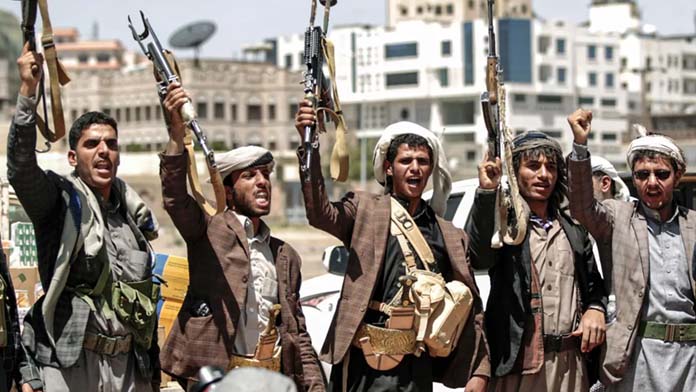
The US has lashed out, bombing targets across Yemen, after the Houthis began targeting Israeli shipping in the Red Sea.
The Houthis’ efforts have exposed the lack of any sanctions or embargoes against Israel from other Arab states, despite their claims of support for the Palestinians.
The Egyptian government, for instance, could halt trade on the Suez Canal altogether until Israel stops the killing. But the corrupt Egyptian regime has made its peace with Israel and the US.
The Houthis have pledged to continue targeting Israeli ships and traffic heading to Israeli ports until it ends its war on Gaza, in the most significant effort to aid the Palestinians anywhere in the Arab world.
Their attacks have disrupted the route through the Suez canal used by 12 per cent of global seaborne cargo and 40 per cent of Asia’s trade with Europe. Most shipping companies are diverting traffic to the much longer route around Africa.
Shipping traffic at the Israeli Red Sea port of Eilat has dropped 85 per cent. This will hurt, although most ships use Israel’s ports on the Mediterranean Sea.
The Houthis are part of what some commentators have called an “axis of resistance” in the Middle East linked to Iran. It includes Syria, Hezbollah, Hamas and armed groups in Iraq.
Iran
Since the Islamic regime in Iran took power in 1979 it has declared its opposition to imperialism and support for the Palestinians. Iran still faces continuing US sanctions and threats of war.
But Iran’s main priority is not opposing Israel and imperialism but maintaining its own wealth and power in the region.
Despite the genocide in Gaza and subsequent Israeli attacks on Lebanon and Syria, the “axis of resistance” has been extremely restrained, limiting any military response.
Hezbollah has fired rockets over the border into Israel but sought to limit the strikes to a narrow strip of land to avoid escalation. But Israeli ministers are still aggressively determined to drive Hezbollah away from the border with Israel. They have even threatened to flatten Beirut.
Iran’s Foreign Minister Hossein Amirabdollahian has said openly it does not want the war to “spread out” beyond Gaza. A Hamas official even told Reuters that Iran’s Supreme Leader Ayatollah Ali Khamenei had asked Hamas to silence those who were calling for greater action to support it.
Instead of encouraging wider resistance to imperialism Iran has been willing to cut deals with the US and its allies.
In March last year it signed an agreement restoring diplomatic ties with key US ally Saudi Arabia. As part of this it agreed to reduce arms shipments to the Houthis—showing that it is happy to use such groups as a bargaining chip to advance its own interests.
In 2015 it signed a deal on its nuclear program with US President Barack Obama in return for a relaxation in sanctions. The deal was later scrapped by Donald Trump.
Iran is also pursuing deals with Russia and China, and has sold its Shahed-136 drones to Russia, which is using them to bombard Ukrainian cities and slaughter civilians.
Behind its Islamic facade Iran is a capitalist economy with massive wealth inequalities.
In recent years the number of millionaires has increased to around 250,000 while at least 30 per cent of the population are below the poverty line. The children of the senior Islamic clerics have become enormously wealthy, with a series of scandals over their imported luxury cars and lavish weddings and parties.
In 2023, the regime also killed over 500 people during months of street protests triggered by the death in police custody of Kurdish woman, Mahsa Amini, after being arrested for not wearing her hijab correctly.
It has unleashed savage attacks on national minorities like the Kurds. Trade union activists are also ruthlessly repressed.
Despite its rhetoric, the Iranian regime will not build the challenge to imperialism in the Middle East that is needed.
Both Iran and Hezbollah sent troops to support Syrian dictator Bashar Assad when he faced a popular uprising as part of the Arab revolutions in 2011. They helped train militias that worked to turn the revolt into a vicious sectarian conflict between Sunnis and Shia.
Consistent opposition to Israel and imperialism will only come from mass movements and working class revolt that can bridge the religious and ethnic divisions.
From the national liberation movements of the 1950s to the Arab revolutions of 2011 there is a rich tradition of revolt from below in the Middle East. Building a mass socialist movement is the key to challenging both Israel and the corrupt Arab regimes that oppress their own working class and back the existing imperialist order.
By James Supple