
After slaughtering over 230 Palestinians and leaving another 1300 injured so far in its latest bombing campaign, Israel has now launched a ground invasion of the Gaza strip.
The invasion comes after Israel and Egypt’s attempt to pressure the Hamas government into a ceasefire completely on Israel’s terms.
The proposal would have restored the 2012 ceasefire terms requiring a temporary easing of the blockade and periodic Israeli incursions of Gaza, which Israel never respected. Hamas rightly called for the re-release of Palestinian prisoners released in 2011, but rearrested in the last month, and a complete end to the blockade.
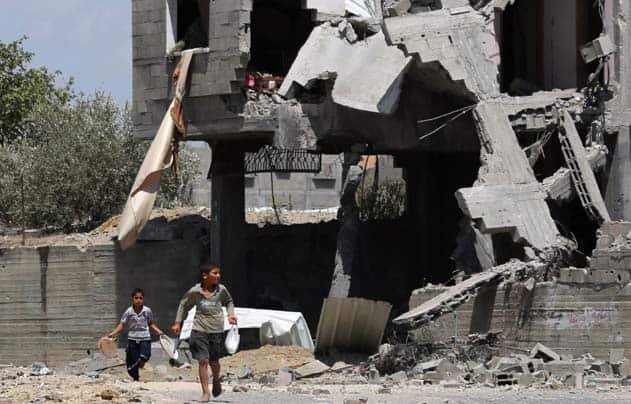
The indiscriminate killing has brought devastation in Gaza. According to Dr Mona Qasim El-Farra, a physician in a Gaza hospital, “At least 70 percent of those killed are civilians.”
Israel bombed a charity housing disabled people, killing two and injuring five others, and has destroyed the al-Wafa rehab and geriatric hospital. Some 22 members of the same family were killed when a bomb struck their home.
Strangling Gaza
The background to Israel’s offensive is a unity agreement between the Hamas government in Gaza and the Fatah government in West Bank. Israel immediately cancelled peace talks after learning of the agreement.
Hamas was elected in 2006 on the back of disillusionment with Fatah’s collaboration with Israel. Since then Israel has maintained a blockade choking the supply of basic goods to Gaza. Electricity is sometimes unavailable for 16 hours in a day, effecting essential services such as health, water, sanitation and schooling.
The latest campaign is part of Israel’s attempt to strangle Gaza and Hamas. They have found a willing partner in Egypt’s military regime, who backed their ceasefire proposal, as did the Arab League.
Egypt has closed the Rafah crossing into Gaza and recently bombed supply tunnels. A shortage of medical supplies has grown even more severe, with doctors prevented from crossing from Egypt into Gaza. According to the World Health Organisation, 30 per cent of essential drugs and half the disposable medical supplies were out of stock in Gaza before the bombing began.
Egypt and the Arab League’s support for the ceasefire only gave Israel cover to continue their killing. As one Gaza commentator, Adnan Abu Amer, told the ABC, “Egypt stood by Israel’s side, as if it was trying to punish Hamas and give Israel some time to pursue its military campaign.” Unsurprisingly, Australian Foreign Minister Julie Bishop has also lined up behind Israel’s ceasefire plan and blamed Hamas for the carnage.
Zionist vision
Israel’s ultimate aim is the complete destruction of historic Palestine. Israel is a state built on racist exclusion, backed first by the British and now by the US, who now provide Israel with $3.3 billion in aid each year.
As Israeli dissident Ilan Pappe has written, Israel’s vision, “is of an Israel stretching over almost the whole of historic Palestine where millions of Palestinians still live.”
Israel has long used the peace talks with Fatah as a fig leaf to extend their occupation of Palestine. Israeli settlements have grown exponentially over the last eight years, with Palestinians now confined to 22 fragmented areas of historic Palestine, divided by the apartheid wall in the West Bank, and subject to checkpoints and daily harassment by Israeli authorities.
Resistance to the occupation inside Gaza has provided some hope after Fatah’s collusion with Israel—so Israel’s aim is to destroy it.
Arab leaders, concerned for the stability of their own regimes, have remained silent over the slaughter in Gaza, or worse.
International solidarity
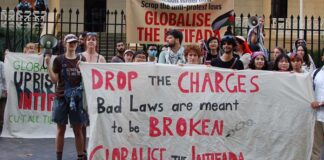
But Israel’s bombing has reignited the movement of international solidarity with the Palestinians—with protests stretching from San Salvador and Caracas to New York, Tokyo, London, Delhi, Cape Town and scores of other cities—as well as here in Australia.
Protesters in Egypt defied the military regime’s ban on protest to take to the streets in solidarity with Gaza, demanding the reopening of the Rafah crossing and the expulsion of the Israeli ambassador. During the Egyptian revolution a mass demonstration destroyed the Israeli Embassy. It still hasn’t been reopened.
Under siege and with little economic power, the Palestinians need international solidarity. The recent Arab revolutions have shown there is a force with the power to push Israel back and stop their cycle of terror.
By Amy Thomas