
Adam Adelpour explains how sanctions work, what difference Australian sanctions would make and how they would hit Israel’s ability to continue the genocide in Gaza
Israel’s genocide in Gaza is reaching unprecedented depths with relief agencies declaring a descent into famine has begun as Israel calls up 130,000 reservists for a major new offensive.
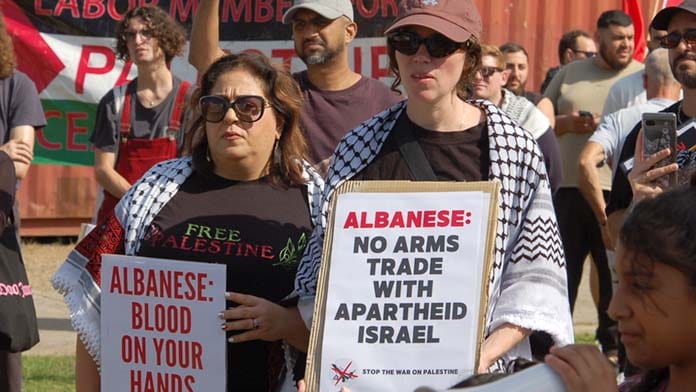
In response to the worsening horror there are growing calls for the Albanese government to sanction Israel. The demand for sanctions was central to the national day of action for Palestine in August and is being echoed increasingly widely.
It has been a key part of the Palestine campaign since 170 Palestinian civil society organisations launched the Boycott, Divestment, Sanctions movement in 2005.
Sanctions can isolate and materially impact Israel and help make it the pariah state it deserves to be. But what would sanctions on Israel look like and how would they be effective?
According to the Department of Foreign Affairs, trade sanctions are “measures not involving the use of armed force that are imposed in situations of international concern”. This usually involves a regime of restrictions on trade, commercial and financial activities as well as travel directed at a particular country.
Australia currently has more than 1500 sanctions on Russia in response to the invasion of Ukraine. These include everything from bans on exporting arms and aluminium ore because it can be used for military purposes to bans on the export of Australian fine wine. Iran also faces over 700 Australian sanctions.
Australian sanctions are monitored by the Australian Sanctions Office and severe penalties apply for breaching them. Individuals can face ten years imprisonment and/or a fine of up to $825,000. Bodies Corporate can face fines of $3.3 million or three times the value of their illegal transactions.
Yet despite the horrific genocide being perpetrated by Israel, its economic and military ties to Australia remain intact.
Not a major player?
Albanese has claimed Australia is not a “major player” in the Middle East in response to calls for action against Israel. But Israel benefits immensely from trade, arms trade, intelligence sharing and diplomatic relations with Australia.
Arms exports to Australia are profitable for both the Israeli state and the Israeli arms companies supplying weapons for Israel’s genocide. One of the most egregious examples is the $917 million contract the Defence Department signed with Israel’s Elbit Systems in 2024. Every cent of this contract funds Israel’s killing machine.
Elbit Systems is a major Israeli arms manufacturer and made the drone that killed Australia aid worker Zomi Frankcom. Its technology has killed countless Palestinians in Gaza.
Australia also supplies weapons to Israel, despite the Albanese government’s desperate attempts to deny this. One of the most important examples is Australia’s supply of parts for the F-35 fighter jet program run by the US. In March this year three new F-35s arrived at Nevatim airbase in Israel bringing their total fleet to 42.
Australia supplies parts which go into a “pool” which all participating countries, including Israel, draw on. More than 75 Australian companies are involved.
RUAG Australia is the sole supplier of the F-35’s “uplock actuator system” that opens the bomb bay doors of the F-35. Sydney company Quickstep boasts that every F-35 has more than $400,000 in parts from its factory in Bankstown.
Wong and Albanese have tried to argue they only export “non-lethal” parts for F-35s. But there is no “non-lethal” part to a killing machine.
Australia has even been caught sending these parts directly to Israel. Documents leaked to Declassified Australia show that an F-35 part was sent from Sydney International Airways to Thailand on a Thai Airways flight. From there it went straight to Tel Aviv in Israel.
It has also been exposed that the Droneshield MK4 drone gun manufactured in Australia has been exported to Israel, as well as the EOS R400 lethal weapons system manufactured in Canberra.
Wong, Albanese and Defence Minister Richard Marles have tried to evade calls to halt arms shipments to Israel. They initially claimed there had been no arms exports to Israel for at least five years. Now the Defence Department has admitted it decided to uphold 35 defence export permits granted before 7 October, 2023.
There are a litany of other military and military-related exports to Israel as well, from armoured steel from Bisalloy in Wollongong, to drone and vehicle parts. In 2024 the bulk coal carrier Captain Veniamis travelled from Newcastle in NSW to the Israeli port of Hadera carrying Australian coal for Israel.
Australia also imports hundreds of millions worth of products from Israel, from medical instruments to machinery parts.
The impact of sanctions
Sanctions can have a significant economic and military impact. This is especially the case for a small country like Israel that is dependent on key strategic imports and foreign military support.
The ability of Western states to impose vast sanctions when they want to can be seen in the case of Russia following the invasion of Ukraine.
According to Castellum, a compliance firm, the US and Europe have imposed sanctions on over 16,500 Russian targets since February 2022. They have targeted Russian oil exports, stopped the export of many goods to Russia and cut off Russia from much of the global financial system.
Despite the dramatic scale of the sanctions, Russia has weathered the storm. It has been able to export its oil to India and China. The International Monetary Fund anticipated Russia’s GDP would shrink by over 10 per cent, but in October 2024 it estimated its GDP output had increased.
But Israel is far more vulnerable to sanctions than Russia. It is a small country and suffers from acute dependency on strategic imports like the coal it uses to generate energy. And its weapons stocks can be replenished only by the United States and its key allies.
Sanctions and the working class
Despite the strong case for sanctions on Israel, there is usually reason to be critical of sanctions. They are a tool used by imperialist powers to weaken their rivals. Sanctions also harm the working classes of the countries targeted and do not usually lead to progressive change. Iran and Russia are cases in point.
Socialists look to the power of the working class to overthrow oppressive regimes and stop brutal imperialist wars waged by their governments. Sanctions can dampen class conflict by giving the ruling class of the targeted country an easy way to blame all hardship on foreign powers.
But Israel is not a normal state. It is a settler-colonial garrison propped up by huge imperialist subsidies, particularly weapons from the United States. These subsidies, the militarisation of Israeli society and its permanent conflict with Palestinians and the region help weld the Israeli working class to the apartheid state. This means they side with the state rather than overthrow it.
In these circumstances the usual criticisms of sanctions do not apply. This fight to impose sanctions on Israel is a fight to sever the arteries of imperialism that feed the apartheid state. This can strengthen the hand of Palestinians and the Arab working class in their struggle against it.
Sanctions from below
The demand for sanctions must be central for the Palestine solidarity movement. A growing list of countries have now applied at least partial restrictions on arms exports to Israel.
Under pressure from the movement even Israel’s close ally and second biggest arms supplier Germany has taken some measures to restrict arms exports. On 8 August German Chancellor Friedrich Merz said Germany is “not approving any exports of armaments that can be used in the Gaza Strip”.
According to some reports Germany’s arms embargo could impact Israel’s ability to replace its Merkava tank engines, putting tanks out of action.
But we can’t wait for Albanese to impose sanctions. We need to fight to impose our own sanctions from below now through boycotts and union bans. Workers in Greece and Italy have repeatedly refused to load arms for Israel. This example must be repeated from Port Said, to Jakarta, to Port Botany.
In May, the ACTU called for sanctions on military trade with Israel, giving unionists the green light to take up the issue.
The South Coast Labour Council in NSW has done research on how to defend workers who refuse work supplying Israel—and has committed to backing any union that takes action.
The MUA recently committed to working towards stopping exports and is consulting members on identifying shipments.
One of the most important boycotts has come from universities. Israeli universities are alarmed at the growing academic boycott and have established a task force headed by Emanuel Nahshon, a former senior official in the Foreign Ministry. The task force collected data showing in 2024 there were 200 boycotts of Israeli scientists and estimated in 2025 that it would be 700.
An employee tasked with monitoring boycotts at Tel Aviv University received 250 reports of boycotts. Nahshon says of the boycott, “It’s strategic damage,” and that “every good thing in Israel—the high-tech, the defence industry, the agricultural prosperity—has come out of the universities.”
So the NTEU policy of academic boycott adopted at last October’s national council is significant and there have already been examples of academics refusing work on this basis, although more needs to be done.
Campaigns have forced Sydney University’s art school to cut ties with Bezalel Art Academy in Israel and UTS to end a ten-year memorandum of understanding with Technion, the Israeli Institute of Technology.
Inflicting this kind of “strategic damage” on Israel is critical. Sanctions from below must be spread everywhere there are ties with Israel. When asked if sanctions helped end apartheid in South Africa Nelson Mandela responded, “Oh, there is no doubt.”