
A Palestinian student from the West Bank spoke at the symposium on Palestine and political expression at Sydney Uni in June. We print part of their speech below.
On 4 June, Israeli forces arrested four young women students from Birzeit University in the West Bank.
One of them, Natalie Abu Dayyeh, is 20 years-old, a journalism student. She also plays football for Palestine’s national team. The same week, Israeli police in Jerusalem detained a second national team player, Rand Halawani, also 20. Their football association says this is not an accident; it is a pattern of targeting Palestinian athletes.
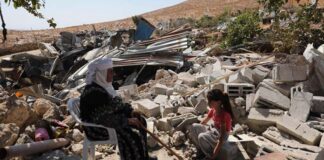
The day before, occupation forces stormed the campus of Al-Quds University in Abu Dis. And the following week, Israeli bulldozers demolished the family home of another Birzeit student, Mays Sultan, in occupied Jerusalem, after more than a decade of court battles, on a single day’s notice. The same demolition flattened a shop that was the livelihood of four families. And then the authorities handed the family a fine of ten thousand shekels to help pay for the destruction of their own home.
A few weeks before that, in the Umm al-Khair village near Hebron, Palestinian children stood in front of Israeli soldiers and protested just to be allowed to walk to their school.
Academic freedom for Palestinians, begins with a much smaller question: Can you get to class? Can you reach your university without being stopped at a checkpoint? Can you study without soldiers raiding campus? Can you graduate without being arrested?
The attack on Palestine and the attack on free speech at Australian universities are not two issues. They are the one project—a project that shields institutions complicit in oppression, and punishes the people who expose them.
Scholasticide
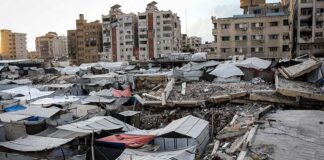
The destruction of Gaza’s education system has been so total that UN experts called it scholasticide. Not collateral damage—the deliberate, systematic destruction of an education system.
All 19 universities in Gaza have been severely damaged or completely destroyed. More than 80 per cent of university buildings are gone. The Palestinian Education Ministry has counted more than 100 academics killed, and roughly 90,000 higher-education students who can no longer study.
Dr Sufian Tayeh was the president of the Islamic University of Gaza, a physicist, UNESCO’s chair for physical and astrophysical sciences in Palestine, ranked in 2021 among the top 2 per cent of researchers in the world. He was born in Jabalia refugee camp and rose to the very top of global science from one of the most besieged places on earth. On 2 December 2023, an Israeli airstrike killed him and his family in their home.
Dr Refaat Alareer taught English literature at the same university. He was a poet who co-founded a project called “We Are Not Numbers”, which paired young writers in Gaza with mentors so the world would see faces, not statistics. Before he was killed, he received calls and messages telling him to stop writing.
He kept writing. He wrote a poem, anticipating his own death, called If I Must Die. It has since been read aloud at events on every continent. On 6 December 2023, an airstrike killed him along with his brother, his sister, and four of their children.
At the Islamic University of Gaza, the bombing destroyed its central library and laboratories. It burned more than 200,000 books. It erased 16,000 master’s and doctoral theses.
Why target the universities, the professors, the books?
After decades of military rule and occupation, Palestine has one of the lowest illiteracy rates in the world, around 2 per cent. The global illiteracy rate is about 13 per cent.
Education is one of the ways Palestinians have refused to disappear.
Complicit with Israel
Israeli universities however are not bystanders to the occupation. The Technion helped develop the remote-controlled D9 bulldozer that flattens Palestinian homes. The Hebrew University runs a program that trains military intelligence officers. And Bezalel, an art and design academy, opened an emergency workshop during this genocide to repair the uniforms of Israeli soldiers, sewing labels into them that read “With love from Bezalel.”
Israeli universities do not sit beside the occupation. They are built into it.
Sydney university is complicit.
Firstly it has exchange programs with Israeli institutions, advertising programs with images of occupied Jerusalem under the words “Experience Israel”, sending students to campuses that host soldiers, and into accommodation in illegal settlements.
Secondly there’s weapons research. Inside the Sydney Nanoscience Hub sits the Jericho Smart Sensing Laboratory, developing nanotechnology for military aircraft and satellites. The University takes research money from the US Office of Naval Research, the US Army Research Office, and US intelligence research agencies and from a joint US–Australian Defence program where, by the government’s own rules, the research must be on a topic the military designates. There is a live project with the weapons contractor L3Harris.
Sydney University has a “special relationship” with Thales, the arms company that partners with the Israeli weapons-maker Elbit on drone production. Elbit’s drones fly over Gaza. Thales funds PhD students here and until last year, Thales Australia’s own chairperson, Belinda Hutchinson, was the Chancellor of Sydney University.
Over five years, Australia approved around 350 defence export permits to Israel. Government deny supplying Israel, but they always use the same careful word: Australia doesn’t sell weapons “directly”.
Francesca Albanese, the UN Special Rapporteur, describes this kind of arms-length, multi-country supply chain as “the economy of genocide”. This is the what university research feeds into. And it is being done in our name, with our fees, every day.
Repression
On 5 May, this University sent two students a formal Notice of Complaint over a protest poster. The offending content? Handala, a barefoot Palestinian child, hands clasped behind his back. Created by the cartoonist Naji al-Ali, Handala is one of the most beloved images in Palestinian culture: the refugee child who refuses to grow up until he can go home.
The University suggested Handala might be antisemitic.
The University has adopted a new definition of antisemitism along with 38 other Australian universities that treats criticism of Israel as racist. It brought in an anti-protest Campus Access Policy. It is building an infrastructure of political management designed to make the next silencing easier than the last.
Everyone should fear that. Because once a university accepts that political speech can be switched off whenever it gets controversial, that switch never stays on. Today it is Palestine. Tomorrow it is whatever embarrasses power next.
The campus crackdown is backed up by the state. In February this year, when Israeli President Isaac Herzog visited Sydney, the NSW government introduced some of the harshest anti-protest powers in the country. Police pepper-sprayed a peaceful crowd. They dragged away Muslim men who were praying.
The crackdown in the street and the crackdown on campus are the same crackdown.
Our universities celebrate critical thinking until students think critically about the university’s complicity.
They celebrate ethical leadership until students demand it be consistent.
They defend free expression until the expression is solidarity with Palestine.
That contradiction is now impossible to hide.
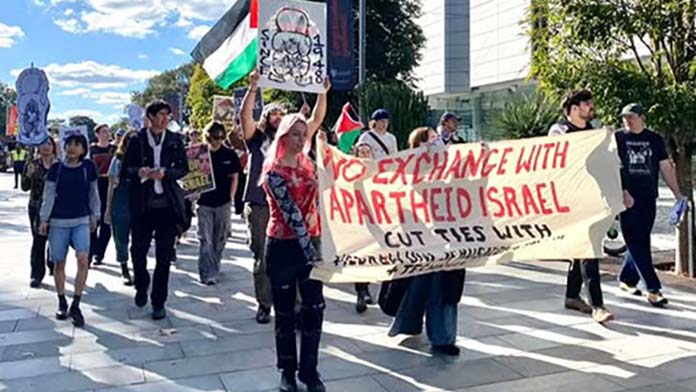
So what do we actually do? We must organise to cut the ties.
Boycotts helped end apartheid in South Africa. Australian unions refused to unload South African ships and weapons cargo, even when a Prime Minister threatened to jail them. And when Nelson Mandela walked free, he came to Australia to thank Australian workers directly. He said their solidarity gave his people strength and hope.
Israel knows boycotts work. Its university presidents have built a dedicated task force to stop the spread of academic boycotts because they know boycotts threaten Israel’s scientific future and its economy.
Trinity College Dublin, the first university in the West to comprehensively cut ties, voted in June 2025 to fully divest from Israeli companies, end collaborations with Israeli institutions, and stop facilitating exchanges with them. Ghent University in Belgium cut academic ties with every Israeli university. Universities across Spain and Ireland have moved to divest or suspend their ties.
Israel’s own reporting admits academic boycotts rose 66 per cent in a single year led by the US, Belgium, Spain and England.
And in Australia, we have also had wins. Sydney University ended its exchange with Bezalel, the art school that sewed uniforms for the IDF. And that victory matters beyond this campus, because the last surviving Bezalel partnership in the country now sits at UNSW.
UTS let its Technion partnership lapse and refused to renew it. Curtin ended its tie with Ben-Gurion University. University of Western Australia ended its tie with the Hebrew University.
Collective action does not transform an institution overnight, but it can make complicity politically expensive. And that is how every wall eventually comes down.
Universities should be a place where hard political questions can be asked, where power can be challenged, where solidarity is possible.
I think of Dr Ahmed Abu Shaban, Dean of Agriculture at Al-Azhar University in Gaza, who spoke at our forum on education as resistance. He told us how many times his faculty has been bombed and how many times they have rebuilt it.
So we need to cut the ties, both with Israeli universities and with the weapons companies, and build links with Palestinian universities, instead of with the institutions destroying them. And defend the right to speak, to argue, to think.
The struggle for Palestine and the struggle for free speech are bound together.
People have the right to challenge injustice whether it wears the soldier’s uniform in Gaza, or the letterhead of an administrator in Sydney.
The answer to both cannot be silence.