
Mark Gillespie looks at the role of counter-protests in defeating One Nation, and the lessons for the fight against March for Australia and the far right today
Pauline Hanson’s explicitly racist One Nation Party was launched in 1997 and soon had 350 branches and about 18,000 members. One Nation was dividing workers and legitimising open racism and looked set to make gains in the 1998 federal election.
But a campaign of protests saw Hanson kicked out of the parliament and One Nation confined to the political wilderness for 18 years. The lessons of the struggle against One Nation in the 1990s is important in the face of the rise of March for Australia and the newly resurgent far right.
Pauline Hanson began 1996 as an obscure Liberal Party candidate in the traditionally safe Labor seat of Oxley, west of Brisbane. She was dis-endorsed by the Liberal Party after writing an explicitly racist letter to a local newspaper complaining about “Aboriginal privileges”.
She stood as an independent but was still listed on the ballot paper as a Liberal. She won, riding an enormous backlash against Labor that not only swept her into parliament but also gave John Howard a landslide victory.
Her maiden speech to parliament openly promoted racist myths about Australia being “swamped” by Asians, that immigration caused unemployment and that Indigenous people were living lavishly on government benefits. The bigots cheered while the media began courting her as representing “mainstream Australia”.
She became an even more serious threat when she used her newly found celebrity status to hold packed public meetings and then launch One Nation as a party.
One Nation was not led by fascists but every far right group in the country rushed to join—including the antisemitic League of Rights and the openly fascist National Action. Verbal and physical attacks on Asians and Indigenous people escalated as complaints of racism to the Federal Race Discrimination Commission doubled.
The mainstream parties boosted One Nation’s racism. Rather than slap Hanson down, Liberal Prime Minister John Howard defended her right to free speech and tried to undercut her appeal by implementing some of her policies.
Immigration was cut by 20 per cent as Howard launched an ideological offensive against the so-called “black armband view of history” saying “we have been too apologetic about our past”. Abstudy was cut by $38 million as was funding to the Aboriginal and Torres Strait Islander Commission, which Howard later abolished.
Labor leader Kim Beazley wasn’t much better. Rather than denounce her maiden speech explicitly he described it as “extraordinary and disappointing”. While he called on Howard to “exercise leadership on this issue” he failed to do so himself.
When NSW Labor secretary John Della Bosca called Howard a racist and received a standing ovation at the NSW Labor conference in October 1996, Beazley responded saying he wouldn’t be “characterising John Howard that way”.
Labor, too, was responsible for creating the conditions that allowed Hanson to get a hearing. Labor had ruled for 13 years federally and during that time embraced neoliberalism. State assets were privatised, the economy and the labour market deregulated and the welfare state run down, creating widespread bitterness.
It was no accident that Hanson was elected in Oxley, a seat based on the industrial city of Ipswich. Seven hundred jobs were lost in the local railway workshops in the early 1990s despite workers in the city voting for Labor to represent them at all three levels of government.
Labor’s vicious turn on its own supporters created the political space for Hanson to pose as an opponent of deregulation and privatisation and present herself as the “voice of the people” against the “elites”.
The fightback
With Howard pandering to Hanson’s explicit racism and Labor failing to put up a clear left alternative, it was left to unionists, Aboriginal activists, ethnic community councils and socialists to organise a serious fightback.
Building the broadest opposition to Hanson and clearly labelling her a racist was important. Hanson was casting herself as representing the “mainstream” and the media backed her message.
Big, broad, but militant, demonstrations directed at stifling her public meetings were needed to counter Hanson’s recruitment drive.
The first major rally against Hanson was the “Unite against Racism” rally in Brisbane in November 1996. Four thousand rallied and for the first time there was a clear anti-racist message on the evening news.
Socialists played an important role initiating this rally and right from the beginning sought to involve Indigenous, migrant, student and faith groups, alongside sections of the Labor Party and importantly the union movement.
Hanson and Howard’s racism was directed at dividing the working class and sought to divert anger over unemployment away from the bosses and the government onto to migrants and Indigenous people. A stand by the unions was needed to combat the spread of racist myths in the workplaces.
The Brisbane rally was addressed by Dave Harrison ACTU (Qld) and state Labor MP David Hamill and was endorsed by six trade unions. Numerous union banners were seen there and the leaflet promoting the rally was translated into Chinese. Several Labor Party branches did mail-outs promoting the rally.
Further rallies followed in Sydney, Canberra, Perth and Melbourne. The Melbourne rally, organised by the Victorian Trades Hall Council and the Ethnic Communities Council, drew over 30,000 people.
On the same day in Ipswich, in the heart of Hanson country, hundreds rallied and marched behind a banner painted by local high school students, “Ipswich Residents Against Racism”. All these protests sought to link Hanson to John Howard, opposing the way he was encouraging and legitimising her from within the political mainstream.
Counter-protests
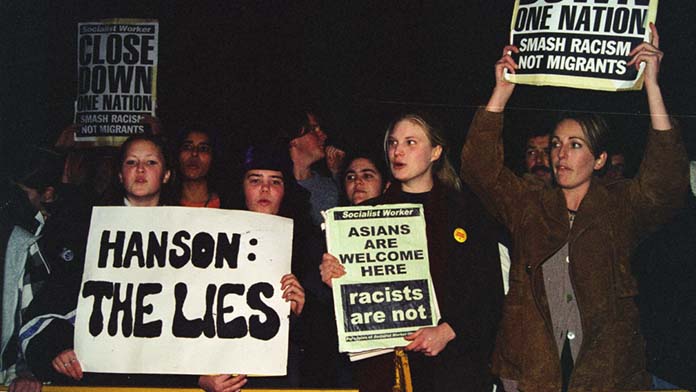
Hanson launched her One Nation Party in Ipswich in April 1997. Socialists initiated a counter-protest that led to wild scenes outside the Ipswich Civic Centre, as angry protesters confronted those attending the launch. The news that night showed Hanson running through the car park trying to avoid protesters.
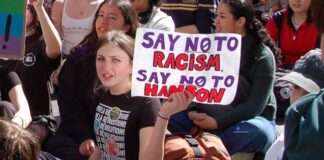
Politicians and the media denounced this and the similar protests that followed as “violent” and an attack on “free speech” but, rather than being deterred, anti-racists were inspired. From then on wherever Hanson spoke there was a counter protest outside attended by hundreds, sometimes thousands—in Perth, Adelaide, Newcastle, Sydney, Dandenong, Geelong, the Sunshine Coast, the Gold Coast, Ipswich, Brisbane and many other places.
Protests spread like wildfire. People didn’t just protest outside Hanson meetings but also wherever One Nation tried to form a branch—including in Toowoomba, Bathurst, Orange, Dubbo, Kiama, Rockingham, and Queanbeyan.
Militant counter-protests were important for several reasons. First and foremost they delegitimised Hanson, clearly labelling her a racist, something the mainstream parties wouldn’t do.
The counter-protests were also important for splitting softer racists from the hard racist core of One Nation. Entering a One Nation meeting now required the political commitment to walk through a hostile crowd. Attendance at Hanson’s meetings began to fall, as would be supporters turned away rather than face the protests.
“They do make it very embarrassing for those who want to come to our meetings,” complained One Nation co-founder, David Ettridge. Hanson described her visit to Perth, where 2000 people disrupted her meeting at the Challenge stadium, as “the worst 24 hours of her life”.
The size and determination of the protests also shifted the media narrative from: “is she an unstoppable juggernaut” to “is she racist”? They also encouraged more timid politicians, community leaders and union leaders to speak out against racism. A number of local councils banned her from using public spaces for meetings.
Hanson’s demise
For a long time, John Howard considered One Nation as the “lesser evil” and refused to rule out a preference deal with them. “Put One Nation Last” became a demand that the movement made on the politicians of both sides.
Some federal Coalition MPs even considered forming a coalition with One Nation. In the 1998 Queensland election the Coalition parties ignored the anti-racist demand and actually preferenced One Nation ahead of Labor. But it backfired dramatically with Labor holding on as a minority government and One Nation taking five of the 11 seats they won off the Coalition.
Between One Nation’s electoral success in Queensland in June 1998 and the October federal election, protests continued to escalate.
Hanson had to abandon a public meeting in the Hawthorn Town Hall in Melbourne because of a massive counter-protest. She also had to abandon a “meet the people” walk in Bendigo after high school students joined a counter-protest.
Thousands of high school students joined a nationwide march on 24 July and a few days later in Brisbane thousands of high school students joined an Indigenous-led protest outside the first sitting of the Queensland Parliament.
At the 1998 Federal election Labor and the Coalition preferenced each other ahead of One Nation. Hanson won 36 per cent of the primary vote in the seat of Blair but failed to win because preferences flowed against her.
The demonstrations had politically isolated One Nation and pushed the racists to the margins.
Today March for Australia is being fuelled by mainstream racism from Labor and the Liberals blaming migrants for the housing and cost of living crisis. This means we have to fight the mainstream racism that allows them to grow.
Exposing the organising role of open Nazis will help split the soft racists attracted to the rallies from their more hardened core.
Mobilising big, broad anti-racist rallies can intimidate the racists at the same time as they increase the confidence of the anti-racists. And just as importantly socialists argue against the flag-waving nationalism that covers up the inequality and misery of capitalism that MFA and Nazis thrive in.
While in the 1990s we were able to push the far right back onto the margins of politics, as long as capitalism creates inequality, misery and alienation, there will always be an audience for their toxic politics. That is why part of the fight against the far right today has to be encouraging every fightback over wages and conditions, for public housing, better health and education, to push back against the despair that fuels them.