

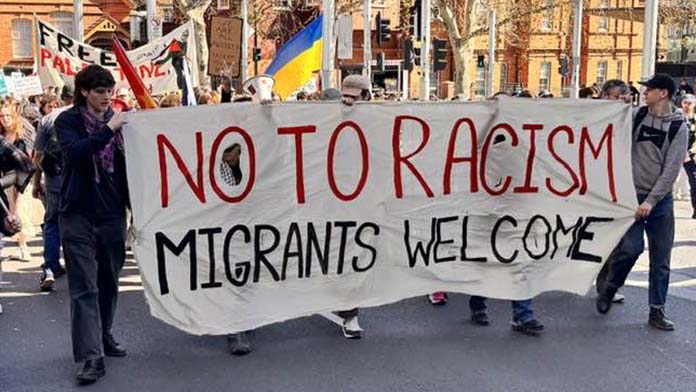
Thousands joined the racist anti-immigration March for Australia rallies on 31 August, with further racist rallies planned for 19 October. The far right wants to exploit frustration with house prices, rent increases and the cost of living and blame them all on migrants.
The cost-of-living crisis and the real decline of public services are the result of policies of successive governments which benefit the rich.
But fears about immigration are being fuelled by the major parties and the mainstream media. Anthony Albanese responded to the March for Australia rallies by saying there were some “good people” there simply concerned about immigration levels and affirmed that “we are getting the numbers down” in response.
The idea that immigration is driving up housing prices due to a shortage of homes is widespread. Morgan Cox’s plea to Albanese on Q&A earlier this year to cut immigration to address the housing crisis went viral.
“It’s just about numbers,” he said, “the number of people and the number of homes.”
But it’s a myth that the housing crisis is the result of immigration and population growth.
The number of new homes has consistently outpaced population growth. Between 2001 and 2021 population increased by 34 per cent but there was a 39 per cent increase in dwellings. Even over the past five years the number of dwellings grew 8.2 per cent while the population increased 7.4 per cent. Despite this, house prices have rapidly increased.
During the pandemic when the borders were closed and migration virtually halted, housing prices increased by an enormous 20 per cent in 18 months, boosted by low interest rates. When interest rates increased, landlords passed the cost on as rent increases.
The real problem is wealthy investors driving up the price of houses. This is the result of government policies that have delivered tax breaks for the rich and chronic underfunding of public housing.
In 1999 the federal Liberal government introduced capital gains tax concessions and negative gearing for investment properties. This encouraged property speculation by cutting the tax on profits in half, sending housing prices soaring over the past 25 years. These tax breaks will cost $165.6 billion over the next decade—money that could be spent on public housing or other services.
The rich are also leaving thousands of homes sitting empty. Prosper Australia estimated that in 2023, more than 27,000 dwellings were empty in Melbourne. A further 70,000 are thought to be barely used. In total this is enough to supply homes for the entire social housing waiting list twice over.
Public housing
Government have also underfunded and neglected public housing for decades. This is the result of neoliberal policies that have handed tax cuts to big business, squeezing government revenue and delivering privatisation of housing, services and infrastructure.
In 1995-96 public housing made up 6 per cent of housing stock in Victoria. By 2019-20 that figure halved to 2.9 per cent. Community housing hasn’t made up the shortfall.
Despite there being 55,000 people on the social housing waiting list, the Victorian government is about to knock down 44 public housing towers, demolishing 6660 homes to sell the sites to private developers and community housing organisations. The first housing towers to be knocked down and redeveloped in North Melbourne and Flemington will not include any public housing.
Instead of investing in public housing and changing policy to alleviate the housing crisis, governments have consistently sought to scapegoat migrants and refugees for their own failures.
Last year Labor capped the number of international students, suggesting this would reduce pressure on the rental market. A study from the University of SA found there is no link between the number of international students and rising rental prices and concluded international students were “thrown under the bus”.
Labor has also passed laws that could be used to deport 80,000 non-citizens, striking a $2.5 billion deal with Nauru to deport people there who have been released from indefinite immigration detention.
Racist rhetoric from the government and media seeks to paint them all as an existential threat.
All this simply gives legitimacy to the racist opposition to immigration from the far right.
We need to reject the efforts to scapegoat migrants and build an anti-racist campaign to counter the racist ideas and policy pushed by governments, the mainstream media and the far right, at the same time as mobilising a mass united movement on the streets to confront racists and Nazis.
Alongside this we must demand that the government take real steps to alleviate the economic pain people are in.
This means building a movement with socialist organisation at its heart which can lead a fight for change in our workplaces, universities and communities, alongside migrants and refugees.
By Liam McMullen