
Sophie Cotton reviews a new book on Marxism and women’s liberation that reasserts the centrality of the family in shaping sexism and the history of struggles for liberation
In their new book, Breaking Our Chains, British socialists Sarah Bates, Judy Cox and Sally Campbell deliver a lucid account of today’s nuclear family as “every bit as manufactured and symbolic of the system as McDonald’s or the combustion engine”.
The book addresses a post-MeToo generation, in which the far right and anti-abortion movements spur on a “new” sexism.
An IPSOS survey across 29 countries earlier this year found that 52 per cent of the 23,000 respondents thought gender equality had “gone far enough”. Some 57 per cent of Gen Z men, aged 16 to 29, believed women’s equality had gone so far “that we are now discriminating against men”.
There has been some official consternation about this “new” sexism. Anthony Albanese, when not making sexual remarks about the Japanese prime minister and Kylie Minogue, has proclaimed online misogynists like Andrew Tate a “global problem” and banned social media for young people.
Before being deposed, British PM Keir Starmer proclaimed that the hit TV show Adolescence should be shown in schools.
But the book sets out that sexism is more than reactionary ideas. It has a real material basis.
This is not merely an era of TikTok but of economic malaise and attacks on public service-provision that doubly impact women as workers and carers, entrenching women’s material inequality.
The family
Marxism is also known as “historical materialism”. An account of sexism must explain the material structures that reproduce women’s oppression and the historically dynamic ways this is articulated within capitalism.
The book explains how the nuclear family was embroidered into the rise of class society.
It critically defends Friedrich Engels’ The Origin of the Family, Private Property and the State. Despite flaws, including a rigid interpretation of stages of development, the authors explain the ongoing relevance of Engels’ insight that the rise of class society produced the “world historic defeat of the female sex”.
He writes that women are “degraded and reduced to servitude … a slave of [a man’s] lust and a mere instrument for the production of children. This degraded position of women … has gradually been palliated and glossed over and sometimes clothed in a milder form; in no sense has it been abolished”.
This material relegation of women has been repeatedly transformed as capitalism confronts crisis after crisis of its own making.
Following drastic declines in child survival rates in the Industrial Revolution, Britain brought in Factory Acts, which set out a higher male “family wage”. Rather than seeing this as an act of a patriarchy that unites misogynist male trade unionists and capitalists, the authors of Breaking Our Chains suggest a more contradictory dynamic wherein the family can be a heart in a heartless world.
There were some bigoted men who saw the family wage was a way of keeping women in the home. But for other workers, like strike leaders Ann and Margaret Fletcher during a lockout of 18,000 textile workers in the 1850s, the demand that their husbands be paid enough so that married women did not have to work was a way of redistributing bosses’ profits towards the capacity to care for their family.
Two decades later, through the Contagious Diseases Acts, the state coordinated arrest, plainclothes kidnapping and humiliating medical examination of working class women who appeared too “boisterous” or wore bright clothes, branded sex workers.
Working-class women fought back through riots, protests and a dramatic mass refusal to attend court or submit to examinations in 1870 in Davenport.
Marxism understands the nuclear family as a dynamic and contradictory structure, which can be contested by working class struggle.
Although women make of 48 per cent of Australian workers, they continue to disproportionately perform the unpaid work of reproducing the next generation of workers that capitalism relies on.
If actually paid for, household work and care would cost $688 billion per year according to economist Leonora Risse. Women do 69 per cent of this work.
Despite many changes in the nuclear family, including more queer relationships, single parenting, divorce rates and lower numbers of children, this care work that capitalism depends upon has continued.
Indeed, these changes can make re-asserting the ideology that women are supposed to have a caring nature more urgent for the ruling class, as we see with the resurgence of anti-trans and anti-abortion movements.
The family also underlies the pay gap, superannuation gap and why women are relegated to insecure and part-time work.
It is impossible to understand the oppression of women without these economic facts.
But it is equally impossible to understand it without conceptualising the visceral, embodied detail of women’s oppression within the family, as seen in Breaking Our Chains’ account of motherhood.
The standard of the ideal perfect mother, against which all women are judged, is every year augmented with new expectations.
Parenting has been “professionalised”, with women expected to “educate, interact with and entertain our children every waking moment”.
Labour-saving inventions have not freed women from domestic work but facilitated heightened expectations of cleanliness and nutritional variety, while individualising this work more than ever.
Every year, new reports demand women breastfeed for longer and monitor everything from their children’s consumption of online content to microplastics. Popular psychology expands even further what mothers can be blamed for failing to have provided.
One longitudinal study found that in 2012, women spent an average of 104 minutes per day with their children, up from 54 minutes in 1965. For men, it had increased from 16 to 59 minutes.
The Australian Bureau of Statistics estimates the unpaid work of women at 4 hours and 53 minutes per day.
While wealthy women can “outsource elements of motherhood” to paid domestic workers, “working-class women can spend every waking moment wiping snotty noses, wiping sticky hands and wiping other people’s shit off the toilet bowl”.
The joy and love within the family is “squeezed” out through the dynamics of women’s oppression.
Trans rights and liberation
No book does everything. The chapter on violence leaves much unsaid about domestic violence and the contradiction between the family as “an environment of unbridled joy or one dominated by abuse and neglect”.
The chapter on trans rights is also disappointingly abstract.
It suggests trans people make social change simply through their gender expression. “The more people who choose to live outside the gender binary, the more they contest and erode binary ideas of gender which limit and restrict our lives.”
The authors go on, “Every trans+ person, every non-binary person, who chips away at the prison walls of gender makes life better, richer and less rigid for everyone.” If only it were that easy!
As Australian sociologist Raewyn Connell argues in Trans Lives, “Treating cisgender people’s lives as conformity to role norms, while treating transgender as non-normative” simplifies gender and paints “far too rosy a picture” of alignment for non-trans people.
Non-trans women and men find themselves within the prison walls of gender every day.
Many people try to build intimate relationships that break away from the brutally sexist expectations of our society. Many parents resist rigid sexist stereotypes in their parenting.
There is nothing wrong with individual subversion, but without the material reorganisation of the “private” reproductive work of the family, which underpins the very idea of a gender binary, trans and non-trans women will remain oppressed.
Trans people have done far more than request unions encourage the “they” pronoun, as discussed in the book. Far more transformative struggles include striking against employers for gender affirmation leave, public protests to win self-identification reform and street-based collective action.
None of this can be reduced to individual gender presentation.
These issues come from a misunderstanding of transphobia as resting on the ideological basis of “biological determinism”.
Trans oppression does not arise in a separate ideological sphere. It is bound up in the same social relations in the family that underpin the reproduction of labour-power for the capitalist system and also give rise to sexism and homophobia.
These deficiencies are tempered when one remembers the toxic anti-transgender tendencies within British politics, including sections of the left like Counterfire or anti-trans feminists in Labour. Celebrating trans existence is infinitely preferable but it artificially limits the capacity of trans people to lead class struggles.
Marxism
Without erecting artificial barriers with the intellectual tradition of feminism, Breaking Our Chains lays out Marxism as a unique and distinctive theoretical framework.
The book refreshingly celebrates women leaders of the socialist movement like Rosa Luxemburg, Clara Zetkin and Alexandra Kollontai for their role as revolutionary theorists and actors, rather than through an awkward, ahistorical rebrand as palatable feminists.
It provides a vivid and inspiring history-from-below of working-class women’s struggles. In the 1818 Peterloo massacre, women carried the banner “Let us die like men and not be sold like slaves”. Lesbian socialist couple Esther Roper and Eva Gore-Booth organised a mass petition for suffrage in 1900.
Millions of women joined the German socialist party and struggled not against “the men of her own class” but “capitalist society”.
Against male privilege, intersectionality and social reproduction theory, classical Marxism understands women’s oppression as bound into a single unitary system of capitalism, imperialism, colonialism and the nuclear family.
It offers a blueprint for fighting this as it unfolds in a single historical process, from the racist origins of obstetrics to the struggles of migrant domestic workers.
The struggles of today pitch us against this sexist system. NSW nurses are up against the industrial court’s ruling that addressing wage inequality is unaffordable. Anti-racists fighting One Nation contend with anti-abortion and anti-trans politics. Anti-war activists fighting Albanese stand in solidarity with the Palestinian women who bear the brunt of Israeli occupation, violence and apartheid.
Breaking Our Chains deserves to be read and debated by these activists, and the struggle against sexism integrated consciously into this work.
As French-Russian revolutionary Inessa Armand writes, “If women’s liberation is unthinkable without communism, then communism is unthinkable without women’s liberation.”
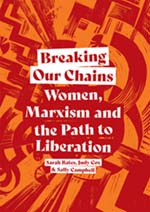
Breaking Our Chains: Women, Marxism, and the Path to Liberation by Sarah Bates, Judy Cox and Sally Campbell is available from Solidarity, order it online here.