

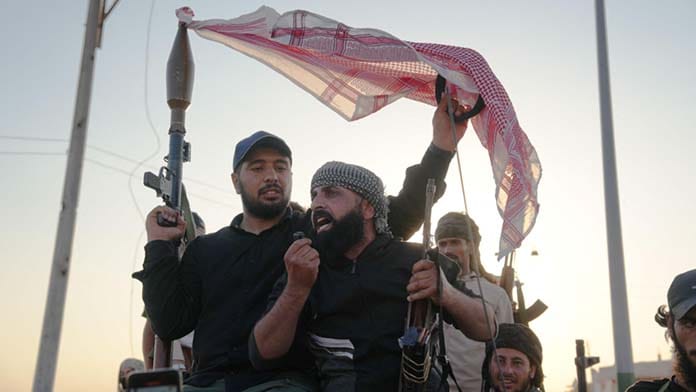
A new wave of sectarian violence has erupted in Syria, centred around the majority Druze area of Suweyda in the south.
The violence began in early July, after a Druze man was attacked by Bedouin fighters. This started a tit-for-tat conflict between Druze and Bedouin groups, which prompted the Hay’at Tahrir al-Sham (HTS) self-declared government to send in troops and armoured vehicles to try to assert control.
This worsened the conflict, leaving more than 1000 dead and over 25,000 displaced since the start of July, including many Druze and Bedouin civilians.
HTS fighters have targeted the Druze, using sectarian violence and collective punishment, such as forcing Druze civilians to shave their moustaches.
Israel seized this opportunity to launch missile strikes on Damascus, hitting the Syrian Defence Ministry and presidential palace, killing three.
Israel justified these strikes by claiming that it was protecting the Druze but it is obvious that Israel is not seriously committed to protecting minorities given it runs a racist apartheid state.
In reality, Israel is exploiting the growing sectarianism of HTS to extend Israel’s dominance, by exploiting sectarian divisions within Syria to further fragment the country.
President Ahmed Al-Sharaa claims he wants to protect Syria’s minorities. But since the overthrow of Bashar al-Assad’s dictatorship last year, HTS has looked to consolidate control over the various armed minorities across Syria, including the Kurds in Syria’s north and the Druze in Syria’s south.
HTS has demanded that these relatively autonomous regions disarm and incorporate into the national army. But HTS has monopolised its top roles, handing them to Sunni Islamists, many of them former members of jihadist groups who committed sectarian atrocities during the civil war—such as Al-Sharaa himself.
And while HTS has announced that there will be elections in Syria next month, the population will not get to vote. A third of the seats will be appointed by Al-Sharaa and the remainder appointed by “electoral bodies” whose members will be similarly selected by HTS.
So far, both the Kurds and the Druze factions have refused to disband, sceptical of HTS’s new regime after similar sectarian massacres carried out by HTS-linked fighters earlier in the year against Christians and Alawites.
In March and April, the regime targeted Alawite groups along the coast after accusing them of being supporters of the old regime.
A wave of sectarian killings saw whole families murdered after some Alawite fighters attacked government forces. More than 1600 people were killed.
Sectarianism
This sectarianism has historic roots within Syria. During the civil war, Assad tried to use sectarianism to rally support among Alawites and other minorities by falsely claiming that the revolutionary movement was entirely Sunni jihadists.
The initial mass protests against the regime in 2011 raised democratic and anti-sectarian slogans, drawing in Syrians across the sectarian divide.
Assad carpet-bombed the most democratic and anti-sectarian sections of the movement and released hundreds of jihadists from his prisons.
He refrained from cracking down too hard on the Druze in Suweyda to maintain their support and present his regime as a bulwark against sectarian violence.
Similarly, Israel has long sought to use the Druze for its own advantage.
But while some of the Druze in Syria see Israel as an ally against the current HTS persecution, most have rejected Israeli intervention.
Inside Israel, Druze citizens have more rights than other Arabs, are allowed to serve in the IDF and have a history of loyalty to the Israeli state.
But Israel is no real friend of the Druze. When Israel occupied Syria’s Golan Heights in 1967, it displaced thousands of Druze and has since set up Israeli settlements, treating Syrian Druze much like it does Palestinians in the West Bank.
After the fall of Assad, Israel quickly sent troops to seize further territory inside Syria around the Golan Heights, demolishing homes and committing to doubling the number of Israeli settlers in the Golan Heights.
Israel is insisting on a demilitarised zone, that it controls, south of Damascus as part of its broader efforts to reshape the region so that US and Israeli domination is unchallengeable.
HTS’s use of sectarianism to crush opposition and its dictatorial control of the state, while imposing sweeping austerity measures, must be opposed.
Genuine Syrian liberation and a free Palestine requires the return of the anti-sectarian and democratic revolutionary movement of 2011, which can both challenge HTS and the US and Israeli domination of the region.
By Maeve Larkins