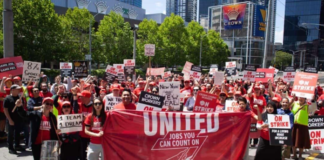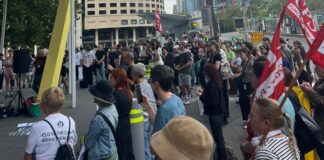


Workers at the Padre coffee roasting factory in the Melbourne suburb of Brunswick walked out on strike on 17 October.
Padre has two cafes in Melbourne, one in Noosa and another in Paddington, Sydney. It presents itself online as a “progressive” company.
Julie Monteiro spoke to United Workers Union delegate Ava Baldwin for Solidarity about the issues.
How did you get involved in organising and what’s been your experience of getting people involved?
A year ago the team came together and we were all really unhappy with the conditions and wages. And we said, what do we want to do about it? I brought up the idea of joining the union and then we talked to the union, who said we could bargain/get an enterprise bargain agreement.
Most of that original team are gone now. But I’ve become the delegate and every time someone new comes in I sit down with them and say this is really important, do you share these values? And we’ve been really lucky. Everyone who’s joined our team has been like fuck yeah, we want to be a part of it.
That’s really amazing because the general experience in casual work is people saying, “I’ll just leave and find something better.”
We’re a mix of full-time and casuals but the casuals are really involved as well. We’ve got a few people in the stores as well who are members and that’s an ongoing conversation trying to get people to understand even as casual workers there’s a lot to be gained from joining the union.
You’re right, people just leave. But you can quit but it’s just gonna be the same shit at another place. So why not step up and actually make change.
What’s the process been like getting to the point of joining the union?
We’re really lucky, a lot of our team are already pro-union. It’s usually the wages. Even after our first negotiation meeting, the business just said we can’t guarantee your wage increase and that’s been their same line every single negotiation meeting.
And as soon as I point that out to any new team members or anyone interested in joining the union, that is a huge red flag.
What are your demands and how did they come about?
The big three we’re really set on are cultural leave (Sorry Business leave and expanding kinship definitions for First Nations people), gender affirmation and, of course, the wages.
We share the passion that all of us in the team, because we all come from different backgrounds, should have the same access to secure employment. That’s really been the big driving factor, the shared values of equal opportunity, equity, security and work.
I’m obviously very passionate about the gender affirmation leave. I’ve just had a major surgery and I somehow had to access 400 hours of leave to recover.
I’ve had to take a huge amount of debt and now I have a negative leave balance, no personal leave, no annual leave. So much sacrifice for something that should be a fundamental right—to get the care that I need so I can go back to work at a place I really enjoy with people I enjoy working with and not have to compromise my job security.
Was part of the inspiration the gender affirmation campaign in the NTEU?
I ended up speaking with a couple of members of the queer caucus at the NTEU who gave some good advice. It’s really just come from my lived experience and my experience chatting to the community. It’s the things my trans siblings have to go through every day.
The amount of people I know who either aren’t out at work or experience hardship at work because they are out is really sad. For me that’s not the kind of cultural society I want to live in. It’s just come from that experience of seeing people suffer around me and in my community and I want to see this change and so does everyone I know. Change needs to happen.
So it started with a small group of people and it grew from there?
I heard two people chatting as I walked past and heard them talking about the shitty conditions and how they aren’t being treated fairly with the wages. And I said we should do something about it. I knew about the unions beforehand but never been a part of a union.
So I said let’s get a beer and invited the rest of the team. And it happened really quickly once we realised we had stuff we shared, those values, and that we had a pathway with a union to actually affect the change we need.
This is so inspiring as someone who is also trying to organise in my workplace.
All my hospo jobs I had such great relationships with my coworkers and that’s what we’re protecting at the end of the day. We have friends at work. And that’s what we’re fighting for and defending.
The wage increase is obviously really important but the core of it is the relational aspect, that we do this for each other. So we can rock up to work every day and know we have each other’s back. That’s how we get through struggle and that’s how we affect change in the world, we do it together.
Division and apathy can benefit employers, or anyone in a position of power for that matter. It is easier to control groups if people when they are disenfranchised.
Just by coming together we undo that, we break down that power they have over us.
What’s been your experience of trying to achieve broader solidarity?
I have had lots of conversations with the staff in the stores and we’ve got a really good relationship as well. It’s a tricky one for the same reason where there’s a lot of apathy. It’s the casualised workforce.
I know the staff in the stores struggle as well but it’s that casual workforce apathy of just move on or it’s just two days a week for me. Those two days a week can be really soul-crushing though. At the end of the day, it’s obviously going to be up to them.
I’m hoping by showing the action that we’re doing and achieving the things we’re setting out to do, that will be the impetus for them to realise they can see some change in the workplace.
How did issuing a petition lead to industrial action, what was the timeline in getting to this point?
There’s a legal mechanism for a majority-support petition. If a majority of staff at a workplace sign this form, you present it to the business and submit it to Fair Work and say a majority of staff would like to negotiate. The employer has a legal obligation to enter into negotiations from there.
The business still turned around and said we will not negotiate. We had to contact Fair Work and request a bargaining order. Our union organiser, a representative of the employer and a Fair Work commissioner sat down and the commissioner said to the business that you must negotiate.
We’ve had regular negotiation meetings on average about once a month. There’s been a few non-financial claims that we’ve come to an agreement on, very simple and low-effort things.
But every single time we’ve come back to the wage claim and the leave claim and the definitions claim and it’s always been a No. We’ve had about a dozen meetings and it’s been no movement at all. So it’s been a year since that happened.
What is the plan after today?
We’re hoping we can meet in the next couple of weeks and move forward with negotiations, hear a reasonable offer, and go from there. That’s what we really want.
Obviously if they don’t want to come to the table, we’re not going to stand down. We’re all stubborn and passionate enough that we’re going to keep pushing. And now we know that the community has our back.
So we either continue with the negotiations or they get put on pause and we spread the word and let people know that it’s not just us, it’s the same kind of fight that many other workers and working class people have right now. It’s a shared struggle and it’s not going away.