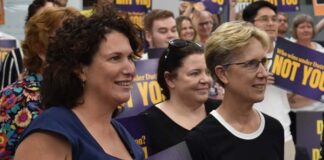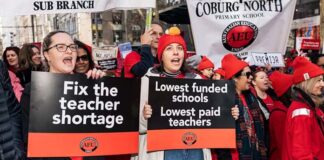

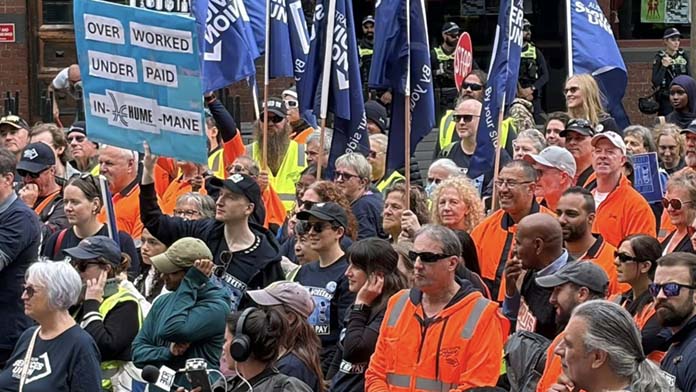
About 2000 union members from across eight metropolitan Melbourne councils took part in a historic strike for fair wages and conditions on 5 May.
The workers, members of the Australian Services Union (ASU), took to the streets on Victoria’s budget day, marching from Trades Hall to Parliament and calling on Premier Jacinta Allan to deliver fair pay or additional funding to local government.
A Town Hall worker from Melbourne City Council told Solidarity, “I think we’re asking for a pretty fair pay rise over the course of four years, especially when we look at some of the salaries of the executive staff in our organisation.”
Workers on strike included city maintenance, waste collectors, library staff, office staff and home care workers.
During the speeches at Trades Hall, Gary, a home support worker with Merri-bek Council for 30 years and an ASU delegate for 15, said, “We give the elderly something that they miss. Most of them are lonely and, without our support, they just wouldn’t survive. We deserve a pay rise.”
Home care and support workers are some of the lowest paid workers across Victorian councils but, shamefully, home care workers with Merri-bek were threatened with pay-docking for striking or bans.
Merri-bek and Hume councils also brought in scab garbage collectors for the day.
Real wage decline
The eight councils that took part in the strike have been negotiating for over 12 months for a multi-employer bargaining (MEB) agreement, the first multi-agreement to cover local government workers across metro-Melbourne.
The MEB seeks to lock in existing employment conditions across all councils under the agreement, improve conditions such as parental leave, gender affirmation leave, dispute resolution and more; in addition to seeking a total pay rise of 22 per cent across four years.
The first-year increase of 10 per cent is seeking to “catch up” council workers’ pay due to inflation, following with 4 per cent for subsequent years.
Dylan, a delegate from Melbourne City Council, told the rally at Parliament that since joining council, pay had gone backwards in real terms.
“Something that cost $1 in 2018 now costs $1.29 due to inflation, but our pay, we were paid $1 in 2019, for each dollar we now earn $1.12. That is a terrible real wage decline and one we will no longer tolerate.”
Speaking to workers from Darebin, Greater Dandenong, Hobsons Bay, Hume, Maribyrnong, Melbourne, Merri-bek and Yarra, Dylan said that the 22 per cent would nearly make up the real wage decline.
Rate cap hammer
Rate capping, introduced in 2016 under the Dan Andrews government, was blamed for the lack of adequate pay rises for council workers.
Dylan said, “Now, anybody who’s been to the bargaining table, and you’ll all have heard it before, anytime we go to bargain in local government, we are told that rate capping is the thing that is constraining our wage growth.
“Over the term of rate capping’s life, it has led to an 8 per cent real funding decline in councils.”
The state government’s rate cap mechanism restricts the maximum amount that local councils can raise rates and municipal charges. The rate cap for 2026-2027 is 2.75 per cent.
A union delegate from Merri-bek told Solidarity, “The rate cap is a hammer used to bludgeon workers and to suppress our wages. The rate cap hasn’t capped CEO salaries, CEO salaries continue to grow well above inflation, well above the rate cap.
“We’ve gotta smash the rate cap or force the state government to cough up more direct funding to local government, so I guess that’s why we are taking a direct confrontation to the state government, they are the ones giving the CEOs the handy excuse. It’s a very convenient political excuse.”
Tash Wark, ASU branch secretary, said it wasn’t acceptable that workers in local government were caught in the middle of councils stating they have no money and state government hiding behind its rate-capping policy.
The rate cap is a weapon aimed at council workers but the focus on raising or breaking it is a mistake. The danger is that union success would lead to much higher rates for working class households already suffering from a cost-of-living crisis—pitting workers against workers.
Instead, unions should be organising further industrial action, demanding greater direct funding from the state government.
A parliamentary inquiry in 2024 acknowledged that councils were under-funded, recommending increases to funding and grant programs, the scrapping of the tax councils pay to deliver immunisation and a 50:50 funding split between the state and councils for libraries and school crossings.
By Dani Amaya