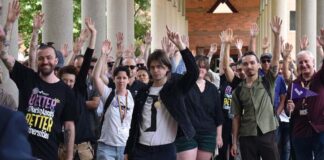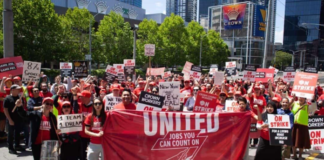

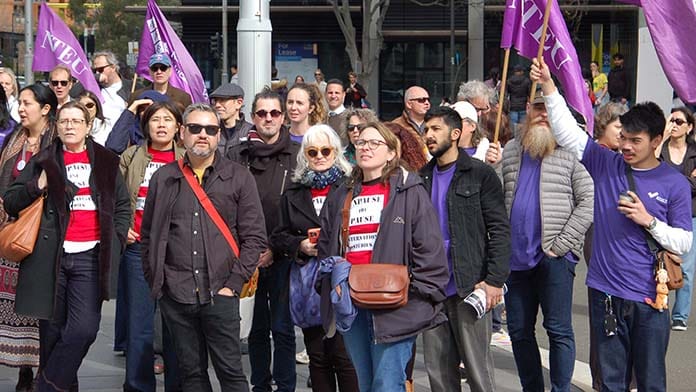
In August, UTS management announced a suspension of new enrolments for more than 100 courses, leaving staff, students and community stakeholders reeling.
As Solidarity goes to press, SafeWork NSW has ordered UTS to pause the release of its “change proposal” once again, due to inadequate planning around psycho-social risk.
The proposal is expected to name 150 academics targeted for redundancy.
The suspended courses and targeted academics undertake valuable public interest teaching and research and must be defended.
Some areas such as Public Health, Education (teacher training) and International Studies have had virtually all course offerings suspended. Others affected include Maths and Physics.
This is the latest move in management’s attempt to implement the “Operational Sustainability Initiative” (OSI), a savage program of job cuts and course cuts.
The initial OSI discussion paper, committing UTS to $100 million in cuts, was released in November, with a follow-up announcement that 150 academic and 250 professional staff would be axed.
A dynamic, member-driven response from the National Tertiary Education Union (NTEU) has seen 200 people join the union this year and meetings opposing OSI routinely attract more than 300.
Management wanted to release its first formal change proposal in June. But the NTEU brought a dispute, arguing UTS had failed to meaningfully consult with staff, as mandated by the enterprise agreement. Management had to pretend its course suspensions were not related to OSI, calling them a “temporary pause”.
The delay has created time and opportunity to build momentum behind a fightback. This also pushed the release of the change proposal closer to a new period of enterprise bargaining—when staff can legally go on strike.
Public interest
The struggle at UTS is over the fundamental question: should universities serve the public good or run on commercial logic?
A freedom of information request by the NTEU revealed that UTS had contracted major consulting firm KPMG at a cost so far of $7.5 million.
The consultants assessed courses and academics based on how much funding each brings into the university and sketched out cuts accordingly. UTS is now ruthlessly implementing these plans.
A statement from Public Health staff, read to an NTEU rally on 19 August by Indigenous academic Jacintha Manton, summed up what’s at stake:
“The core reason for a university is not profit, but to teach, to research and serve society in areas that matter most.
“[Cutting Public Health] sends a message that prevention does not matter, that Indigenous health does not matter, that the passion of our students to make positive change does not matter.”
As Isobel Creely, a lecturer in Education, wrote in The Guardian, “If preparing teachers for NSW during an ongoing teacher shortage is not in the public good, what is?”
Regressive federal government policy has pushed universities down the corporate path. Public investment in tertiary sector research declined from 2.25 per cent of GDP in 2009 to 1.68 per cent in 2022, much less than the OECD average of 2.7 per cent.
We need to fight for more public funding. But university bosses have adopted the ideology of commercial management with gusto and must be fought head-on.
UTS announced OSI in response to Labor’s plans to cut international student numbers. But when the cuts did not materialise, management continued to pursue $100 million in savings to return UTS to budget surplus.
The pursuit of a big surplus is totally arbitrary. Senior managers want discretionary funds to pursue their own priorities and earn a reputation in the corporate world for ruthless commitment to the bottom line.
Union fightback
Fair Work action has held up management’s plans and we should continue to challenge UTS using available clauses. The SafeWork decision also buys more time.
But the arbitration system is rigged in favour of the bosses—it will never challenge their fundamental power to make cuts.
Recent large protests and mass members meetings in response to OSI show the potential power of staff acting collectively.
UTS is now obliged to consult on the future of suspended courses and named staff. We should not cede a single course or job and take every opportunity to mobilise the outrage being felt across campus and the wider community.
We need all staff attending meetings to become union activists—signing up their workmates, organising area meetings to plan the campaign and bringing more people to events.
We need to be ready to strike as soon as bargaining opens and show UTS we will not accept their austerity agenda. The cuts being felt at UTS are happening across the sector. The NTEU needs to co-ordinate action across campuses and fight hard for public-interest teaching and research.
By Paddy Gibson