
In the wake of the Bondi attack, governments are attempting to repress the Palestine movement, with anti-protest laws, federal hate crime laws and plans to ban chants such as “Globalise the Intifada”.
The experience of activists at the University of Melbourne, mobilising hundreds to face down threats of police and academic sanctions, provide a rich example how we can fight repression and continue the fight for Palestine.
Since Israel’s genocide Gaza began, students at UniMelb have campaigned relentlessly to cut the university’s ties to weapons manufacturers complicit in the genocide as well as Israeli universities.
With the emergence of a global student movement of Gaza solidarity encampments, students at UniMelb set up their own encampment in April 2024.
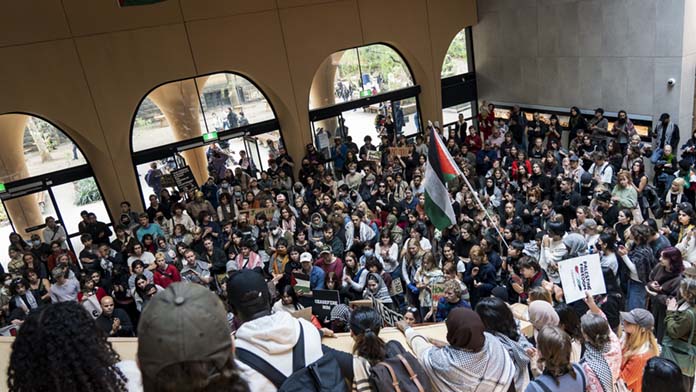
After three weeks, on Nakba Day, students escalated by marching a rally of over 500 people into the Arts West building and renaming it Mahmoud’s Hall, in memory of a prospective Palestinian scholarship student who was killed by an airstrike in Gaza.
Students called on the university to disclose and divest from its ties to weapons manufacturers, determined to stay in the hall until these demands were met.
Within 30 minutes of the sit-in starting, the Deputy Vice-Chancellor came to tell students they had to leave or the police would be called to clear them out. Students willing to defy arrest formed a circle in the middle of the hall.
The National Tertiary Education Union (NTEU) called a snap picket, where dozens of members wearing “Academic Staff” signs guarded every entrance of the hall.
Despite the university threatening to call them, the police never came.
In the following eight days as the sit-in continued, threats of disciplinary action blared through loudspeakers and the hall was littered with copies of the warning in writing. Every day, students would call for a rally to defend the sit-in, mobilising hundreds of students, staff and community members to ward off the university’s threats.
University management then plastered the campus with signs claiming that anyone who wasn’t a student or staff member attending protests could be arrested for trespassing. Staff immediately organised a union meeting and the NTEU called a rally, inviting unions and community members to defy the new trespassing rules, rendering them unenforceable.
The same notices warning of trespassing remain at every entrance on campus today. But we have held countless rallies on campus with outside speakers and not a single arrest has occurred.
After the sit-in ended, the university brought disciplinary action against 19 students and two staff members. In a defiant response, hundreds of students and staff rallied on the day of the misconduct hearings, scaring university management to the point where they tried to change the location of the hearings.
As a result, all participants were given warnings on their academic transcripts, a mere slap on the wrist in comparison to the suspensions and expulsions that the university had threatened. This was a major victory for a movement that united student and staff power to defy repressive measures and threatened the everyday functioning of the university.
In contrast, smaller sit-in attempts have not been as successful in garnering wider support and fighting back repression.
In the following semester, a sit-in with a handful of students was held in the office of the head of the joint PhD program with Hebrew University. Police were called within 30 minutes and issued protesters a move-on order. The university expelled two students and suspended another two. Fortunately, at least one expulsion has been overturned on appeal.
Indoor protest ban
On the first day of the academic year in 2025, the Vice-Chancellor introduced a ban on indoor protest, clearly in response to the sit-ins of 2024 and fearing more militant action on campus.
Some have argued that since Mahmoud’s Hall, defiance is more risky. But the repression has been beaten back whenever it’s been fought with mass action.
Students against War has openly defied the ban on indoor protest twice, with rallies of hundreds of students and staff marching back into Mahmoud’s Hall, confidently calling for more people to join us and come out in defiance of the rule until it’s scrapped.
Despite the university issuing threats during defiance of the indoor protest, nearly a year later it has not penalised anyone.
Despite the ceasefire agreement, Israel is still bombing Gaza and expanding settlements in the West Bank. So long as this genocidal apartheid state exists, the ethnic cleansing of Palestinians will continue.
We must keep up the fight for Palestine everywhere by engaging with broader layers of students and the community and building a movement willing to stand up to repression and ultimately end our universities’ and government’s complicity in the genocide.
By Julie Monteiro