
Tom Orsag tells the story of how union power and solidarity broke WA’s repressive anti-protest laws
Fifty years ago, in November 1976, the Western Australian Liberal Premier Sir Charles Court passed a law banning any public meeting of three or more people without a police permit. This effectively banned street protests, as the police would not issue permits.
The law was an amendment to the Police Act, called Section 54b. Police Minister Bill Hassell argued it ensured maintaining public order.
Only the WA Police Commissioner could now issue a permit if there were a written application for any form of protest. They could put conditions on the approval and there was no right to a court appeal against a police decision.
Almost immediately, there was a public outcry over the banning of protests, including from the WA Labor Party and the WA Trades and Labour Council (WATLC) but there was no political street campaign against it, with the Perth Left outside Labor smaller and less self-confident than in the eastern states.
Court lied to the WATLC to gain their consent when he said the permit system would not be used against unionists holding meetings or protest rallies.
Because of this, the implications of the ban would not be realised until June 1979, when an outdoor union meeting of 200 striking workers at Karatha, in the northern Pilbara region, was held.
Political activists
Court justified the change to the law because, in an era of strikes, protests and demonstrations, he argued “society’s most dangerous enemies” were “political or social activists.”
WA, like the rest of Australia, had protests over conscription during the Vietnam War in the 1960s and environmental activism began in the early 1970s, although on a smaller scale to the east coast.
For example, at the first Moratorium, in May 1970, Perth had 4000 on the streets compared to Melbourne’s 75,000 and Sydney’s 25,000.
Court became Premier in April 1974 and resigned in January 1982 but he was a long-time servant of the WA mining industry.
As Minister for Industrial Development from 1953 to 1971 he became known for developing WA’s mining industry.
That included the WA government paying for the building of a township for the Australian industrial conglomerate CSR for its blue asbestos mine in Wittenoom, northern WA, which would end up poisoning both CSR’s miners and production workers interstate.
Once the federal export ban on iron that had been in place since 1938 was lifted in 1960, Court pushed for building up the iron ore mining industry in the Pilbara.
Court was renowned for being “in and out of boardrooms” of mining companies.
As Premier he wanted to end the new era of unionisation and social protest of the late 1960s and early ’70s, which might impact mining companies’ profits.
Penal Powers
In May 1969, workers around the country went out on strike over the jailing in Melbourne of tram and bus union leader Clarrie O’Shea, under the federal anti-union Penal Powers Act, defying and defeating the law.
In WA, 200 bus drivers walked out, starting the snowballing of a WA state-wide strike in response. Bus and tram workers then held a mass meeting and day-long strike of 1300 members at Leederville.
They were later joined on strike by waterside workers, seafarers and other maritime workers at Fremantle, followed by the whole WA branch of the waterside workers.
About 3000 metalworkers at Medina, holding a meeting over their own local dispute went out for the rest of the day over the Penal Powers.
The WATLC, for only the second time in its history, called out all 85 affiliated unions for a mass strike of 100,000 workers against the Penal Powers.
In the far north of WA, the mines at Mt Newman, Mt Tom Price and Mt Goldsworthy went on strike. They were joined by Australian Workers Union members, despite the opposition of their union leaders.
Between 1963 and 1967, there had been between 25 and 33 strikes each year in Perth alone.
With the smashing of the Penal Powers, the number of strikes in Perth increased to 125 in 1969, rising to 257 in 1974, 306 in 1978, and 436 in 1982.
By 1976, Court wanted to end the rising tide of social unrest for the capitalist class of WA.
Hassell, his Police Minister, portrayed the state government as the victim. “There was never any intention to curtail the right to assemble or to march.
“It was a typical political pile-on: the unions saw the chance to have a go at the Court government and they beat it up mercilessly.”
Shop stewards
The problem for Court and Hassell was when a 10-week long strike erupted in the newly-unionised iron ore industry at Hamersley Iron, involving the 2737 workers in early 1979.
With 200 shop stewards, a tradition of rank-and-file organising and a women’s strike support committee of more than 200, the Hamersley Iron workers would not be forced back to work by the company without a win.
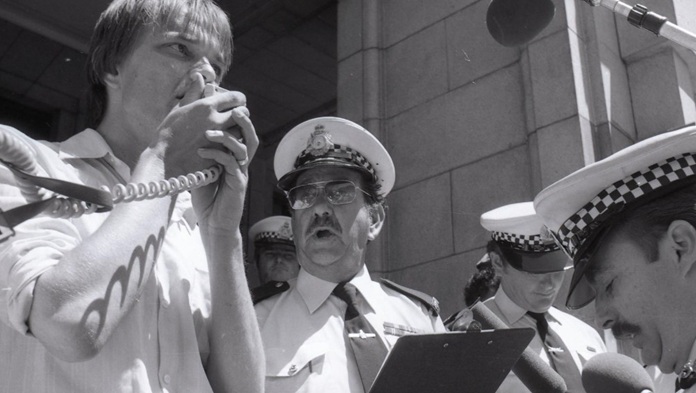
On 11 June, some 200 Hamersley Iron strikers met at Karatha to discuss their claim at an upcoming Industrial Commission compulsory conference.
Court decided the Section 54b law would be enforced against three union leaders who spoke at that open-air meeting.
They were Laurie Carmichael, the national assistant secretary of the metal workers’ union (AMWSU), Jack Marks, the assistant WA state secretary of the AMWSU and Don Bartlem, the convenor of the shop stewards at Hamersley Iron.
Unions had approached the local police twice for permission to hold the meeting but were refused a permit on the grounds that permission could only be granted by the WA Police Commissioner in Perth, 1520 kilometres away.
Local police then warned that the assembled meeting was illegal and took the names of the three officials and others.
Carmichael and Marks were arrested when they got off the plane back in Perth. Their dramatic arrests were contrary to the usual procedure for minor legal charges, receiving a summons in the mail.
Until then there had been many similar union meetings held and the local police had taken no action.
‘General strike’
In response to the arrests, WA unions acted within days.
The Transport Workers Union held a snap strike of 100 members at Perth airport delaying Court’s flight to Israel for three hours.
The issues spread nationwide. The WATLC, the South Australian TLC and the Victorian Trades Hall Council decided to hold a 24-hour protest strike in their respective states on 21 June, the day the cases against the three men were to be heard.
The ACTU, led by Bob Hawke, nominally called a national “general strike” for the same day, only the second in Australia’s history.
But Hawke did so only to head any further rank-and-file initiative, a lesson the ACTU had learned from the June 1976 Medibank general strike, which came about after a mass meeting of delegates in Melbourne had voted for a 24-hour general strike, in opposition to the ACTU leadership.
One Communist Party historian admits that the ACTU didn’t really make it a “national stoppage” but called for “a day of protest”, leaving it “to each individual union to decide what form of action should be taken”.
There were no mass meetings, which might have extended the strike, and no rallies on the day.
The ACTU exempted numerous “essential services” from striking and right-wing unions felt they were free not to strike.
Despite the ACTU’s mealy-mouthed equivocation, a magnificent 890,000 workers nationally went on strike on the day, although this was down from the 1.574 million workers who walked off for the Medibank strike.
The national strike saw the WA police “adjourn the charges” against the union officials. Section 54b was amended by the Court government in September 1979.
Refuse to pay
The changes did not go far enough and Court used the law again against First Nations people protesting at Noonkanbah Aboriginal Reserve over an oil exploration company drilling on their land in August 1980, and union officials supporting them.
Some 30,000 WA workers went out on strike in support of their union officials who were charged, convicted and refused to pay their fines.
When the Brian Burke State Labor Party government was elected in 1983 it amended Section 54b the next year.
In WA now, you still have to apply for a police permit but can now go to a magistrate to appeal a police decision on a permit.
Today, the Victorian state Labor government of Jacinta Allan has promised the Victorian Trades Hall Council that her government’s new anti-protest laws, which are aimed at the pro-Palestine movement, won’t be used against union protests.
Unions should learn from the WA example that promises like this are not to be trusted.
In Western Australia the police commissioner is being given extra powers to ban protests that are “likely to promote hate based on religion, race, ethnicity”. Queensland is introducing bans specifically to ban “Globalise the Intifada” and “From the River to the Sea”.
Union power will be crucial in the fight to scrap the latest repressive attempts to stifle the right to protest.