
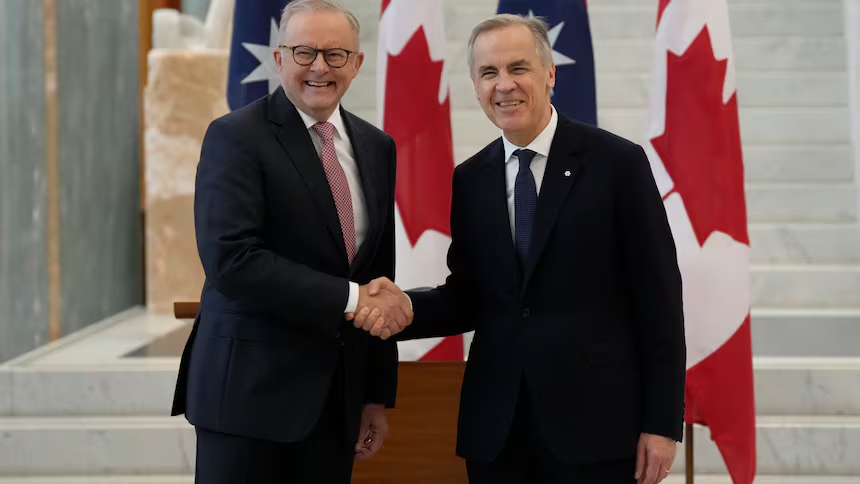
Canadian Prime Minister Mark Carney was greeted with eagerness in Canberra by Australian Prime Minister Anthony Albanese on his official visit to Australia this week.
His presence at the Lowy Institute, an influential centre-right policy institute, was humorously hailed by Australia’s highest-profile capitalists as “the hottest event in Sydney since the Bad Bunny concert on the weekend”.
Defence, critical minerals, and artificial intelligence were the largest priority areas identified by the two leaders, among others that conflicted directly with these goals, such as a clean energy transition.
Both Prime Ministers spoke of a “natural partnership” built on a shared British settler-colonial history, their possession of fully one third of the world’s mineral resources between them and alliances during the World Wars and other international conflicts.
They emphasised the ways that the climate crisis has caused extended fire seasons in opposite hemispheres that now threaten to overlap, complicating the longstanding exchange of firefighters across the two countries. Neither spoke of the ways that their energy policies, which have pushed massive oil, gas, and mining projects on Indigenous lands, have contributed to that very same crisis.
Middle powers
The overt purpose of the trip was to strengthen Canadian and Australian capitalism, during a period where the nation-states cannot rely on their dominant partner, the US, to be a stable ally.
To pursue the goal of strengthening capitalism, the two so-called “middle powers” are pursuing their existing sub-imperialist agendas in their respective geopolitical regions (the Arctic, for Canada, and the Asia-Pacific, for Australia), which means arming themselves accordingly.
Despite having highly unpopular policies and poor polling, Carney and Albanese were elected only days apart on the wave of fresh anti-Trump sentiment in 2025. They rapidly partnered on the Arctic Over-the-Horizon Radar (surveillance) system that Australia developed, to help Canada “defend its territory and assert its sovereignty in the North.”
Since then, both have been accelerating resource extraction and fossil fuel projects at the expense of Indigenous and ecological justice and degrading public services to fund their militarisation.
Both have also provided continuous material and ideological support to the Israeli state during its continued genocide in Gaza, violent ethnic cleansing in the West Bank and East Jerusalem and apartheid on the Palestinian citizens of Israel.
The Prime Ministers are now taking near-identical positions to each other on the US and Israel’s war of aggression on Iran: qualified endorsement. To both governments, the punishment of the repressive and brutal Iranian regime is welcome, but, as Carney has added as a postscript, it is also regrettable. US allies “should have been consulted”.
Carney and Albanese both deflected questions about supporting a war that breaches international law (“that is a question for the United States and Israel, not us”). The ideological alignment of both governments with the US, when it comes to endless justifications of military attacks on Iran, is another reminder that standing up to Trump is a cynically selective rhetorical device.
As Carney said in the press conference that followed his address to the Australian Parliament, “We will always stand by and defend our allies when called upon.”
Fawning
The Australian ruling class, including former Prime Minister Malcolm Turnbull, have fawned over Carney since he was elected. Turnbull has called him “the man for the times,” as well as “a very successful businessman,” which resonates with Turnbull’s own big business-to-politics trajectory before he became Prime Minister in 2015.
He also praised Carney’s knack for “handling tough times,” referring specifically to his roles as Governor of the Banks of Canada and England during the 2008 global financial crisis and Brexit respectively. It is telling that there is little daylight between the ideologies of the right-wing Liberal Party of Australia and the so-called centrist Liberal Party of Canada.
On Carney’s recent visit, he was greeted with a similar enthusiasm by Australian capitalists, while in an extended address to, and conversation with, the centre-right international relations and policy think tank, The Lowy Institute. The Institute’s founder is the former owner of Australian shopping centre giant Westfield, less known for his role as the current Chairman of the Institute for National Security Studies in the Israeli state.
Across all the speeches and the named priority areas (defence, critical minerals, AI), the reverberations of Carney’s Davos speech could be heard: that a collaboration by “middle powers” such as Canada and Australia will be used for the purpose of “countering hegemons and hyperscalers”.
Fittingly, Carney’s visit to Australia followed a whirlwind of international networking in just over two months since the start of the year. It began with a trip to France to meet with the “Coalition of the Willing” (named in cartoonishly bad taste, given its origins) about peace negotiations for Ukraine, followed by a visit to China to meet with the authoritarian President Xi Jinping to discuss “new strategic partnerships,” including an agreement by China to remove tariffs on canola, of which China is the largest importer.
In Qatar, he held trade and security talks with Sheikh Tamim bin Hamad Al Thani, after going on to deliver his now infamous speech at the World Economic Forum in Switzerland. Immediately preceding his trip to Australia, he met with Prime Minister Narendra Modi in India, whose far-right Bharatiya Jarata Party (BJP) is in an intimate, if complex, relationship with the fascist paramilitary Rashtriya Swayamsevak Sangh (RSS).
This meeting followed the recent trilateral agreement on AI and innovation, drawn between Canada, Australia and India. The two leaders discussed how to achieve the nation states’ common goal of “shared prosperity”.
The extent to which other nation-states repress those they rule, as well as the extent to which they are global hegemons, are no barrier to Carney’s mission of strengthening the national economic and military power of the Canadian state.
It is indeed shared prosperity to which they aspire. But it is a shared prosperity exclusively for the capitalists and ruling political classes, the world over, and it comes at a great cost to everyone else.
By Tami Gadir, a member of the International Socialists Canada
Jointly posted by Solidarity and the International Socialists Canada.