
One hundred years on, Jack Stubley looks at the general strike that saw millions of workers paralyse Britain, only to be betrayed by their own union leaders
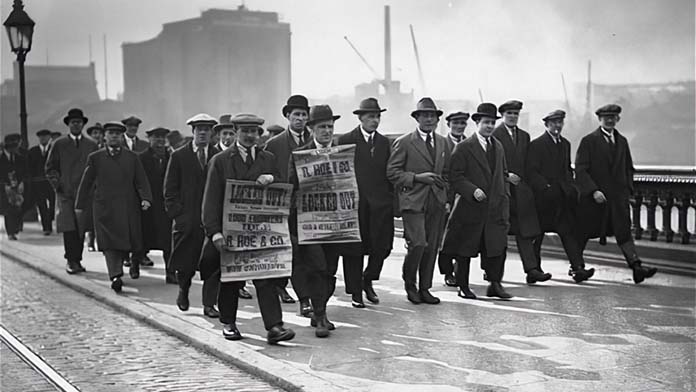
The British General Strike of 1926 lasted nine days—a titanic battle between the bosses and a union movement that had grown in strength over the past two decades.
British workers joined the strike enthusiastically but were badly betrayed by the trade union leaders. Despite the growing influence of the Communist Party of Great Britain, its lack of political clarity about the role of the trade union bureaucracy undermined its ability to spread and deepen the struggle.
The lead up to the strike began in June 1925 when coal mine-owners demanded wage cuts and an increase in working hours. There were more than a million coal miners, the largest single section of the British working class. The British Trade Union Congress (TUC), the equivalent of the ACTU, called a complete coal embargo the day before a planned lockout.
The government stepped in to put the attacks on hold through a nine-month subsidy to the coal industry while a royal commission, the Samuel Commission, examined the situation. This victorious moment was dubbed Red Friday by the press.
Red Friday was a temporary ceasefire. The government immediately began preparing for a major confrontation, stockpiling coal, establishing volunteer groups called “Organisation for the Maintenance of Supplies” (OMS) and dividing the country into ten districts to prepare the deployment of troops, logistics and scabs.
Meanwhile, trade union officials did almost nothing to prepare.
On 10 March 1926 the Samuel Commission unsurprisingly recommended immediate wage cuts alongside future “industrial reorganisation”.
Despite the TUC’s conciliatory tone and efforts to negotiate a compromise, mine-owners were looking for a fight and threatened a lockout if wage cuts were not speedily accepted in full. The government and mine-owners were intransigent. The TUC had no option but to organise a mass defensive action in support of the miners.
However, even after calling a general strike the officials continued to seek negotiations to avoid going ahead with it. It took the government demanding nothing less than complete surrender for the TUC to begin the strike.
The Prime Minister had insisted, in response to print workers refusing to print a lead article in the Daily Mail, that union leaders had to repudiate all plans for strike action and accept the terms of the Samuel Commission report completely for negotiations to resume.
Even after being forced to fight, the TUC was reluctant to call all-out action. They spoke instead of a “national strike”, planning to gradually call out various waves of workers one section at a time in the hope that this would encourage the government to negotiate.
This both weakened the strike and confused matters, with the workers who were meant to be on strike in a given area or workplace often unclear on their role.
The government was far more prepared and far more determined. Public parks were used as supply dumps, OMS volunteers were made special constables and battalions of troops and two battleships were stationed in Liverpool.
Despite this, workers responded to the strike with enthusiasm, understanding that the miners’ defeat would result in an assault on their own pay and conditions.
Two million workers joined the strike in its first eight days, in addition to one million locked-out mine workers. Many local union branches created Councils of Action for collaboration between different sections of the labour movement.
Actions repeatedly broke through official hesitancy at the local level, as mass meetings, local strike bulletins and picketing were organised. Workers Defence Corps were formed to fend off police attacks and prevent scabbing, eliminating the police presence in some areas.
The TUC’s leadership was abysmal. They discouraged physical confrontation with strike-breakers through picketing and encouraged friendly relations with the police. The TUC General Council’s strike organising committee, led by a “left” official, was primarily concerned with stopping local initiatives, including censoring bulletins from using overly radical language.
As the general strike continued more workers joined in. The day before the strike was called off hundreds of thousands of metalworkers and ship-building workers went out on strike for the first time.
On the strike’s fifth day union officials were again negotiating with mine-owners and the government for an agreement on the basis of the Samuel Commission. After nine days the strike was called off, leaving the miners to fight on for three months before accepting defeat.
Officials accepted wage cuts in the mines without any guarantees stopping retaliation against strikers, and without so much as a whimper of resistance from the left officials (except the miners’ union itself).
Their excuse was that the strike was faltering and faced collapse. Yet enthusiasm was still running high with another 100,000 workers coming out on strike a day after it was officially called off.
Important lessons
There are a number of important lessons from the strike. First, it showed the timidity of the union officials and their reluctance to organise the powerful strike action needed.
During the strike the senior union officials, grouped together in the TUC, desperately sought to appeal for negotiations with the bosses and the government, rather than organising the strike.
Union officials knew that the longer the strike continued, the more their leadership of the strike would be called into question as it clashed with initiatives from below. This made them anxious to hold back the strike and end it as quickly as possible.
This behaviour is a result of the position of union officials as a unique layer in society. They are professional negotiators between workers and capitalists. This makes them responsible for cultivating relationships and honouring agreements with bosses, which has a conservatising effect on them.
Their control of a bureaucratic apparatus of union staff and assets that they are anxious to protect means they often come to see strike action as something to be avoided. They are concerned with a mix of retaining their credibility, control of the union and see workers’ strength primarily as a bargaining chip for negotiations.
Secondly, the strike showed that despite the existence of a sizeable militant left-wing inside the union movement, with the Communist Party wielding influence over a significant section of the working class, it lacked the political clarity necessary to challenge the union officials and carry the struggle forward.
The Communist Party had been founded only a few years earlier but it had the authority of the still recent Russian revolution of 1917 behind it. The party had about 6000 members, with 1000 of them organised into workplace branches.
In the lead up to the strike the Communist Party raised demands for grassroots organisations like factory committees, stronger Trades Councils and Councils of Action. Roughly a quarter of the Communist membership was arrested in this period for their political activity. The entirety of the top leadership was arrested and tried for sedition with sentences ranging between six to 12 months.
In 1924 the party had launched the National Minority Movement, an effort to bring together militants within the unions that aimed at “making the trade unions into real militant organs in the class struggle”. It was launched by delegates representing 200,000 union members and by early 1926 had affiliations from bodies claiming to represent 950,000 members, with supporters in senior positions in several unions.
But the Communist Party was severely hampered by its illusions in the TUC General Council and specifically the left officials’ abilities and willingness to lead the fight.
Radical posturing
The union officials readily used radical rhetoric to conceal their lack of serious organisation. Even the most left-wing union leaders like the miners’ union’s AJ Cook were unwilling to criticise the TUC’s shortcomings during the strike and appeal to rank-and-file unionists in other unions over the heads of their leaders, because they were too concerned with maintaining their relationship with the other union leaders.
The Communist Party relinquished leadership to the General Council of the TUC during the general strike and encouraged illusions that they were willing to lead a serious struggle, their main slogan being “All Power to the General Council”. The Communists’ paper, Workers Weekly, uncritically celebrated the radical talk of the union officials at the Trades Union Congress in September 1925.
Instead of a steady diet of unrelenting and plainly worded warnings and criticisms about the union officials’ lacklustre preparations during the nine-month build-up, Communist papers fawned over their radical posturing.
This was largely due to the Communist Party’s financial and ideological reliance on the Communist International, run by the Soviet Union now under control of Stalin. By 1924, Stalin was ditching the revolutionary principles of the 1917 revolution and was pursuing a policy of “socialism in one country”.
Stalin was more interested in maintaining alliances with left-wing British union officials in the hope that they would defend Russian interests when needed.
According to Stalin, the Anglo-Russian Committee supported by British trade union leaders was engaged “in organising a wide working class movement against new imperialist wars in general, and against intervention into [Russia]”.
This led to a confused perspective by the British Communists, seeing the key division within trade unions as being between left and right wing officials rather than between officials and the rank-and-file. It encouraged the illusion that the left-wing officials would break with the right-wing officials and lead serious struggles.
The only guarantee of unions’ abilities to seriously wage struggles is the strength and confidence of the rank-and-file, organised independently of the union officials.
The Communist Party’s confusion meant it was not ready or willing to mount a challenge to the union officials when they inevitably faltered and offer the working class an alternative leadership. This remains an important lesson for how socialists should organise in the trade unions today.