
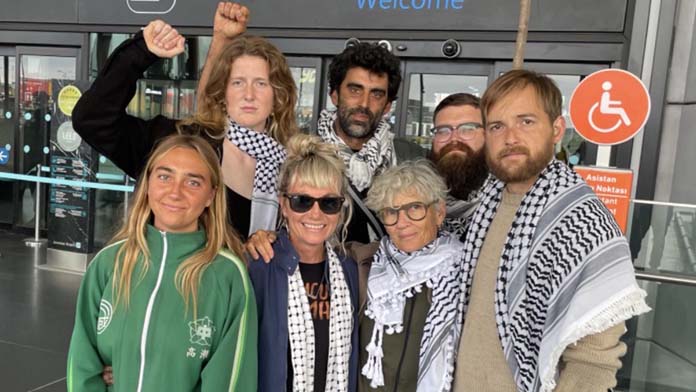
Solidarity spoke to Zack Schofield, who has just returned after being captured by Israel on the Global Sumud Flotilla
The Global Summit Flotilla’s aim of getting food through the illegal Israeli naval blockade of Gaza is a material contribution to the lives of Palestinians in Gaza.
Israel completely controls what goods get into the Gaza Strip. Since 2007 they’ve completely decimated the standards of living of people in the territory.
The attempt to directly contest Israeli occupation is valuable because resistance to the genocide is required to show the world what a reasonable response is. Our governments continue to support and fund the genocide. Australia considers Israel an ally. We still give them weapons parts. So it’s up to civilians to do what is right.
I was intercepted west of Crete for the first time, over 1000 kilometres away from territorial waters that Israel has any claim to.
The violence that we experienced there was shocking but it was nothing compared to the violence during the second interception and during Israeli custody.
Interception
I was on a boat called the Marilyn. We were one of the first to get intercepted that second time around. We were treated with less brutality than people who were intercepted later. I was threatened with a stun gun by a commando that boarded our boat. We had weapons pointed at us and one of the commanders shot a security camera that was mounted just above our heads.
There were two prison boats. People who were intercepted later, particularly those loaded onto the other prison boat, they were shot at point blank range with beanbag rounds.
I remember the shells that were ejected because I picked up one of them on the prison boat, an LAPD Super-Sock round from a 12-gauge shotgun. People were zapped with stun guns in the face or the neck, they were beaten in a processing tent by a number of armed guards.
Juliet Lamont recounts being forced to lie flat on the ground, face down with her hands zip-tied behind her back as they washed the floor with seawater, a crude form of waterboarding. People recount being shot at completely randomly during the course of the days they were on there, having flash bangs thrown into crowds randomly.
There are stories of sexual assault and rape that come mostly from that boat. Isla Lamont recounts being injected with an unknown substance.
Israeli prison
Once we got onto shore, the treatment became more systematically violent and designed to humiliate us, being forced to sit in stress positions for extended periods while [Israeli government Minister] Ben-Gvir took a tour of the facilities.
People were moved around the site with their heads always held down, with pressure points being applied, with our hands zip-tied behind our backs and being moved around by raising our arms to the point of dislocation.
[Australian activists] Surya McEwen, Sam Watson and Juliet Lamont all had to attend hospital for broken bones. Neve O’Connor experienced a very serious concussion, as did Surya.
Ben-Gvir is a perfect representative of Israeli policy, the glee that he finds in brutality and the humiliation of people he considers Israel’s enemies cuts through the claims that Israel tries so hard to hang on to that they are a moral society.
But I think that politicians like Ben Gvir show the world the attitude of the people that are in control of the state of Israel. This is a problem for Israel’s hasbara [propaganda] operation and it’s why he was so swiftly condemned by Netanyahu and other members of the government.
The footage that he put out barely touches on the violence that we received and certainly is far less severe than the violence from Israel’s genocide over the last three years.
I think public opinion is shifting. I have no love for the New York Times, but it’s important that it has felt it necessary to publish an exposé, based on the work and testimonies from Palestinians, showing that there’s evidence of systematic rape and sexual abuse in Israeli prisons and that they’re willing to publish it and then face the lawsuits that Netanyahu said that he’s going to bring.
I think the best thing that the flotilla has done is to demonstrate to people around the world that we can take action into our own hands. The question that it does pose to all of us, I think, is what are you going to do?
It doesn’t have to be getting on a boat in the Mediterranean.
It means thinking about what can be done at home as well. I went on the flotilla because I was inspired by the actions of people in the previous flotilla. And I really hope that what we’ve done will inspire further action in the future.