

Victoria faces the terrifying prospect of One Nation in government after November’s state election. One Nation could either win the most seats itself or do well enough that the Liberals need their support to form government.
One Nation was on 27 per cent, ahead of Labor and the Liberals both on 26 per cent of the vote in a Redbridge poll published in early July.
Labor has been in power in Victoria for 12 years and faces accumulated bitterness about COVID-era lockdowns, corruption scandals and the cost-of-living crisis.
The Liberals and Nationals are also likely to lose seats to One Nation, especially in regional areas, which could make it harder for them to win government in their own right.
Premier Jacinta Allan has seized on this, warning of the risk of a “One Nation-led government” and arguing the Liberals won’t be able to govern without their support.
But One Nation’s surge is no longer simply a matter of Liberal and National voters moving further to the right. Allan has admitted the party “is taking a slice out of the Labor vote as well”.
But rather than challenge Pauline Hanson’s racism, Labor will only attack her support for cuts and anti-worker policies. Allan has called One Nation “a risk to working people and families”.
The union movement has adopted the same approach.
Victorian Trades Hall Secretary Luke Hilakari told The Age, “I’m looking at numbers that it could be 30 seats” for One Nation. Trades Hall is ramping up an electoral campaign to target the party, with Hilakari saying, “We’re running against Pauline Hanson.”
In March, following One Nation’s gains in the South Australian election, Trades Hall prepared a briefing paper Antidote arguing that unions had a “vital role” in taking on One Nation and that, “The far-right’s path to power leads through workers and their communities. Only unions can defeat them on that terrain.”
Trades Hall is running events on “How to persuade One Nation leaning voters” and has titled its state election campaign launch “United against One Nation”.
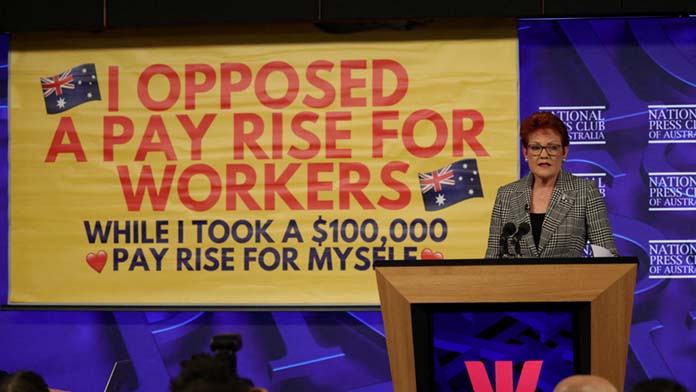
Pauline Hanson has consistently voted against protecting workers’ rights. At the National Press Club she said businesses needed more rights to sack people, declaring workers “are lazy and businesses are tired of it”, and stood by her opposition to minimum wage increases.
She also called for cuts to health and education spending, opposed pay increases for childcare workers and questioned whether women need paid parental leave.
Unions have seized on these comments, pushing out clips from her speech across social media.
But they are ignoring her opposition to immigration, at most gently defending multiculturalism against Hanson’s call for a “monoculture”.
Victorian Labor’s approach mirrors Anthony Albanese’s effort to deal with One Nation at a federal level. GetUp is doing the same—dropping a banner during Hanson’s Press Club speech highlighting her support for wage cuts but not her racism.
It’s right to expose One Nation’s anti-worker politics. But Labor is pushing anti-worker policies itself—refusing above inflation pay rises to teachers, council workers and health workers in Victoria and presiding over the cost-of-living crisis.
Workers who are fed up and looking for a protest vote won’t come back to Labor.
Some in The Greens share a similar approach. Former Greens MP Max Chandler-Mather has argued that “attacking One Nation can be counterproductive and sometimes only serves to reinforce them as outsiders to the political system”.
The left should instead focus on the anger about cost of living, housing and privatisation that is driving One Nation’s support through “connecting with, and properly understanding peoples’ material circumstances”, he says.
Combating racism
Just abusing someone who’s considering voting for One Nation, or sneering at them as stupid, won’t win anyone over.
But focusing on economic concerns alone won’t be enough to undermine the party. It’s the combination of racism and anger at the cost of living that is powering their surge.
The far right globally from Donald Trump to Reform UK is riding a wave of racism, scapegoating refugees and immigrants for the failures of the system.
Pauline Hanson’s rise in the polls began following the anti-immigration March for Australia rallies last year and was reinforced by the Islamophobia and smears against the Palestine movement following the antisemitic Bondi attack in December.
Anyone willing to support One Nation as a protest against the political system will be well aware of the party’s racism. Many back them because of Hanson’s anti-immigration stand—with 35 per cent of all voters saying One Nation is the party best able to handle immigration, the highest of any party.
To drive back One Nation we need to build a left that fights both over the cost of living and stands up to racism.
By James Supple