

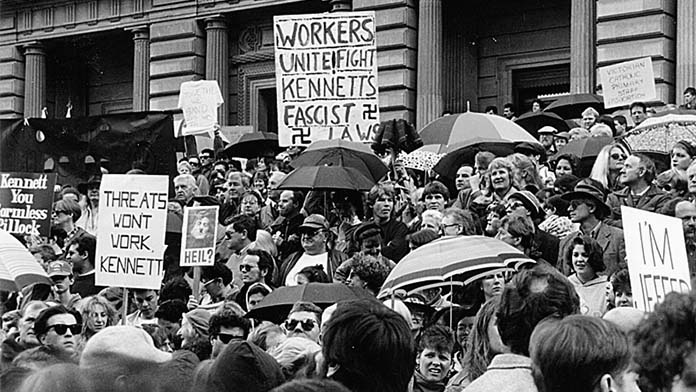
David Glanz explains how the onslaught of cuts from the newly elected Liberal government in Victoria in 1992 provoked mass strike action
Workers angry about falling living standards, cuts to social spending, rising state debt and unemployment, a largely unknown Liberal Opposition leader, a stopgap Labor Premier leading an unpopular state ALP government facing a wipe-out.
It sounds very much like Victoria today as voters prepare to go to the polls on 28 November. But this was the situation in Victoria in October 1992.
The Liberals won in a landslide in the election on 3 October. Labor lost 19 seats, with the Coalition led by Jeff Kennett establishing a commanding majority of 61 to 27.
On the face of it, Victorian workers had lurched to the right, giving Kennett a clear mandate. But just a month later, 800,000 workers joined a political strike against the Liberals.
Many workers who had voted Liberal had intended it to be a protest vote, not expecting the Liberals to win. Other workers voted Liberal out of their anger with Labor, thinking things couldn’t get worse.
Within weeks, Kennett had launched massive attacks on the education system and workers’ rights. Things were getting worse. He immediately faced blowback.
It’s an important lesson as Labor faces armaggedon on 28 November, this time at the hands of not just the Liberals but possibly One Nation.
Workers who are conned at the ballot box can be part of the fightback. What happens after an election, in the workplaces and on the streets, can prove decisive.
Blizzard of attacks
On 10 November 1992, the Victorian working class struck and came out on to the streets in numbers that shocked everyone, including union leaders, the media, the ruling class and workers themselves.
Perhaps 150,000 workers clogged central Melbourne. Tens of thousands also took to the streets across regional Victoria. Statewide, there were 800,000 on strike.
The demonstration was the biggest in decades, mobilising far beyond traditionally militant unions in manufacturing, the waterfront and construction. Members of the shop assistants’ union, the SDA, marched in considerable numbers. Journalists at Murdoch’s Herald Sun struck, as did federal and state public servants.
The mass strike, called by a Trades Hall mass meeting of 4000 delegates and shop stewards, was a response to a blizzard of attacks launched by Kennett. According to the Herald Sun, Kennett’s government passed 34 bills in 12 sitting days:
Dozens of government schools were closed immediately, with the final toll reaching more than 350, with the loss of 7000 teaching jobs
New employment contracts were brought in which outlawed penalty rates, leave loading and picket lines
Tens of thousands of public servants were sacked
Water, electricity and gas were privatised
Public transport came under attack, with tram conductors scrapped
The government imposed a $100 tax on households.
Conventional wisdom
According to conventional wisdom, Kennett’s victory indicated a shift to the right in Victorian politics and a popular acceptance that something had to be done to curtail the state’s debt in the midst of the recession of the early 1990s.
In practice, his win was a result of a working class revolt at the ballot box against the austerity measures implemented by the previous Labor Premiers John Cain and Joan Kirner, which led to the axing of 31,000 jobs in three years and the sale of the State Bank of Victoria.
As the recession bit, Kirner put 2200 state government properties up for sale and contracted out services. Her government cut funding for community groups like the Public Tenants Union and the Aboriginal Advancement League. $105 million was cut from education in 1990 and $125 million the following year.
Kennett benefited from workers’ outrage with Kirner over her cutbacks. But as soon as he gained office he launched a blitzkrieg against the working class.
Rather than achieving a quick knockout, his attacks provoked the return of the mass strike for the first time in two decades. Many in the ruling class panicked.
The nervousness was reflected in The Age the next day. “Yesterday’s strike and rally has energised and empowered his real opposition [the unions] … Mr Kennett should back off and keep his eye on the substance of change rather than the form.”
Kennett and his Treasurer, Alan Stockdale, were class warriors in the mould of Britain’s Margaret Thatcher. Within days they had harangued The Age into a backflip. On 17 November it editorialised, “If it comes to the crunch … then the Government must prevail.”
For most workers, 10 November was the beginning of the fightback. People began to organise—occupying schools in Richmond, Northland and Fitzroy that were slated to close in December, protesting the planned closure of the Upfield and Williamstown rail lines.
The argument to many workers seemed straightforward: widen the strike action (including shutting down the power stations in the Latrobe Valley, which were exempted from the 10 November strike), and cripple the new government.
Union strategy
The union leadership saw it differently. Trades Hall was led by John Halfpenny, a former Communist Party metalworker, by then on the left of the ALP. He understood the need to make fiery speeches to put himself at the head of the movement. But he also began reminding workers that it would be “a long fight”—code for waiting for the next election.
The immediate outcome was to undermine the ACTU’s national day of action against Kennett on 30 November. Workers in many parts of the country walked out on strike—in Brisbane, 5000 attended a mass meeting, with thousands more gathering in Rockhampton, Mackay and Townsville.
But in Melbourne, there was no central rally. Strikers, including construction workers, metalworkers and public servants, marched separately, in some cases just city blocks apart. The unity and sense of power that workers had experienced on 10 November was beginning to be squandered.
The struggles drifted apart. Victorian public transport workers, wharfies, health workers, nurses, teachers and state public servants all took strike action. But the sense of one big fight was lacking. Trades Hall called off a strike in the power industry on 9 December and declared a “Christmas truce”.
Numbers at a mass delegates meeting in Melbourne in February dipped to 2000. As The Socialist, a forerunner of Solidarity, reported at the time, “The willingness to fight was still there. Not one delegate spoke against action … But the mood was sober.”
In a major warning sign, the tram workers’ union held a mass meeting on the same day and accepted a shoddy deal, trading away conductors’ jobs for minor concessions.
The mass delegates meeting did endorse a mass stoppage on 1 March and 80,000 marched. By “normal” standards, it was a magnificent turnout. But in the context of the previous November it represented a clear decline and everyone knew it.
There were no more mass rallies and, with Kennett looking powerful, even the sectional battles wound down. It was left to the occupiers of the three schools to carry the banner of struggle.
The legacy
Looking back, Kennett told the Herald Sun that his government won by attacking on several fronts at once. “The beauty of that strategy was that after the initial flurry of protests from those who were most affected, everyone started protecting their own area of interest. So we split the opponents.”
But this outcome was far from inevitable. The key problem was the politics of the union leadership and the layer of worker activists who looked to them. As The Socialist put it in February 1993, “Why is the union leadership so half-hearted? … Part of the answer lies in the nature of the trade union bureaucracy …
“Their central concern is to retain their position as negotiators. As Halfpenny said at the delegates meeting, the fault with the Tramways Union was not talking to the Liberals but failing to consult Trades Hall about the deal.
“The other part of the answer lies in the officials’ belief that political change comes only through ALP governments. Behind the fighting rhetoric, the message from senior Victorian officials is that will take four years to beat Kennett—in other words, until the next state election. The union officials hold back the struggle because they think it cannot win.”
In addition, the union officials and the left of the ALP did not know how to respond to the fear whipped up about the state’s debt. Instead of arguing that workers shouldn’t pay for the bosses’ financial crisis, they quietly accepted that sacrifices had to be made, legitimising Kennett’s cutback agenda.
Kennett survived until 1999, doing enormous damage to working class living standards and services.
The strikes of 1992 and 1993 did not stop him but they did have a lasting impact in two respects. One was a sharp shift to the left among union officialdom. Reform tickets won in unions including those covering electricians, textile workers, firefighters, food workers and metalworkers.
The other was to resurrect the practice of mass mobilisations and political strikes, particularly in Melbourne. The spontaneous walk-offs in support of East Timor in 1999, the S11 anti-capitalist protests of 2000, the massive march against war in Iraq in 2003 and the succession of huge rallies against the Workplace Relations Act and then WorkChoices owed a debt of gratitude to 10 November 1992.
Today, in the face of a coming Liberal win in Victoria we can draw three key lessons from 1992.
The first is the need to unite the separate struggles when they break out. When industrial resistance becomes general, it creates a political crisis for our rulers.
The second is to take on the political arguments that the Liberals and the media are already raising about rising state debt justifying the need for sackings and cuts.
And the third is to build a fighting socialist party that can provide an alternative political leadership within the workers’ movement when union officials fail to do the right thing. The fightback against Kennett had the power to stop the government’s attacks. Struggle is the way to stop the Liberals and One Nation this time as well.