

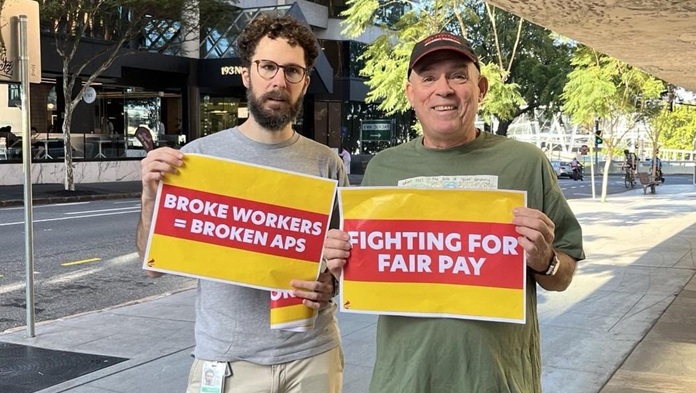
Bargaining has started in the Australian Public Service (APS) agencies covered by the Community and Public Sector Union (CPSU).
Union members in the ACT Public Service have already shown the way, rejecting a lousy 3 per cent offer in an all-staff vote in September. An enormous 63 per cent of workers voted No in a record 51 per cent staff turnout.
CPSU campaigned on socials against the offer and will now organise protected industrial action to win a better outcome.
In the main agencies of the APS, bargaining is conducted service-wide across the federal public service. CPSU members expect an offer in October. Some agencies which opted out of the service-wide claim have been offered 3 per cent per year over three years.
The CPSU has a modest claim for a pay rise matching cost of living or 5 per cent per year (whichever is greater), for three years.
One CPSU delegate said, “The last round of bargaining left us way behind inflation with an 11.2 per cent pay rise over three years, plus a 0.92 per cent sign-on bonus. It fell well short of the union’s claim of 20 per cent.
“Members voted 67.5 per cent in favour with 32.5 per cent against in the third union indicative poll, demonstrating significant dissatisfaction despite a recommendation by the union officials.”
Despite the government’s recent agreement to bargain service-wide for pay and core conditions, the framework for enterprise bargaining in the APS remains broken. Years of agency-based bargaining have left huge divergences of pay rates and conditions between the agencies.
Fighting for a strong Part A demand allows CPSU members and non-members to unite across the service and reject this divide-and-rule game. Part A applies APS-wide while agencies are also able to bargain for additional local improvements, known as Part B.
Public Service Minister Katy Gallagher will be watching closely and has already told The Mandarin, “5 per cent a year would be ‘impossible’.”
Real wages
With inflation still over 3.5 per cent, CPSU members would say we need at least 3.5 per cent plus what we lost last time. The OECD reports that average real wages in Australia have fallen by 5 per cent since 2021.
Many questions about how to beat inflation have arisen with reference to public servants’ responsibilities. Some have asked, “Can we reduce inflation by accepting a low pay rise?”
Current inflation stems from price-gouging and profiteering after the pandemic as well as the impact of the US and Israel war against Iran.
Our employer is under severe pressure to cut government spending. That can only mean cutting the costs of services and the staff who provide those services. Already there have been severe cuts threatened for the NDIA and NDIS, as well as Aged Care.
At the same time the huge military budget is growing, especially the AUKUS spend of $368 billion on nuclear-powered submarines.
Our employer clearly wants us to pay for this budget outcome. In a cost-of-living crisis we must say No!
Collective action our power
We can increase our economic security by creating stronger collective power through union organisation. But we must confront these issues way before the government digs in against our claim.
Members should consider any offer collectively, not as individuals via surveys. In the past, public service-wide bargaining was directed by in-person, city-wide mass meetings. But today members are playing almost no role and even delegates are often reduced to attending virtual “updates”.
This top-down approach undermines the campaign and saps confidence that workers can decide their campaign tactics. Whereas the important truth is that the power for any dispute outcome is determined by the collective industrial effort of members.
Without industrial action, we have no leverage against an employer intent on making public servants pay for service cuts.
We cannot legally take industrial action until after 28 February when the current enterprise agreement expires. However, there are no laws against planning for action against a subpar offer so that we are ready to use the best weapons we can when the time comes.
Greg Brown, a Members United activist in Magadjin (Brisbane), told Solidarity, “A lot of effort is being put into organising the wages campaign, and that’s great. We can win increases that protect us against the cost of living. But a change of tack is needed to avoid the appalling outcome we saw last time.”
“Mass recruitment and effective industrial action is critical for a union win. Australian workers did it in the post-war period. There was 80 to 90 per cent union density in APS workplaces when I first started. So, it’s possible, and we can do it now if there’s a change in direction.”
To contact Members United and help build a campaign for a cost-of-living pay rise, ring Hannah Dale on 0466 096 690.
By Judy McVey, CPSU member
Talk to union friends and colleagues, and discuss these motions in your next meeting:
CPSU delegate and Members United activist Hannah Dale is promoting this model motion (amend and use as appropriate):
This meeting of CPSU members at [agency] commits to taking a stand against the cost-of-living crisis by fighting for nothing less than the CPSU’s claim in full. In doing so, this meeting:
- rejects any and all notions that winning the claim is in any way oppositional to the good functioning of the public service. By virtue of simply being CPSU members, we understand our role as stewards of the public service better than any other party
- understands that in order to win members must encourage each other to build their union and contribute to the fight, whether that fight be in the members own agency or across the APS
- recognises the immense opportunity that service-wide bargaining presents to demonstrate worker power and that preparations must be made for agencies across the APS to coordinate their protected industrial actions, once the agreement expires
- and calls on the executive of the union to accept rank-and-file workers as the true centre of power of the union and commit to city-wide, in-person mass members’ meetings to allow for open consideration and debate of any offer put forward by the government.