
Twelve years before the Nakba that founded the Israeli state in 1948, Palestine rose in revolt against British colonial control and growing Zionist domination.
From 1936 to 1939, workers went on strike and, alongside fellahin (peasant farmers), took up arms for national liberation.
It was a threat to the British Empire, which sought control of the region to pillage its oil reserves and to safeguard shipping routes to India, the jewel in the imperial crown.
And it challenged the expansion of the Zionist colonial settler movement.
The story is told magnificently in Palestine 1936, a film by Annemarie Jacir, a Palestinian born in Bethlehem and a founding member of the Palestinian Filmmakers Collective.
The film had its world premiere in Toronto to a 20-minute standing ovation. Israel banned a showing in Jerusalem.
Jacir intersperses the narrative with (colourised) historical footage that shows us Palestine as it was then—the vibrant street life, the influx of European Jewish settlers and the eruption of the revolt.
Tellingly, she finishes the film with footage of a mass Palestinian demonstration through the streets of Jerusalem. The message is clear—the 1936 revolt is not a history lesson but part of a living tradition of struggle.
Indeed, the continuity between the racist, domineering behaviour of the British then and Israel today are stark—the all-pervading racism, the illegal seizure of farmland, the ruthless military domination, the rejection of elementary civil liberties.
An unhinged British officer, Orde Wingate (played by Robert Aramayo), personifies British colonial cruelty throughout the film. Wingate was a historical figure, a fervent Christian Zionist with an impeccably imperialist background.
Jacir portrays the British rather than the Zionists as the dominant force against Palestinian resistance. But in the background, we see Jewish migrants erecting armed enclaves and watch towers as their settlements spread across Palestinian land, a process that continues today across the West Bank.
The key character, Yusuf (played by Karim Daoud Anaya), lives in a village near Jerusalem and commutes into the city to work for a wealthy Palestinian family, his story weaving together urban and rural Palestinian life.
The struggle in the cities pulls at traditional relationships, with the wife (played by Yasmine Al Massari) and husband (Dhafer L’Abidine) that Yusuf works for taking very different political paths. In the village, the resistance is part of everyday life—supporting guerrillas in the hills and confronting soldiers as they menace the community.
Stockpiling guns
The film follows the course of events chronologically, as British control and support for Zionist settlers push Palestinians to revolt.
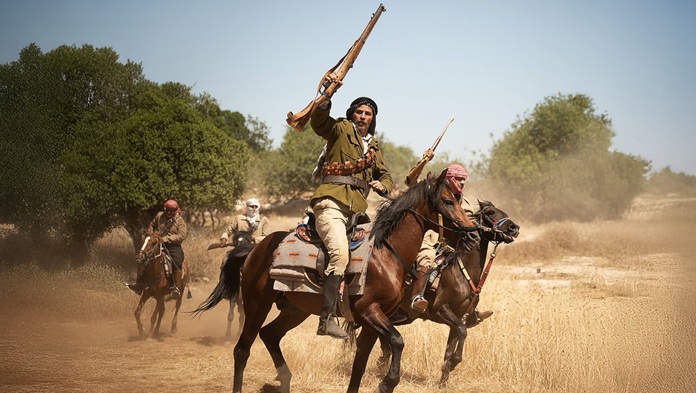
We see workers organising their strike and villagers stockpiling guns. In the countryside, Palestinians on horseback roam the hills, ambushing the British and blowing up railway lines.
The Arab Higher Committee of wealthy notables called off the revolt after six months. But the next year, 1937, the Peel Commission established by the British decides that Palestine is to be divided into Arab and Jewish statelets, with 200,000 Palestinians to be uprooted in the process. Revolt flares again.
Jacir shows how Palestine in 1936 was divided by class, with wealthy Palestinian landowners seeing Zionist immigration as an opportunity to cash in. Meanwhile the British inform the fellahin that generations of tilling the soil and shaping the hillside terraces is not proof of ownership, meaning Jewish settlers can seize land almost at will.
Jacir also shows how Muslim and Christian Palestinians lived and fought side by side. It’s clear that the revolt is not a battle over religion but a national liberation struggle against the imperial power, the British, and their sponsored settler-colonialists, the Zionists. Armed resistance was justified then, as it is today.
If there is one criticism of the film, it’s that it packs so much in that those new to the story are likely to miss the implication of some of the points being made or be unaware of the context.
For instance, the historical footage shows Jewish migrants from Eastern Europe pouring off ships. But we’re not told that by 1936, the US had all but closed its borders to Jewish refugees fleeing the Nazis, as had Britain and Australia.
The antisemitic prejudices of Western governments and their concern to control the Middle East funnelled sometimes unwilling Jewish refugees towards Palestine.
But these are minor quibbles. Palestine 1936 is a compelling film that will help inform a new generation of activists.
Palestinian resistance did not start on 7 October 2023. And it began well before 1936. But the story of that revolt illuminates and informs the struggle today.
See the film. And if you didn’t hate the British Empire and imperialism before you go in, you sure as well will on the way out.
By David Glanz
Palestine 1936 is playing at independent cinemas nationwide.