
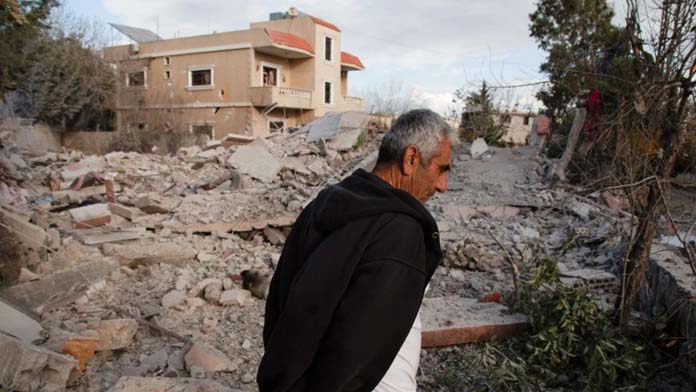
Israel is threatening to widen its war into Lebanon, trading rocket attacks over the border with Hezbollah. By the end of December it had killed around 120 people, including at least 20 civilians.
Israel has illegally used white phosphorous on at least four occasions including in a strike against the town of Dhayra that Amnesty International labelled “indiscriminate” and said “must be investigated as a war crime”.
Two Lebanese-Australian men died in December when Israel bombed their house in the town of Bint Jbeil. In a further escalation in early January, Israel bombed a Hezbollah office in Beirut, killing senior Hamas leader Saleh Arouri.
Hezbollah is right to oppose Israel and the genocide it is inflicting on Gaza. Israel is a ruthless expansionist power that has invaded Lebanon several times.
The Australian government has hypocritically declared Hezbollah a terrorist organisation. But it is Israel that is waging a campaign of terror against the whole civilian population of Gaza—and threatening to spread this into Lebanon as well.
Israel’s invasion of Lebanon in 1982 killed an estimated 18,000 people, as it laid siege to the capital Beirut and indiscriminately bombed civilian areas.
It aimed to crush Palestinian Liberation Organisation (PLO) fighters who were allied with left-wing groups in Lebanon’s civil war, and to install the Christian Phalange leader Bashir Gemayel in power.
Israel continued to occupy southern Lebanon for the next 18 years in order to create a “buffer zone” on its northern border.
Hezbollah was formed as an armed resistance movement against the Israeli occupation, based among the country’s impoverished Shia Muslim population and inspired by Iran’s Islamic revolution.
Its courageous resistance and its network of health and welfare services brought it mass support.
Israel responded by assassinating its leaders and targeting villages where it gained support. In 1996 it bombed a UN compound in the village of Qana, killing over 100 refugees.
Hezbollah fighters succeeded in driving Israel out of southern Lebanon in 2000. Then in 2006 it humiliated Israel again after it invaded a second time with the aim of wiping Hezbollah out.
These victories made Hezbollah and its leader Hassan Nasrullah heroes across the whole Arab world.
But Hezbollah then discredited itself when it sent fighters into Syria to help crush the 2011 revolution, siding with the dictatorship of Bashar Assad.
This was the result of Hezbollah’s alliance with the Iranian government, which helps fund and arm it as part of what it calls an “axis of resistance”. But Iran’s real aim is to secure its own power in the region.
Sectarianism
Hezbollah has become part of Lebanon’s sectarian political elite. The country’s political system parcels out power based on religious identity, including Sunni and Shia Muslims and Maronite Christians.
Instead of seeking to unite workers and ordinary people on the basis of class against Lebanon’s corrupt elite Hezbollah has joined the scramble to divide up the spoils of office.
Since 2005 it has participated in a number of governments, supporting wave after wave of austerity measures and defending the sectarian political system against challenges from below.
In October 2019 mass protests erupted after the government introduced a new tax on WhatsApp calls, sparking a movement against decades of privatisation and neo-liberalism. It spread across the whole country, uniting ordinary people across sectarian divisions.
Weeks of road blockades and strikes forced the resignation of the prime minister and the axing of the new tax.
Hezbollah, however, was part of the governing coalition and opposed the protests. Its supporters even beat up some of the protesters.
Hezbollah’s support base among some of the poorest areas in Lebanon has meant that, at times, it has backed efforts to challenge inequality. But it also draws support from across the class divide within the Shia community, relying on wealthy donors to fund the party’s schools, hospitals and welfare services.
The more it has become incorporated into Lebanon’s political system the more it has backed wealthy business interests, sponsoring property development and facing accusations of corruption.
Lebanon’s economy is in a state of collapse, with hyperinflation and surging cost of living and unemployment. Yet it also boasts six billionaires with a combined wealth of $11.8 billion.
In the 1990s nationwide strikes demanding wage rises paralysed the country. Public sector strikes between 2012 and 2017 succeeding in winning a new pay system.
But workers’ struggles have been continually undermined through state repression and the establishment of rival sect-based trade unions that have fostered division and tied them to the political elite. Hezbollah has colluded in this process by setting up separate unions under its own control.
Fundamental change requires united working class action across sectarian divides against Lebanon’s corrupt ruling class—and challenging Hezbollah’s own role as part of it.
By James Supple