
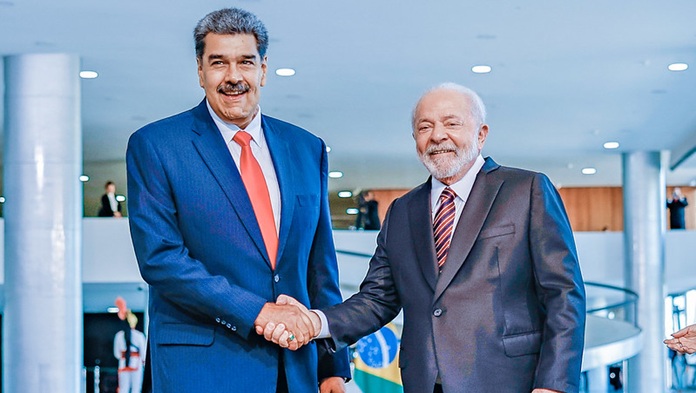
Donald Trump has declared that US will “run” Venezuela after its military captured President Nicolas Maduro and his wife and launched airstrikes on the Latin American country.
It is a brazen and nakedly imperialist attack to overthrow the Venezuelan government, unleash violence and make Latin America a playground for US corporations.
At a media conference on Saturday, Trump said, “We are going to run the country until such time as we can do a safe, proper and judicious transition.”
When asked who will run Venezuela, he gestured towards himself and US Secretary of State Marco Rubio. “It’s largely going to be for a period time the people that are standing right behind me,” he said.
“Under the Trump administration, we are reasserting American power in a very powerful way. The future will be determined by the ability to protect commerce and territory and resources that are core to national security. These are the iron laws that have always determined global power—and we’re going to keep it that way.
“We don’t forget about the Monroe Doctrine anymore. US dominance in the Western Hemisphere will never be questioned again—it won’t happen.”
He added that “we’re not afraid of boots on the ground”, pointing out that the US military had “boots on the ground last night at a very high level”.
Trump made clear it was a plan for plunder. “We’re going to have our very large United States oil companies, the biggest anywhere in the world, go in,” he said. And he warned, “We’re there now, we’re ready to go again if we have to.”
Rubio says Maduro, who had an $80 million bounty on his head, will stand trial.
Albanese dithers
Prime Minister Anthony Albanese has failed to condemn the US’s use of brute force, bleating on X, “We urge all parties to support dialogue and diplomacy in order to secure regional stability and prevent escalation …
“We continue to support international law and a peaceful, democratic transition in Venezuela that reflects the will of the Venezuelan people.”
But there was no such dithering when Russia invaded Ukraine in 2022—an act that Albanese described as a war crime, supporting extensive sanctions.
Albanese frequently calls on China to respect the rule of “international law” but has failed to condemn Trump for his use of gangster imperialism.
Indeed he has given Trump’s criminal attack on Venezuela effective backing, declaring, “Australia has long held concerns about the situation in Venezuela, including the need to respect democratic principles, human rights and fundamental freedoms.”
Meanwhile governments in Brazil, Mexico, Chile, Spain, Slovakia, Cuba and Uruguay condemned the invasion. But it was a different story across most of Europe, with the European Union merely “monitoring” the situation.
French President Emmanuel Macron backed Trump to the hilt, tweeting, “The Venezuelan people are today rid of Nicolás Maduro’s dictatorship and can only rejoice.”
And Britain’s Labor Prime Minister, Keir Starmer, echoed his view, saying, “The UK has long supported a transition of power in Venezuela. We regarded Maduro as an illegitimate President and we shed no tears about the end of his regime.”
Regime change
The air strikes on the capital Caracas and kidnapping of Maduro are a significant escalation in Trump’s plan to reassert US control of Latin America. His administration has been building up US forces in the Caribbean under the guise of targeting “narco boats” and demanding “regime change” in Venezuela.
The US has tried to force regime change in Venezuela since Maduro’s predecessor, socialist Hugo Chavez, was elected in 1999. This included a notorious coup attempt in 2002 that was defeated through mass mobilisations in less than 48 hours.
The US has intervened elsewhere in Latin America, backing coup attempts and reactionary forces. But this is the first direct military intervention since George Bush Senior removed Manuel Noriega, once the US puppet dictator in Panama, in 1989.
What’s behind the escalation? It is of a piece with Trump’s National Security Strategy (NSS) published in December.
Here, the White House outlined a new strategy to combat the decline of US hegemony, its ability to dominate the world.
The document spoke about how “the United States rejects the ill-fated concept of global domination for itself”. It said that it was “dropping America’s misguided experiment of hectoring” states in the Middle East “into abandoning their historic forms of government”.
But it didn’t mark some end to US imperialism—far from it. It was a shift to more openly predatory imperialism and a renewed focus on dominating what’s known as the Western Hemisphere—the Americas and Greenland.
So the National Security Strategy spoke about a “Trump Corollary” to the Monroe Doctrine. First declared in 1828, the doctrine said that Latin America was part of the US sphere of influence and warned European imperialist powers to stay out.
Today, the US warned, “We want a Hemisphere that is free of hostile foreign incursion or ownership of key assets.”
That partly builds on previous US administrations. General Laura Richardson, who headed US Southern Command between 2021 and 2024, said, “Our competitors know that, our adversaries know that this region is so rich in resources it’s off the charts rich.
“Sixty per cent of the world’s lithium is in the region, you have heavy crude, you have light sweet crude, you have rare earth elements.
“You have the Amazon which is called the lungs of the world, you have 31 per cent of the world’s fresh water here in this region. And there are adversaries that are taking advantage of this region every single day right in our neighbourhood.”
The main competitor of the US is China, which has built close economic ties with Latin American states including Venezuela. While the National Security Strategy played down the US focus on China, the inter-imperialist competition between them still shapes policy.
The US hopes that regime change in Venezuela would stamp its control across the continent and send a chill through all those who want to challenge it.
Popular resistance
Venezuela was a beacon for the left, progressive movements and resistance to imperialism in the 2000s.
Chavez came to power in 1999 amid popular resistance to neoliberalism. In 1989, the Caracazo Uprising saw a wave of resistance among workers and the poor to a “structural adjustment package” demanded by the IMF loan shark.
The Venezuelan ruling class never accepted the legitimacy of Chavez or workers and the poor having a say in politics.
Even after Chavez was elected, there was a high degree of popular mobilisation and organisation. This defeated the US-backed coup and Venezuelan bosses’ attempts at sabotage, such as the oil bosses’ lockout that threatened to crash the economy in 2003.
Maduro has been a faint echo of Chavez, who died in 2013. An unaccountable bureaucracy and corruption grew around the ruling PSUV party, while ordinary Venezuelans faced a growing social crisis.
This demoralised and demobilised the PSUV’s working class base compared to the height of the “Bolivarian process” in the 2000s.
However, there can be no equivocation and hand-wringing on the left and labour movement. The overthrow of Maduro at the hands of the US will only hurl back the fight for liberation in Venezuela and across Latin America.
The kidnapping of Maduro and his wife is a war crime and a prelude to vicious attacks on people in Venezuela.
The main enemy is at home—in the White House and The Lodge. Take to the streets, show solidarity with people in Venezuela resisting US imperialism, demand the Australian government condemn Trump’s gangster invasion.
Adapted from Socialist Worker (Britain)