
A mass student revolt in India has claimed victory after a wave of protests against corruption and youth unemployment. Protesters defied a brutal police crackdown and forced a member of Prime Minister Nahendra Modi’s cabinet to resign.
The spark for the protests was the cancellation of India’s National Eligibility Entrance Exams in May after questions were widely leaked. About 2.3 million students planned to take the exams, competing for just 137,000 spots in one of India’s medical and dental schools.
The exams are a critical pathway to a stable income, with youth unemployment at about 40 per cent. Leaks of exam questions, usually to the wealthy and well-connected, have occurred at least 90 times across the last two decades.
Forcing already over-worked students to re-sit the exams pushed some beyond the brink, with at least 21 students taking their own lives.
Shortly afterwards, a member of Modi’s BJP party, Chief Justice Surya Kant, publicly insulted the students as “cockroaches” and “parasites” who “don’t get any employment”.
In response a Boston-based Indian student, Abhijeet Dipke, made a viral post which asked, “What would happen if all the cockroaches got together?” He subsequently formed the “Cockroach Janta Party” (CJP) which described itself as “secular, socialist, democratic and lazy”, and demanded the resignation of Education Minister Dharmendra Pradhan.
In early June, the CJP organised rallies that mobilised thousands. They set up a protest camp and several activists began a hunger strike. Solidarity demonstrations erupted across the country.
The CJP planned a march towards the parliament on 20 July. Two nights beforehand, Modi forcibly detained and hospitalised prominent hunger striker Sonam Wangchuk, hoping to quell the movement.
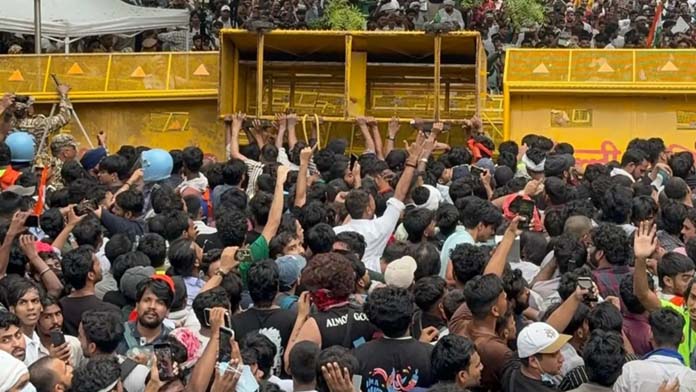
This only deepened students’ rage. On the day more than 50,000 protesters gathered.
Modi fell back on brutal repression to stop the march. He sent waves of baton-wielding riot police to bash the protesters. Many were arrested and at least 200 suffered severe injuries.
This only increased the movement’s support further.
One participant, Gulal, told Socialist Worker in Britain, “[We] supported the movement by trying to send food and resources to the protest site. And a lot of gig workers for food delivery firms … volunteered to help. When the Delhi government stopped trains … auto-rickshaw drivers offered to take people to the protest for free.”
Modi agreed to Pradhan’s resignation, withdrew the charges against protesters and agreed to compensation for the families of students who had taken their lives. The CJP has claimed victory and announced that it “withdraws its nationwide agitation with immediate effect”.
The CJP were careful to limit the movement to narrow demands about the exams’ cancellation. It will take a much broader campaign to tackle Modi’s authoritarian regime. But the movement has shown that mass resistance has the power to defeat him.
By Maeve Larkins