

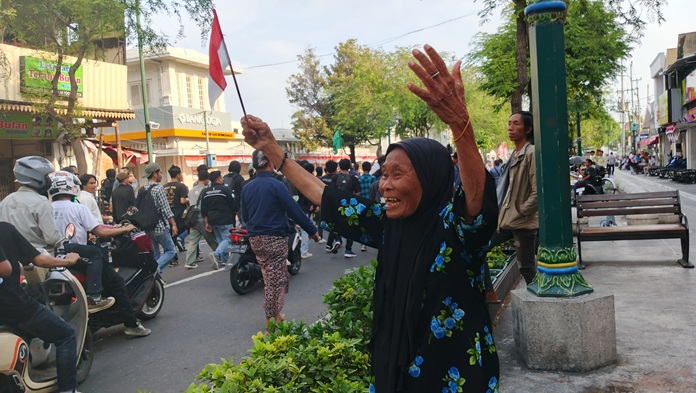
Anthony Albanese visited Indonesia in February, his fifth visit as Prime Minister. He signed a security treaty with Indonesian President Prabowo Subianto. But there was not a word about Prabowo’s vicious crackdown on protest and the jailing and torture of political prisoners. An Indonesian socialist tells the story that Albanese ignores
Following the August 2025 protests in Indonesia, more than 3000 people were arrested. The cry has gone up, “Bebaskan kawan kami!”—“Free our friends!”
A 12 January update by GMLK (the Gerakan Muda Lawan Kriminalisasi alliance), identified that out of the 652 political prisoners they could track, 523 remain in prison, 88 have been found guilty, 17 were released or put on probation, 24 remain missing and one man, Alfarisi bin Rikosen, died after facing brutal conditions in custody.
Last year, Solidarity covered current President Prabowo’s sordid history of human rights abuses as a Kopassus Commander under the former dictator Suharto. Many have already drawn parallels between the August events and his involvement in the disappearance of 23 people in the 1998 riots, 13 of whom remain missing.
The subsequent brutal crackdown following August has left many fearful of organising further actions, knowing the sheer scale of violence the police have got away with and the impunity with which the government has allowed this.
August protests
To understand why the 3000 were arrested, it is important to remember the situation they are being scapegoated for.
A World Bank report indicated that in 2024, 68.3 per cent of Indonesians lived on less than 1,512,000 rupiah per month ($130). In 2025, the youth unemployment rate neared 14 per cent. There was a 32 per cent surge in layoffs in manufacturing and retail.
All this was compounded by the Prabowo leadership’s deluge of austerity measures and tax hikes. Indonesia is a unitary state. Much of the funding for provincial governments is given by the central government. They began telling regional governments and mayors that budgets were going to be drastically cut and they encouraged them to either cut costs or make more money.
Meanwhile, the DPR, Indonesia’s lower house of parliament, increased their monthly housing allowances for MPs to 50 million rupiah, 10 times the Jakarta minimum wage. A DPR member’s monthly salary could total around 50-60 million rupiah or more than 100 million rupiah with the housing allowance.
In Pati, land and building taxes were raised by 250 per cent. Regent Sudewo (an elected official) taunted protesters, “Who is going to stop me, I’ll wait. Go ahead. Don’t just send 5000 people, send 50,000, I’m not moving. I’m not changing my mind.”
On 13 August, an estimated 100,000 protesters turned out, swarming police barricades and demanding Sudewo’s resignation, among other things. This was the seed of the later protests which later spread throughout the country.
DPR members continued producing horrifically bad soundbites. Ahmad Sahroni called protesters “the dumbest people in the world”. As Dr Jonathan Tehusijarana, a local historian who teaches at Jakarta Intercultural School, aptly put it, this was “tone deaf in a country with a cost-of-living crisis”.
“There were protests called for 28 August,” said Dr Tehusijarana. “I heard a lot of people saying it was escalated by a really heavy-handed police response. Police usually begin deploying really heavy-handed tactics only after the sun went down, like after 6-7pm, but when the first protests began on 28 August there were reports that police deployed tear gas as early as 3pm.
“It ultimately culminated in a Gojek (motorbike taxi) driver getting run over deliberately by a police armoured vehicle. The Gojek driver died, he was killed by police, and this inspired a much bigger wave of riots.”
The Gojek driver, 21-year-old Affan Kurniawan, was forced to drop out at year 1 of vocational school due to poverty. He was the main breadwinner of his family. He worked for 10 hours every day in the notoriously unreliable job of ojol (motorbike taxi) driving, paid 1 million rupiah monthly for the room he rented with his brother and sister, plus his sister’s school fees, and often gave his parents what money he could set aside, hoping to save to build them a house in their home village, Lampung.
For many, the symbolism was unavoidable—here was a young man, struggling to support his family, murdered by the government for being in the wrong place at the wrong time, by a police armoured vehicle, whose drivers faced no real punishments (they were given 20 days of “special placement” and ordered to apologise; one was dishonourably discharged).
Everybody could see a little bit of themselves in Affan’s situation. The implied message was clear. “If they can just kill him like that, what’s stopping them from getting me?”
The situation was such that everyone could taste the economy’s precarity. “There was a job opening for a Jakarta municipal street cleaner,” recounted Dr Tehusijarana, “and a lot of people applied, and a lot of them were actually university graduates. Because this actually nets you decent minimum wage, decent benefits, much better than what their usual job prospects can offer.”
With terrible future prospects, the yoke of exorbitant tax hikes, inflation and unavoidable misery, many felt that there was nothing left to lose. So they fought. The sheer scale and intensity of the August 2025 protests has not been seen since the 1998 pro-democracy movement.
The August protests began around the 25th and largely simmered out by 3 September. The 50 million rupiah housing allowance was rescinded, many of the DPR members who made insulting comments were sacked and asked to apologise, but a lot of the further demands were not met.
But the government wanted their pound of flesh.
Crackdowns
Prabowo released a statement the day after Affan’s death, on the 29th, in which he briefly expressed condolences and concern for “the excessive actions of police” before launching into a nationalist screed blaming “anarchist elements” and pleading for the Indonesian people to be wary of those who “want riots and chaos”.
There was no single group responsible for organising the protests, unless we count the Indonesian government’s best efforts at extracting capital from and alienating their own population. According to Dr Tehusijarana, many experts used the word serabutan in reference to plants with roots that grow with no apparent order. Thus it was impossible to blame any specific group, so the government resorted to blaming “anarchists” for the August events.
Over the following months, many faced sudden, arbitrary arrests often from their own homes. One woman, Laras Faizati, was arrested for making Instagram posts expressing outrage at Affan Kurniawan’s death. She was found guilty and sentenced to a year of probation.
In an interview with Tempo, one of the prisoners, Delpedro Marhaen, observed that as a high-profile prisoner with a lot of support and media attention, he had largely evaded police mistreatment; however, he had seen his fellow prisoners forced to bite a bell to make it ring, strangled and left with open wounds.
A report by the GMLK identified in the pattern of arrests what they call a chain of violence (rantai kekerasan). These political prisoners have faced continuous, gratuitous violence at every stage of the process, from arrest to trial.
In Central Jakarta, an M Azzril had his head stepped on and was dragged by police on a dirt bike. He is at risk of permanent disability.
In Magelang, six minors were tortured by police to extract confessions. They were beaten with shoes, rulers and brass knuckles. They were also forced to take turns chewing onions.
Often, detainees are barred from being visited by their families and legal counsel. In North Jakarta, almost every family reported that they could only visit 2-3 weeks after their relative’s arrest.
There have been reports of families being demanded to pay an extortion fee for their relative, with amounts of 1-2 million rupiah upon arrival at detention centres and weekly fees ranging from 150-250,000 rupiah, under threats of further mistreatment of the detainee such as beatings or deprivations.
In North Jakarta, Ryan Sahroni was deprived of medical care. His doctors recommended that his bandages were changed daily, which was not done. He later attended court with open wounds that reportedly emitted a foul smell.
Alfarisi bin Rikosen had reportedly lost 30kg by the time he died in prison. He was healthy before being detained.
A 31 December report by GMLK stated that the most recent arrest they were aware of is of a student, Alif, on 26 December, four months after August.
Local activist groups report constant infiltration attempts by police and military spies, operating with varying degrees of competence. There are rumours among activists, from observing patterns, that various factions among the police and military are competing to see who can arrest the most people in a bid for influence. According to organisers, the doxxing of an activist’s information can net them 10 million rupiah.
A particularly brilliant spy, at time of discovery, had written a number of leftist articles and had embedded himself in various WhatsApp groups posing as a seasoned activist.
The arbitrary nature of the arrests becomes obvious when you analyse what they are being charged with. According to GMLK’s analysis, Article 170 of the criminal code (group violence) was by far the most common charge. In many cases this included people who threw plastic bottles. Some have also been charged with Article 160 (incitement), Article 28 paragraph 3 of the Electronic Information and Transactions law (EIT) (fake news that causes unrest), and Article 218 (insulting the President).
People are being arrested randomly, with no warning, in a system that is deliberately obtuse.
Shadow of 1998
In The Jakarta Method, Vincent Bevins writes of the anti-Communist purge in 1965, “They weren’t officially executed. They were arrested and then disappeared in the middle of the night. Loved ones often had no idea if their relatives were still alive, making them even more paralyzed with fear.
“If they complained, or rebelled, could that be what cost their imprisoned loved ones their lives? Might they be taken too? Even in the face of overwhelming evidence that mass murder is occurring, the human instinct is to hold out hope that your son, or your daughter, might still be saved. This freezes people and makes populations much more quiescent—easier to exterminate and easier to control.”
It would be inaccurate and misleading to directly compare 2025 to 1965. It is not as though the military is rounding up and killing Communists. The scale is incomparable. However, there are indeed parallels we must address.
Prabowo had, as we stated earlier, worked as a Kopassus commander under Suharto, during which he had a long career of snuffing out resistance movements, the most famous example being his personal involvement in ordering kidnappings in 1998.
The principle behind the arbitrary arrests appears similar to the Suharto dictatorship’s playbook—to demonstrate that the government is able and willing to do this to you, that you might be next, and you have no idea whether you would be.
A closer comparison would be to situate the events of August and beyond with the events of 1998. “1998 had a very clear goal,” said Dr Tehusijarana, “which was to overthrow Suharto. It doesn’t seem like these protests have a very clear goal right now.”
There have been rumours floating of military/police interference even during the protests in August, just as there had been in 1998 and in 1965 to manufacture a pretext for a more brutal response, said Dr Tehusijarana.
“The houses of certain members of parliament were looted but they were all houses that belonged to leading government officials. Now, there has been a lot of speculation that the lootings were pre-planned, that they were organised by undercover agents of the military or the police. To effectively create an image of chaos that would justify more heavy-handed intervention.”
He continued, “There were lots of little details, like ‘certain things were returned after’ that feels sort of convenient. So, I think that the military and the police have a history of trying to create chaos.”
There is one last comparison to 1998 I believe must be mentioned. Dr Tehusijarana said, “There have been calls to racialise the protests, to attack Chinese-Indonesians, online, but I think most people ended up ignoring or challenging those. The racial component isn’t very important, I guess.”
The fact that, this time, the overwhelming public response rejected the sort of racism that was taken advantage of in 1998, is encouraging news.
Militarisation
When asked about comparisons of August to 1998, Dr Tehusijarana had this to say, “I think Prabowo realises that if he gives up the pretence of democracy he’ll lose hold of power completely. But I think we’ll be seeing a much larger presence of the Indonesian military in politics than in 1998.”
Under the Suharto government under which Prabowo worked as a military commander, there was a Dwi-Fungsi (two function) doctrine in which military members held political and civilian roles.
During the Suharto era, TNI (military) officers could hold both military and civilian positions. Individual military members report to a military command structure and were posted to infiltrate regular society with the assignment to surveil ordinary people—this was even done to remote villages—and this was with the intention of overseeing and curtailing involvement in politics among those being watched.
Many were worried that Prabowo’s election would herald a return to the militaristic, authoritarian policies of the Suharto dictatorship. In 2025, the officialisation of RUU TNI (a revision of TNI law) has expanded the sectors officers can get involved in, once again allowing the military to take up more roles, up to and including in civilian government.
Since 1998 there had been various efforts demanding the investigation of the 13 disappearances as well as prosecutions of Suharto-era human rights violators. There are human rights advocacy groups such as KontraS.
In 2014, when Jokowi was elected, there were hopes that as the first elected president outside of Suharto’s direct sphere of influence, he would acknowledge the human rights abuses which activists had been campaigning for recognition of, but these hopes did not pan out.
In 2025 the Prabowo administration declared Suharto a National Hero, alongside Marsinah, a 24-year-old trade unionist who was tortured and killed in 1993 by a military command under the Suharto dictatorship. A local activist remarked, “It is like if Hitler and Anne Frank were declared national heroes in the same ceremony.”
In January 2025, the Indonesian government launched an ambitious project to rewrite Indonesia’s history, recruiting 113 professional historians to write what would become a 10-volume epic of blatantly obvious historical revisionism. Director of Amnesty International, Usman Hamid, warned it might become a tool for “deifying individuals and glorifying the past”.
Dr Tehusijarana said that, “In its initial brief, the anti-communist genocide of 1965-1967 (which resulted in hundreds of thousands of deaths) is presented simply as a ‘resolution’ of the 30 September Movement.” The “30 September Movement” is in reference to a 1965 failed PKI (communist party) coup which Suharto later used as a pretext to destroy the entire country’s left wing.
This historical revisionism, alongside broader attempts at spreading the military’s influence, all indicate one thing—where most governments generally operate on the pretext of a form of legitimacy that pays lip service to concepts like democracy, even if they only exist as a mask over the inherent lack of real power a citizen holds under capitalism, the Prabowo government is willing to play fast and loose with these concepts as long as it serves their interests.
A local activist had this to say to Solidarity, “Well, in general I think for military expansion, brute force and repression is needed. The last thing militarism needs is a broader democracy and that is what Prabowo’s regime has been doing with the arrests and repression of these political prisoners.
“A lot of the detained were people that were arrested mistakenly or did something that was very trivial.”
Campaigning to free prisoners
The GMLK is a coalition of many organisations, such as KontraS, Perempuan Mahardhika, etc, which was founded to further the campaign to free the political prisoners. They have also, as we have seen, been documenting and tracking individual cases, though the numbers they are citing represent only the cases they are aware of.
A 4 December statement by the Police Reform Commission stated that they had 1038 people still detained, which indicates there may be hundreds that the activist group has not been able to account for.
“The sentiment mostly revolves on normative solutions, such as advocating for the prisoners in the name of ‘rule of law’,” an activist told Solidarity. “This is the dominating sentiment among activists.”
Indeed a lot of actions taken thus far have been conducted bringing attention to legalities being transgressed. The GMLK activists have easy access to trial schedules and often intervene in them. KontraS prepared a document regarding the most high-profile cases (Delpedro, Syahdan, Muzaffar, Khariq) which provided a compelling account of just how many rights of these defendants were violated.
“We found it difficult to organise with younger people because they got a bit traumatised,” stated an activist to Solidarity. “Because 3000 people got arrested, many of them now are just focusing on internal activities instead of trying to consolidate [political organisation] more.”
This was, of course, likely the intended result of the crackdown. However, the activist added, “But that’s our homework, we have to push it more. Because in a time like this, instead of hiding, we have to establish a solidarity movement.”
The capitalist state
It is a common critique among socialists that the police are not the protecters of society and justice they claim to be, but a force chiefly concerned with protecting and advancing the interests of capital.
It was indeed a foundational tenet of Marxist thought that the state in a capitalist country is simply an instrument of the bourgeoisie used to facilitate the oppression and further exploitation of the working people.
In this case the two above premises are quite transparently, almost insultingly obvious. It is the only explanation for which the events we have covered make any sense. How else could we explain the way in which the state’s lackeys continued giving itself massive benefits, continually squeezing its people dry for every penny, in a cost-of-living crisis?
How else could we describe the way the state hunted down and doled out brutal punishments to so many people for the crime of being upset about the state of things, while its own enforcers saw absolutely nothing of consequence?
It remains to be seen whether this realisation will produce and further forward momentum, for it increasingly feels that we live in a world where everybody realises this, and yet every month there are more Affan Kurniawans.
When asked about the most important thing people should know, Dr Tehusijarana had this to say, “I think it’s important to know that Indonesians won’t tolerate stupidity and arrogance in the government lightly.”
The challenge now is to build lasting, effective socialist organisation despite the repression, to give that mood a cutting edge.