
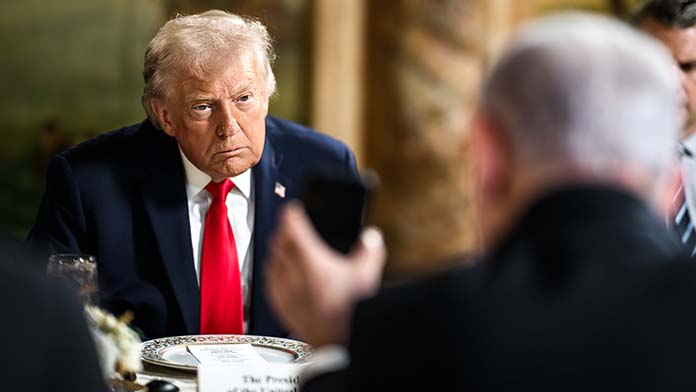
The US might have the most powerful military in the world, but it’s Donald Trump who has been humiliated with the end of the war against Iran.
Trump and Israel started the war but it’s Iran that has largely dictated the terms of the peace agreement signed this week.
The White House has released the 14-point memorandum of understanding between the two governments. Gone is Trump’s talk of “unconditional surrender”, regime change or ending Iran’s ballistic missile capability.
The deal is humiliating, too, for Benjamin Netanyahu in Israel, who has failed in his aim of obliterating Iran. And it’s a slap in the face for Anthony Albanese, among the first world leaders to endorse the US-Israel attack in February.
As American bluster faded in the face of Iranian resistance, Trump made ending Iran’s supposed plans for nuclear weapons his bottom line—even though he claimed a year ago to have obliterated Iran’s nuclear stockpile.
Trump regularly denounces the agreement between Iran and President Barack Obama in 2015, which saw 97 per cent of Iran’s nuclear stockpile sent to Russia. This time, Iran keeps its enriched uranium.
Its only concession is agreeing to “down-blend” (dilute) the stockpile, and to reaffirm that it has no intention of building a nuclear weapon.
Another blow
Both sides will lift their blockade of the Strait of Hormuz, although it will be weeks before shipping returns to normal.
In return for essentially reverting to the situation before the war began, Trump has made a series of concessions.
There will be an end to war “on all fronts”, meaning the US will need to pressure Israel to stop its attacks on Lebanon.
The agreement leaves open the possibility that Iran and Oman will impose tolls on shipping through the Strait of Hormuz after 60 days—another blow to the US’s agenda.
Trump has agreed to a $US300 billion reconstruction fund for Iran, although he will be trying to get the Gulf states to pick up the bill.
The US has also conceded that it will lift all sanctions against Iran. The timeline will be subject to negotiations on a final agreement—but sanctions on Iran’s oil industry are lifted immediately.
Iran will also be able to access all its funds in frozen bank accounts abroad if the agreement is fully implemented, worth at least $100 billion.
Talks on a final agreement, especially over nuclear matters, are supposedly to be wrapped up in 60 days but it’s widely expected they will drag on much longer.
Art of the deal
Trump knows that it’s Iran that demonstrated “the art of the deal”. Meeting with other G7 leaders in France, he publicly exploded with frustration, threatening to bomb Iran if it broke the agreement.
He started the war in February, boasting that it would be won in days. His arrogance saw him reject advice that Iran would retaliate by closing the Strait of Hormuz.
The US pounded Iran, killing its Supreme Leader, sinking its fleet and wreaking death and destruction on Iranians already suffering under the theocratic regime.
On the opening day of the war, US missiles hit a primary school in Minab, killing more than 150 people including more than 100 children and teachers. As many as 6000 Iranians died during the war.
But Iranian missile attacks on the Gulf states, including US bases, and the global economic chaos caused by the closure of the strait, shifted the balance of power in Iran’s favour.
Potential flashpoint
The agreement still faces challenges. Probably the biggest is the role of Israel. The memorandum calls for an end to the war on all fronts—but Israeli Defence Minister Israel Katz insisted that Israel’s military presence in Lebanon would continue “without any time limit”.
“We oppose an IDF withdrawal from Lebanon, despite all the current pressures and those that may yet come. We will not compromise on Israel’s supreme security interests and the protection of our citizens, and we will not withdraw from the security zones.”
A senior US official said Israeli withdrawal from Lebanon was not a clause in the agreement
But Iranian Foreign Ministry spokesperson Esmaeil Baghaei said the memorandum would not be sustainable “without guarantees for Lebanon’s security and territorial integrity”—setting up a potential flashpoint.
Even if the deal sticks, the misery caused by the war will continue. Some oil and gas facilities in the Gulf may take months or even years to repair. Workers and farmers around the world are likely to continue to pay higher prices for fuel and fertiliser, fuelling inflation.
In Iran, an end to the fighting might create political space for a revival of resistance to the regime that exploded on to the streets in January.
Iran has stared down the US and won concessions for Hezbollah in Lebanon. But Israel continues to occupy southern Lebanon and parts of Syria, and is extending its grip on Gaza and the West Bank.
The setback in Iran shows that Israel and the US are not all powerful. But the war has again exposed the complicity of the Arab states, with the United Arab Emirates and Saudi Arabia launching their own attacks on Iran and Jordan helping defend Israel through downing Iranian missiles.
Freedom for Palestine is going to rely on a mass uprising of workers and the poor, to bring down these collaborationist governments and end the imperialist domination of the region.
Whatever happens in coming months, one thing is clear: the US empire is in decline. But a declining empire, especially one armed to the teeth, can also be vicious. Trump is now threatening Cuba. His Board of Peace is overseeing genocide and occupation in Gaza.
The need to build a movement against US imperialism and its allies in Tel Aviv and Canberra remains urgent.
By David Glanz