

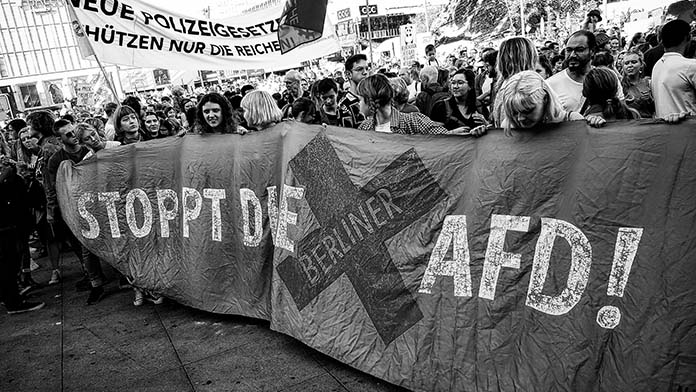
German politics is in turmoil after the fascist AfD (Alternative for Germany) outpolled all other parties in two state elections.
In Saxony-Anhalt the AfD won 44 per cent of the vote, more than doubling their vote since 2021. The party will likely take the post of state prime minister. In Mecklenburg-Verpommern the AfD also topped the polls with 38 per cent.
The AfD promotes extreme racism and is increasingly dominated by Nazis inside the party.
Influential AfD politician Bjorn Hocke has been twice fined for quoting Nazi-era slogans.
Ulrich Siegmund, its leader in Saxony-Anhalt, is a Hocke ally. He pledged “deportation from minute one” and to introduce a “Remigration Task Force” alongside Citizens’ Watch Groups, vigilante groups which would help the police crackdown on left-wing activists.
In 2023, Siegmund was among AfD politicians who secretly met with open Nazis and other far-right groups in Potsdam to plan to “remigrate” non-European migrants.
AfD leader Alice Weidel now embraces “remigration” openly, and a program of mass deportations.
The AfD also seeks to increase refugee detention pending deportation and to exclude children without permanent residency from regular state schools.
They also want to ban pride flags from schools and exclude disabled children.
The AfD is capitalising on anger at austerity policies from the mainstream parties.
Chancellor Friedrich Merz, of the right-wing Conservative Democratic Union (CDU), leads a coalition with the SPD (similar to the Labor Party), which is cutting spending on pensions, welfare and healthcare while increasing Germany’s defence spending to 5 per cent of GDP.
Automobile companies plan massive sackings. Even as Volkswagen looks to benefit from government defence contracts, they announced up to 100,000 job cuts across Germany.
Young people are leaving Saxony-Anhalt in their thousands. Deindustrialisation and the closure of plane, train and chemical manufacturing have produced mass unemployment.
The AfD presents itself not just as an “anti-establishment” party but demands a vicious racist crackdown as the solution.
They accuse migrants and refugees of taking jobs, draining the German welfare system, and exacerbating an “accommodation crisis.”
Asked why they support the AfD, 96 per cent of its supporters in Saxony-Anhalt pointed to its promise to keep out migrants and refugees.
Rather than challenging this, the CDU and SPD have boosted the racism. Merz talks tough about excluding “illegal migrants” and boasts about the government’s own deportation policies. But Merz’s cuts are deeply unpopular.
Pauline Hanson’s surge in Australia echoes the rise of the AfD, and other far right parties in Europe and Donald Trump in the US.
Their use of racism as an explanation for economic and social problems must be challenged.
Anti-fascist opposition
In early 2024, over a million Germans protested the Potsdam “remigration” meetings.
Protests reignited in January 2025, when the CDU accepted AfD votes to pass a motion to turn asylum seekers back at the border and restrict migration.
This mass movement has boosted the fortunes of the radical left Die Linke party. In 2024-5, it doubled its membership from 60,000 to 132,000. Die Linke also won the Berlin elections in September this year with 25.7 per cent of the vote.
But its electoralism has led it to collaborate with mainstream parties and it was part of a government in Berlin which privatised state assets and carried out deportations.
As socialist Christine Buchholz explained, “Because of such experiences, many people do not perceive Die Linke as a credible anti-establishment party.” In both Saxony-Anhalt and Mecklenburg-Verpommern, Die Linke lost votes.
An insurgent left that looks to struggle outside parliament is the alternative needed.
In Germany, tens of thousands blockaded an AfD conference in July. Sections of the blockade chanted for an intifada against pension and wage cuts, and for a free Palestine.
In September, 40,000 school students struck against conscription. Almost 200,000 workers rallied against austerity and job cuts. That’s the power that can beat Merz and the AfD.
In France where the fascist National Rally is leading the polls for the 2027 presidential election, the mass high school student demonstrations are showing the way forward.
Teachers and other workers are striking to join the student revolt that is rocking the Macron government. “We are all anti-fascists,” chanted students, in southeastern France, as they protested.
Linking anti-racism with anti-austerity is the way to forge a real movement to challenge the rise of the far right.
By Finnian Colwell