
Matilda Fay looks at how workers in Hungary exposed the lie that Stalinist Russia was socialist through rising up to try to take control of society into their own hands
It has been 70 years since Hungarians rose against their rulers in 1956. The revolution is often remembered for the devastating invasion when Russian tanks crushed the resistance, demonstrating the brutality of Russian imperialism to the world.
But it is also worth celebrating the revolutionary power Hungarians built. The revolution was based on workers’ power and exposed the lie that Stalinist Russia represented real socialism.
Workers toppled their government through mass protests in the streets, mobilising through organs of mass democracy known as workers’ councils. Operating across key urban centres, the workers’ councils took over production and effectively ran society during the revolutionary upheaval, ensuring the people maintained access to transport, electricity, food and medical supplies.
There are lessons in this for anyone aiming to wage revolutionary struggle today.
Historical context
Hungary in 1956 was part of Russia’s empire in Eastern Europe. Its rulers claimed it was a socialist country run in the interests of the working class but in reality it was under the control of a bureaucratic ruling class.
The Russian revolution of 1917 was a genuine socialist revolution that for a short time saw workers take control of society. But foreign invasion and civil war led to the collapse of workers’ democracy and allowed a new ruling class under Joseph Stalin to impose a counter-revolutionary dictatorship.
Russia developed a form of state capitalism focused on military and economic competition with the West, which involved intense economic exploitation. The same system was imposed on Hungary after the Second World War. For years the country was led by Mátyás Rákosi who described himself as “Stalin’s best pupil”, building up heavy industry at the expense of living standards.
But Stalin’s death in 1953 produced a series of political disputes within the Russian ruling class, and likewise in the Russian satellite regimes in Eastern Europe. Russia’s rulers were fumbling to maintain and advance their power. This culminated in Krushchev’s “secret speech” to the twentieth congress of the Russian Communist Party in 1956 in which he denounced Stalin in order to assert his own power and modernise Russia’s economic program.
This instability created space for demands for reform and struggle from below in the Eastern bloc countries. In 1953 East German workers struck, seized control of key municipal buildings and freed prisoners, until the uprising was crushed by Russian tanks. In Poland in June 1956, strikes broke out in Poznań, leading to a mass uprising. The Poznań rising set off solidarity protests in Hungary and sparked the revolution.
A worker in a telephone factory described how the events in Poznan, “caused quite a stir … These articles were posted up and workers would immediately discuss them … the workers were politically very active … There was a tense political atmosphere, for a fresh breeze had entered the factory against the suffocating pressure of the party.”
Protest becomes revolution
On 22 October students at the Budapest Technological University called a demonstration for the following day “in solidarity with our Polish brothers”.
At first the government gave permission for the march and allowed details to be broadcast on the radio. Permission was then suddenly withdrawn. But it was too late, excitement had spread in Budapest.
The next day 100,000 people gathered in the streets peacefully. Speeches were delivered in solidarity with the Polish struggle. Their most prominent demand was for Imre Nagy, a previous leader who had been an economic reformer (although by no means an opponent of the Kremlin) to take over government in Hungary. Other demands were for an independent national policy on the basis of equality with Russia, and for factories to be run by workers.
Hungary’s ruler Erno Gero broadcast on the radio asserting that the demonstrations were nationalistic and were slandering the Soviet Union. The crowd demanded the right to broadcast a reply and moved toward the radio station. The AVH, Hungary’s brutal political police force, blocked the building. The crowd of tens of thousands began to get agitated. The AVH responded with tear gas and then fired a machine gun.
After shots were fired at the crowd, peaceful demonstration turned into revolution. People fought back and armed themselves with anything they could find.
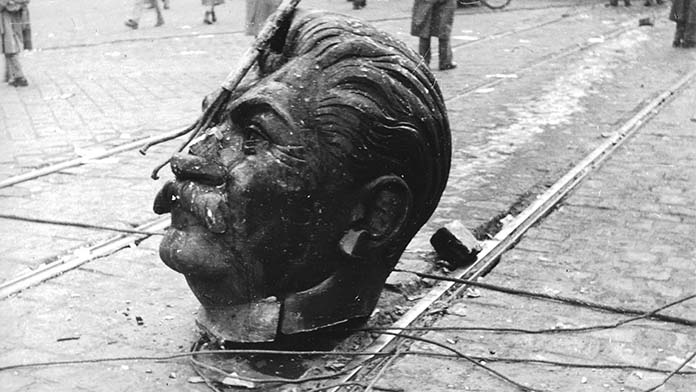
Thousands took to a 16-metre statue of Stalin, tearing it down by cutting through its legs. The statue’s severed head was left in the streets, with people chipping off parts as souvenirs.
Barricades were put up and people attacked the organs of the state, in particular the AVH who had brutally repressed them. When Russian tanks were brought in, people resisted with molotov cocktails.
The Hungarian state collapsed. A new government led by Nagy was declared the next morning. It called on Russian troops to “restore order”.
On 25 October an unarmed demonstration in parliament square was fired on by snipers, killing up to 100 people. This only escalated the resistance and it continued to spread and deepen.
Workers’ power
When revolution took hold in the streets, it very quickly spread to the factories.
By 26 October “revolutionary councils” had sprung up in industrial centres. They called mass strikes but also prioritised essential work to support the revolution, such as distributing food and maintaining communications through the post and newspapers.
They took over local radio stations at Gyor and Miskolc and broadcast statements from the workers’ councils. In Miskolc they took control of the garrison and police.
The government tried to recognise the existence of the workers’ councils in an attempt to bring things back under their control. A Budapest telephone factory worker told of going into work to find the trade union council was trying to run an election for a workers’ council with government-approved candidates, but the workers proceeded to elect their own representatives instead.
Representatives of workers’ councils placed demands on the Nagy government. They echoed the demand on the streets: Russian troops out.
By the end of October, Nagy’s government was forced to promise immediate withdrawal of Russian troops from Budapest.
Russian units were withdrawn from the major cities. A new government was formed. Nagy announced the abolition of the one-party system and placed the government in control of “cooperation between coalition parties”.
It seemed that the people had won. Hungarians now had the freedom to openly politically organise and many flocked to join political parties. But while political parties could debate how to run society, the workers’ councils were already doing so.
The revolution had reached a position of dual power, where formally the state apparatus was still in place but workers were functionally wielding democratic control through their councils.
But the people faced a larger military opponent than just their own state. The Soviet Union, which claimed to stand for workers’ power, could not tolerate seeing it in practice.
After Nagy proclaimed Hungarian neutrality, a delegation was sent to Russia to negotiate the terms for a full withdrawal. Its representatives were arrested by the KGB and imprisoned.
The next morning tanks rolled into Budapest, wreaking intense destruction and killing thousands. Hungarians fought back valiantly—in the streets and with a general strike.
The power of the movement in the street and the workers’ councils did not immediately fall away, even up against the armed force of the Soviet Union.
The councils continued essential work to keep society functioning in the absence of a functioning state. Even as they were outlawed and leading militants arrested, they continued to organise from underground for months, until finally the revolution was crushed completely.
Learning from 1956 today
The Hungarian revolution is often seen in the West as a precursor to Hungary shaking off Russian control in the revolutions of 1989 that brought down Stalinism.
But the democratic control that the workers’ councils represented in 1956 was greater than any so-called freedom that was to come in 1989 with free market capitalism and parliamentary democracy.
1956 showed the brutal imperialism of the Soviet Union. But the Western “democratic” states, too, are run by brutal imperialist ruling classes.
In 1956, while the Soviet Union was crushing Hungarians, Israel invaded Egypt in response to Nasser nationalising the Suez Canal, colluding with Britain and France.
The West did nothing to support Hungary because it had been given to Russia as part of the imperialist carve up of the world at the end of the Second World War.
Today, our rulers have armed a genocide in Palestine with billions of dollars of weapons, because they depend on Israel to stand as an outpost for US power in the Middle East. Satellite images show Gaza razed to the ground by countless US bombs, dropped from F-35 fighter jets with parts made in Australia.
It is hard to imagine the Soviet tanks in Budapest without also picturing the tanks we see today rolling through Gaza and the West Bank, built with steel from Australian manufacturer Bisalloy.
Hungary in 1956 produced confusion within communist parties around the world, which believed that Russia was a socialist country. It helped to shatter this illusion and open space for the anti-Stalinist left and a revival of the real Marxist tradition.
There is no shortage of avenues to carry on the legacy of the Hungarian revolutionaries today. We can build the fight for Palestine, the fight for wage rises amid a cost-of-living crisis, and the fight against the rise of the far right.
In these struggles we can see glimpses of what workers were able to build in Hungary: the power needed to bring down the state, and the revolutionary democracy that can replace it.