

Paddy Gibson looks at the Albanese government’s rush to join the data centre boom, the military connection and the threat they pose to communities and the climate
On 22 May, 200 people rallied on the access road of a new industrial campus near Moss Vale in the NSW Southern Highlands, opposing plans to build three gas-fired power stations.
With a proposed joint capacity greater than 700 megawatts (MW), these plants would increase gas consumption in NSW by more than 30 per cent, driving global warming and toxic air pollution.
But as local Greens Councillor Heather Champion told the crowd, the project “will not turn on a single light bulb outside of this campus”.
Its purpose is to exclusively power a new “hyper-scale” data centre, filled with thousands of graphics processing units (GPUs) to train and run artificial intelligence (AI) models.
At Marulan, less than 50 kilometres from Moss Vale, EnergyAustralia is planning a colossal 1.43 gigawatt gas-fired plant, the largest in Australia’s history, also in response to data centre development.
The top six publicly-listed US companies at the heart of the global AI boom—Alphabet (Google), Microsoft, Amazon, Meta, Oracle and NVIDIA—have a combined market value of almost $US20 trillion, representing a quarter of the entire US stock market.
They are all making huge capital investments in AI infrastructure, projected by Goldman Sachs to top $US8 trillion globally over the next five years. These plans have obliterated any lingering rhetorical commitment to climate targets from governments cashing in on the boom.
Gas-fired boom
In the US, gas-fired power station capacity doubled last year, with all new demand coming from data centres.
In Australia, the past 12 months have seen investment in NSW and Victoria driven by data centre development of almost $300 billion—greater than the $250 billion invested in WA and Queensland during the high point of the mining boom in 2012-2013.
Many of the major projects under construction are in suburban working-class areas of Sydney and Melbourne, where residents are now suffering from the constant noise and heat generated by hyper-scale data centres.
At Kurri Kurri in the Hunter, a new publicly-owned 660MW gas-fired power station has already been built and is scheduled to come online next month.
This was initially planned as a peaking facility, operating only 2 per cent of the year to “firm” renewable energy supply. Now there are plans for a data centre that would see the plant running continuously at full capacity.
In the Northern Territory, the Country Liberal Party announced its intention in July to make the NT the “data centre capital of the globe”, inviting companies to burn gas set to be fracked from the Beetaloo Basin to generate the necessary power.
In March, Federal Labor claimed all new data centres would be powered by “100 per cent new renewables” and announced an “expectation” developers would invest in renewable projects to match their draw on the grid.
But by the time Albanese gave his major AI policy speech last month, the language had shifted. While financing new electricity generation will become a legal obligation for data centre developers, Albanese now talks about renewables and firming—code for gas.
Albanese paid lip service to community fears about AI including mass job losses, theft of intellectual property and the environmental impact of data centres that, along with guzzling power, also require huge amounts of water to cool the processors.
His speech was clear, however, that the scramble to establish firm regulations was to “enhance our appeal to international investors by delivering greater clarity and speed for approvals”.
The NSW government has already established a new Investment Delivery Authority to shepherd data centres through development approval processes as quickly as possible, dubbed a “tech bro concierge service” by Greens MP Abigail Boyd.
Labor’s priority is securing massive profits for big companies and ensuring Australian capitalism maximises its competitive advantage through immediate access to AI applications as they emerge.
Imperialism
The extraordinary speed and scale of the AI build out needs to be understood in the context of sharpening inter-imperialist rivalry, particularly between the US and China.
Marxists define imperialism as a global system of competing capitalist states. The underlying dynamics of this system emerged in the late 19th century, described by the Russian revolutionary Lenin as the era of “monopoly capitalism”.
Major industries such as steel, chemicals production and ship building had become dominated by a small number of massive enterprises with operations and supply chains that stretched across the world.
Cut-throat economic competition for investment and market share increasingly spilled over into geopolitical competition between the national states each firm relied on to negotiate and guarantee access to raw materials, finance, trade routes and export markets.
These states also worked to ensure their national economy included the advanced industries needed to produce modern military equipment that kept them competitive on the battlefield.
This saw a fusion between the operations of capitalist enterprises and the major imperialist states—Britain, France, Germany, Russia, USA and Japan—that had carved up the world into colonies and spheres of influence.
The state became instrumental in planning and co-ordinating production and, in Germany and Japan, both latecomers to industrialisation, state enterprises played a central role.
These rival imperialist powers, today joined by the economic dynamo China, remain locked in competition.
Beneath them sit a host of smaller sub-imperial states similarly eager to build up their military capacity and forge alliances to extend the reach of their own national capitalists—and to exclude rivals.
This system of inter-imperialist competition underpins both the open warfare we see in Ukraine and the Middle East and the AI arms race between the US and China.
All the US tech firms dominating the AI industry have major contracts with the Pentagon and are heavily integrated into the broader US military industrial complex.
While the likes of Amazon, Google or AI firm Anthropic compete, they also invest in and lend to one another and subordinate their competition to the needs of US imperialism, united by a desire to crush the threat posed by China.
As the advantages of AI became clear in 2022, the Biden administration placed export controls on the super-fast computing chips produced by NVIDIA, depriving China and Russia of their economic and military applications.
China in turn has used its dominance in the mining and refinement of rare earths—crucial materials for production of AI infrastructure—for geopolitical ends.
Most recently this has meant export controls on the technology required for refinement, attempting to restrict the capacity of the US and its allies to develop alternatives to imports from China.
AI warfare and US imperialism
The Trump administration has moved from trade restrictions to actively encouraging AI infrastructure development in a select group of countries as a way of consolidating an imperial bloc under its leadership.
In December 2025, the US Department of State announced the “Pax Silica Initiative” in partnership with Australia, Israel, Japan, Singapore, South Korea and the UK.
This involves a commitment to deepen co-operation across the entire AI-infrastructure supply chain, from the mining of critical minerals to chip production to the hosting of data centres using state-of-the-art US technology.
Other countries have joined since, most significantly the UAE and Qatar. Along with Saudi Arabia, these Gulf states have been deliberately fostered by the US as AI-infrastructure hubs.
In May 2025, Trump announced $2.8 trillion in investment pledges during his tour of the Gulf, including a $700 billion AI data centre in Abu Dhabi, built in partnership with OpenAI, NVIDIA and Oracle.
In the war with Iran, AI systems have played a crucial role in US-led attacks—developing target lists, assessing battle damage and mapping the likely outcome of different strategies.
Now AI infrastructure has itself become a target—with Iran hitting Amazon data centres in the UAE.
This builds on the experience of Israel during the genocide in Gaza.
Israel’s advanced tech sector sits at the core of its economy. The very existence of this sector is the result of generations of contracts with, and integration into, the US military production system.
Amazon, Google and Microsoft systems all formed part of the AI-tech used to identify and strike thousands of the buildings and people obliterated in Gaza since October 2023.
In Australia, as Albanese explained in his speech, membership of the Five Eyes intelligence sharing arrangement and the AUKUS military alliance underpins the economic opportunity presented by the data centre boom.
The AUKUS agreement includes both Pillar 1—the well-known and widely opposed nuclear submarine program—and Pillar 2, which includes commitments to jointly develop AI military capabilities.
This connection means Australia can use cutting-edge NVIDIA GPUs and otherwise restricted AI models.
It also led in April to an announcement by the US and Australian governments of more than $5 billion joint funding to subsidise rare earths mining and refinement in Australia.
Federal Labor’s Industry Minister Tim Ayres told the Sydney Morning Herald that government support for data centre and critical minerals development is designed to make the country “indispensable” within the US-led AI ecosystem.
The article also reported comments from security policy experts comparing this with the US Pine Gap spy base, which has been similarly indispensable for US imperialism.
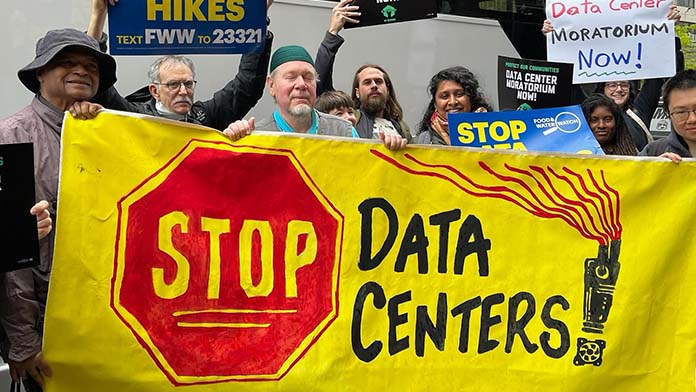
Local communities like Moss Vale are just starting to recognise and protest against the threat that data centres pose to health and to the environment.
These centres also need to be seen as part of the infrastructure of the US-led empire responsible for genocide in Gaza and threatening unending war and climate catastrophe.
In the USA, community resistance to data centres is intensifying and has blocked or stalled an estimated $US170 billion worth of development.
On 14 July, New York became the first US state to declare a moratorium on new data centre development.
A moratorium on hyper-scale data centres is also urgently needed in Australia, to block the roll-out of these factories of death torching the future.