

The German government—a coalition of the conservative Christian Democratic Union (CDU) and the Social Democratic Party (SPD)—is massively increasing military spending, with 140 billion euros allocated in the 2027 federal budget. This represents a 180 per cent increase in spending since 2021.
At the same time, the budget will see huge cuts to social services, with 34 billion euros slashed from health, 7 billion from education and 5 billion from transport.
To fund their militarisation, the government is also taking on massive debt, with unlimited debt for military spending approved by the previous parliament in its final days of government. “We can’t defend ourselves against Putin with a balanced budget,” said SPD finance minister Lars Klingbeil.
Alongside this, the government has pushed through a “summer of reforms” it claims will “revive the stagnating economy and keep Germany competitive in a changing world”.
The reforms include cuts to health services, raising the retirement age, privatising pensions, tightening sick leave regulations, extending the eight-hour working day and giving bosses greater power to hire insecure workers.
After suspending conscription in 2011, Germany now plans to build “the strongest conventional military force in Europe” through recruiting an additional 80,000 active-duty troops and tripling their reserves to 200,000 by 2035.
In November last year, the parliament voted to introduce voluntary conscription. All men aged 18 must complete a form indicating their willingness to serve in the army and provide information about their health and education. But after sending out 300,000 invitations, only 530 people have signed up.
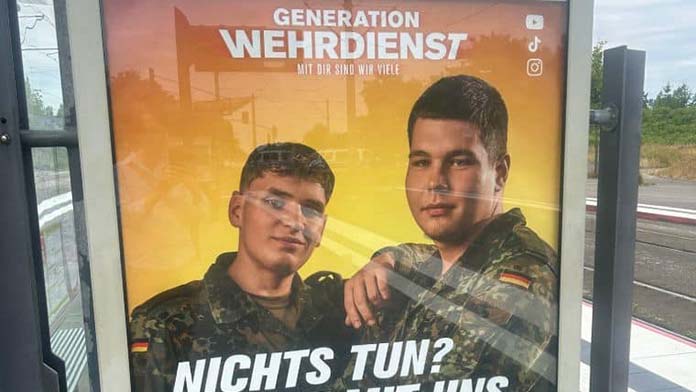
In an effort to boost recruitment, soldiers are being sent into schools, bus stops are plastered with ads for a new YouTube series called “Generation Military Service”, and young people are reportedly receiving leaflets to join the army with their takeaway food.
Unwilling to serve
Germany was not allowed to re-establish an army after the Second World War until 1955. After the Berlin Wall fell in 1989, military spending fell to little more than 1 per cent of GDP.
Conservative MP and chair of the defence committee, Thomas Roewekamp, has said, “If Germany cannot reach its targets through the voluntary system, we will have to return to conscription.”
He is right to hold “serious doubts that we can”. Conscription is extremely unpopular with young Germans, with 99.82 per cent of 18-year-old men reporting they are unwilling to serve in the army.
And in the first six months of 2026, almost 6000 young men applied for exemption from military service on moral or religious grounds, more than double the number of applications in 2025.
Instead, thousands of young people are taking to the streets against the state’s increasing militarisation, donning keffiyehs and carrying signs saying, “We are not cannon fodder” and “Send Friedrich Merz to the front line”.
Schulstreik Gegen Wehrpflicht (School Strike Against Conscription) has been organising school strikes against conscription since December. This year, more than 50,000 protesters have taken to the streets in further strikes, on 5 March and 8 May, with the next action planned for 25 September.
Up to 10,000 protested in Berlin in March, including some parents and teachers from the German Education Union (GEW). One teacher said, “The government is spending billions more on weapons at the same time they are cutting education. This means that we are unable to serve our students, and then they are sent to the military to shoot at other people.”
A student protester told British Socialist Worker, “Schools, culture, sport and youth clubs are being shut down, because they say there’s no money. But they always find money for war.”
In 2025, global military spending was $US2.88 trillion, equating to $US350 for every person on the planet—the largest level of military spending in history. This number will only continue to grow after NATO leaders reaffirmed their commitment to spending 5 per cent of GDP on defence by 2035.
The surge in military spending in Germany, and across the world, is a result of inter-imperialist competition as Western nations scramble to secure access to resources and global markets in a growing rivalry with China and Russia.
Across Europe, ruling class fears of Russian imperialism after the invasion of Ukraine are fuelling militarisation, with Germany warning that Russia could be ready to attack a NATO country by 2029.
Around the world, we must follow the lead of the student strikers and resist the drive to militarisation and war. In Australia, this means fighting to end the AUKUS deal and opposing Australian imperialism in the Pacific.
By Ruby Wawn