
Finnian Colwell looks at how racism and scapegoating has been the defining feature of Pauline Hanson’s career—and why countering it is crucial to pushing her back
The dramatic rise of One Nation in the polls means that organising against her racist and far-right politics is urgent. Some argue that we should criticise Hanson by focusing only on her anti-worker policies. There is an argument that it’s not strategic to label her a racist, or even that this feeds her support.
But racism has always been central to her political project. To stem her support, we have to campaign against her racism and expose it as a false explanation for economic and social crises, which does real harm to immigrants, refugees and Indigenous people.
Hanson’s rise in the 1990s
Pauline Hanson first drew national attention in 1996 as a Liberal candidate when her Labor opponents noticed a letter she wrote to a newspaper. She accused the government of showering Indigenous people “NSWwith money, facilities and opportunities that only these people can obtain”.
It was a racist inversion of the fact that Indigenous people are structurally disadvantaged. Infant mortality rates then were three times higher than the national average, school completion rates less than half.
The Liberal party disendorsed her as a candidate at the last minute. But she was still listed on the ballot paper as the Liberal candidate and won the seat of Oxley as part of a landslide against Labor.
In her maiden speech to parliament, she infamously spoke of Indigenous people being a privileged class and of the danger of Australia “being swamped by Asians”.
She suggested Asians had failed to assimilate and multiculturalism should be abolished. The open racism of Hanson’s speech drew shock and unleashed a political earthquake. By October 1996 18 per cent of Australians said they would vote for a political party led by Hanson.
Liberal and Labor failed to challenge Hanson’s racism. In response to her speech, Liberal Prime Minister John Howard said he was proud that “people can now talk about certain things without living in fear of being branded as a bigot or as a racist”. This helped legitimise her racism.
Labor leader Kim Beazley said Hanson’s maiden speech was “extraordinary and disappointing” but fell short of calling it or Howard’s response racist.
Howard supported aspects of Hanson’s agenda and thought he could undercut her through appealing to her supporters.
He cut immigration by 20 per cent, and slashed Abstudy by $38 million. He cut funding to the Aboriginal and Torres Strait Islander Commission, then later abolished it.
Howard refused to apologise to the Stolen Generations and railed against what he called the “black armband view of history”, saying Australia should not be “too apologetic” about the country’s history of dispossession and genocide.
But this only fuelled Pauline Hanson’s support and emboldened racists even further.
Complaints of racism to the Federal Race Discrimination Commissioner doubled in the year following Hanson’s maiden speech. There was an increase in violent racist attacks, like a bashing of an Asian father and son in Canberra’s city centre.
Her racism appealed to many people still bitter at the impact of the neoliberal economic policies imposed through 13 years of Labor government that ended in 1996.
Labor had privatised state assets, run down welfare and even defended a recession as one “we had to have,” while cutting the corporate tax rate.
Hanson’s seat of Oxley covered Ipswich, a previously rock-solid Labor area. Labor’s neoliberalism had decimated Ipswich’s local railway workshops, where there were 700 jobs cut in the early 1990s.
There was a serious danger of racism spreading within the working class. The idea that migrants were to blame for job cuts and unemployment would undermine the possibility of working class solidarity and resistance against the bosses and governments really responsible.
When pollsters pushed Hanson voters to describe why they supported her, they more often cited her policies on immigration or Indigenous people than other issues.
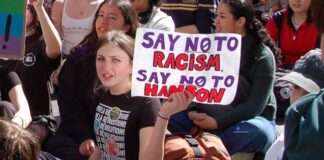
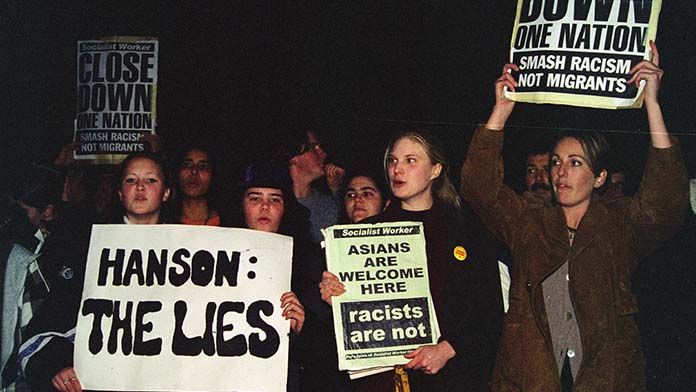
Broad anti-racist mobilisations changed the political calculus and dimmed Hanson’s appeal. In November 1996 in Brisbane, 4000 joined a “Unite against Racism” rally, followed by 30,000 in Melbourne.
Wherever Hanson spoke, hundreds protested. Protests plagued One Nation meetings. High school students came out in their thousands.
The news coverage shifted to questioning Hanson’s racism, and the rallies emboldened more timid politicians, community leaders and union leaders to criticise her racism.
Even Howard felt the pressure and later suggested Hanson was on some issues “bigoted”.
The movement forced the Liberals, who up until the 1998 Queensland state election preferenced One Nation over Labor, to put them last.
As a result, Hanson lost her seat in the 1998 federal election. One Nation still won 9 per cent of the senate vote and one senator but in the years following this the party collapsed.
Racist scapegoating remained part of Howard’s political agenda. In 1999 he adopted Hanson’s temporary protection visa policy for refugees, holding the threat of deportation over them through denying them permanent visas.
The 2001 Tampa affair saw him beat up a racist scare against refugee boat arrivals and ensure One Nation voters backed the Liberals.
Hanson’s return
In the decades following 9/11, mainstream political parties and the media promoted anti-Muslim racism, blaming “Islamic terrorism” and treating Muslim communities in the West as suspect. Howard accused the Muslim community in Australia of failing to “integrate” and talked up the supposed threat from Muslim “extremism”. Police using anti-terrorism legislation carried out publicised mass raids on Muslim communities.
Liberal Prime Minister Tony Abbott in 2014 said that Australians faced threats from “murderous hordes” of a “death cult” in ISIS.
Immigration Minister Peter Dutton championed a discriminatory refugee policy. From 2015, the government favoured Christians from Syria and Iraq over Muslims.
Blaming Islam for terrorism was racist and was used to justify the US wars on the Middle East, in which Australia participated.
Hanson rode back into parliament in 2016 on the back of the racist climate the major parties had created. In her first senate speech she complained that Australia was being “swamped by Muslims”. She wore a burqa into parliament in a racist attempt to link religious attire to a terrorist threat.
One Nation’s surge today
Racism remains central to her appeal. This year, she has repeated her burqa stunt, called for an Australian “monoculture”, said there are “no good Muslims”, expressed nostalgia for White Australia and once again suggested Indigenous people are getting too much welfare.
But the most important issue has been One Nation’s opposition to immigration. Here too the major parties have led the way, giving Hanson undeserved legitimacy.
Both Labor and Liberal have blamed immigration for the housing crisis. In the lead up to last year’s election then Liberal leader Dutton pledged to slash migration, claiming this would free up homes and “get young Australians into housing”.
Labor has followed, saying it is getting immigration levels down and restricting the arrival of international students. It has already strengthened deportation laws and increased international student visa fees.
Israel’s genocide in Gaza has produced another surge in anti-Muslim and anti-Palestinian racism, again promoted by the Labor government and the media. The Islamophobia Register has recorded a 619 per cent increase in reported incidents from October 2023 to February 2026, and an additional 740 per cent increase since the Bondi terror attack.
Albanese has contributed by making the racist accusation that pro-Palestine protesters are “bringing foreign conflicts home”, threatening social cohesion. But it is the government’s own support for Israel and Australia’s export of parts for the fighter jets bombing Gaza that have made the genocide a local issue.
Albanese has failed to label Hanson a racist, accusing her instead of fuelling “division”.
Focusing on austerity not enough
Hanson and the far right internationally feed off the dissatisfaction created by austerity and anti-worker governments.
Racism provides a false explanation for economic problems. It encourages the idea that immigrants steal houses or jobs, Muslims make the community unsafe or Indigenous people waste government money. Racism also provides a false solution: that stopping immigration or defunding Indigenous welfare will make others better off.
A poll for the Nine Papers in August found the top reason voters supported One Nation voters is immigration.
So long as Hanson’s supporters think the main problem is immigration, and see this as responsible for the cost of living and austerity, pointing out that Hanson supports anti-worker policies is not enough.
Her racist solutions seem like solutions until we convince people that migrants aren’t to blame for the housing crisis. We need to point out that scapegoating migrants does not address the real problem: investors hoarding properties to avoid tax, and the government spending money on nuclear submarines rather than public housing.
We need to challenge the racist arguments and convince more people to oppose austerity and anti-worker policies, from Hanson or others.
By not challenging Hanson’s racism, we also let Labor and Liberal leaders off the hook. They have continually stirred up racism themselves and their response to the rise of One Nation has been to adopt some of her policies in an effort to win over her racist supporters.
But this has legitimised her and means her views are treated as much less shocking now that they are shared by mainstream politicians. And it has allowed Hanson to win greater support through claiming the major parties are copying her policies.
Challenging Hanson’s racism goes hand-in-hand with building broad anti-racist demonstrations. The recent high-school walkouts, where thousands protested Hanson, shows the kind of mobilisations needed to drive Hanson out of parliament and put the racist, anti-immigrant Labor leadership on the back foot.