
Lucy Honan spoke to Solidarity about the lessons from Victorian teachers and school staff’s bargaining campaign and the role of rank-and-file organising in it
After a campaign driven by unrelenting rank-and-file organising, Victorian teachers and school staff voted to accept a new offer from the government in August.
Fight the Crisis was crucial to pushing the campaign forward.
Lucy Honan, an activist with the group, told Solidarity, “We broke out of the normal polite EBA exchange and pushed for demands that were serious about trying to deal with the crisis in schools.
“It was significant that the rank-and-file organised a fight for them, independent of the union leadership, and also against the leadership when we needed to.
“Fight the Crisis came together out of fighting for our union to support Palestine and defend staff who stood up for Palestine. That process saw members coming up against a refusal to act from our union leadership. There were about 15 of us who drew the lesson that we have to do this ourselves.
“We started developing basic union practices like writing a motion, taking it to your sub-branch (the union meeting at your school), regional union meetings and so on.
“Our union elections came up in 2024 and it was clear to us that we couldn’t just run on Palestine, we needed to talk about the crisis in our schools.
“We’re facing burnout rates of new teachers within the first three years faster than emergency nurses. It’s normal to collapse primary classes so that you’ve got 50 kids in a room and one teacher.
“School refusal rates, with kids just not coping with school, and cuts to year 11 and 12 subjects, mean that Virtual School Victoria is now the biggest school in the state with about 7000 kids.
“In the previous EBA we got less than 2 per cent per year pay rise and people were burning with anger and wanting to fight. So we ran on a ticket called Fight the Crisis and our headline demand was ‘strike to fight the crisis’. People wanted to strike simply because they hate this government so much.
“The way AEU council is organised geographically meant although we got 38 per cent in the presidential election, we only got seven out of 120 seats on council. But it gave us confidence that we had hit a nerve and that members wanted to strike.”
When the union started discussing its log of claims for bargaining, Fight the Crisis came up with its own demands. “We started sending that to people and building our networks. And we had a strike pledge saying I’m willing to strike for these demands. So we were raising that we would have to fight from the beginning.
“The union leadership got the message. The day our EBA expired they began the process to vote to strike. People knew that we had pushed them into this.
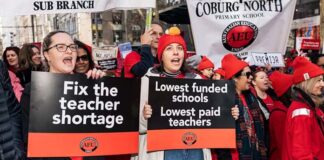
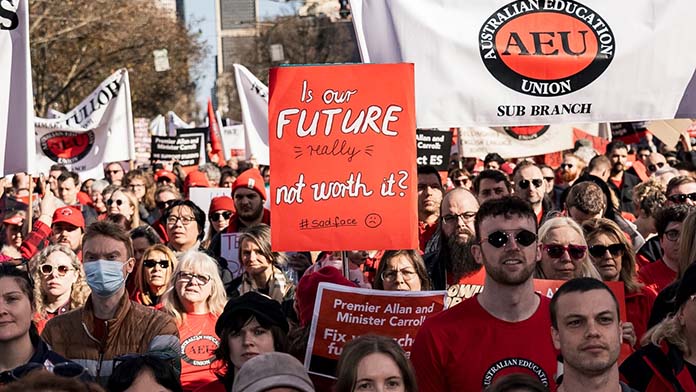
“In March we went out on strike and it was an extraordinary day, with 30,000 people on the streets.” This was the union’s first strike in 13 years.
That strike “grew the union by 15,000 members, from 35,000 to more than 50,000”.
“At the beginning of the dispute, it appeared that the union leadership wanted to lead a fight. But I think they underestimated the extent of the crisis in schools and how much people want to fight for change.
“That became clear after that first strike. They tried to sell us an in-principle agreement, telling members that this was the best that we could get.
“There were regional briefings which the officials would front, and they would just get humiliated at every single one. Fight the Crisis members argued that the agreement was not good enough, and Socialists in Schools opposed it as well.”
The deal was voted down by 58 per cent of union members, in a rare defeat for a union-backed deal.
“After the membership voted against the agreement, the union leadership refused to call another strike,” Lucy explained.
“But as soon as it became clear that we were going to push from the bottom up and call a strike regardless, they scrambled to put themselves at the head of it.
“That contradictory position meant that when the next offers came through, they didn’t want to endorse them because that would be risking their leadership again. They also couldn’t argue against them. So they just did what the department wanted them to do, which was essentially run a bosses’ ballot for them every time a new offer was put.
“Instead of the usual practice where sub-branches meet and hold a collective discussion about it, they just put it to a text message ballot.”
Fight the Crisis organised within the union both to campaign to vote no to the proposed agreements and to push for further strike action.
After the officials refused to call a second strike day for instance, “We held a strike committee and agreed to send out a resolution for a 4 August strike to all our contacts,” Lucy said. “We got everybody within Fight the Crisis to see if they could get it up in their sub-branch.
“Within the last week of school 20 sub-branches committed to the strike action. We put out Instagram reels appealing to people to call the strike from the bottom up. In the school holidays, we mailed schools that we didn’t have direct contact with, inviting people to pass the motion. We followed up with emails, we cold-called schools and asked to speak to the union rep.
“We rocked up at parking lots at schools to see what teachers at different schools were saying and reach out to people. We made a map of all the schools that had called the strike and put that online. It was a building and campaigning process from the bottom up.”
After this, the union backflipped and agreed to call a second strike day on 23 July.
Rank-and-file organisation
“Fight the Crisis combines people who are frustrated with the union leadership and want to see them replaced, and also people who see that no matter what happens, the power to make change is with the rank-and-file, never with the union officials.
“Socialists see trade union officials as mediators between the employers and the working class. They sit at the negotiating table and deal with the bosses all the time. Unlike rank-and-file workers they do not have to live the reality of the workplace.”
This means union officials face conservatising pressures to compromise instead of leading a serious fight.
“As Solidarity members within Fight the Crisis, we led the strategy to push the rank-and-file to take independent action into the campaign. We showed how organising at a rank-and-file level independently of the union officials can push the officials into taking more serious strike action and win gains.
“Without Solidarity members in the heart of this campaign, there would not have been any further strikes; local or statewide.
“The first in-principle agreement that the union put to us included a small pay rise over four years that would have kept us behind inflation counting from 2020,” Lucy said.
“After we rejected that and pushed for a second strike, we won an offer to halve meeting times. That’s an hour extra preparation time that every teacher won. We increased the pay offer so that at least some people have the chance of being above inflation during this agreement.
“We won wage rises for education support staff to be included as part of their base salary rather than add-on allowances. It showed that it was a lie that the previous offer was the best that we were going to get. It showed that strikes win.
“It fell short of our main demands. But the fact that there were open arguments about the way forward that were debated out at every level of the union was really significant. Some sub-branches were willing to call local forms of stop work action and protest independently, taking matters into their own hands.”
Teachers and education support staff also had to confront the anti-strike laws that restrict industrial action. But as Lucy explained, “We shouldn’t accept that because there are anti-strike laws, there’s nothing we can do. We were told we had to wrap up the campaign because of the intractable bargaining laws. That had a very intimidating impact.
“The union leadership was fearmongering about this. When it came to us calling a strike ourselves, the union had already given notice to the department that we would be stopping work throughout term three to give comment to the media and the public.
“So we had total legal cover to stop work on 4 August but we were told that if we did that, we would be risking personal fines of $20,000.
“The union said to us, it’s only meant for short periods of time. So we said, here’s a stop work only three hours long. The Department of Education would contact principals about these stop work actions, threatening that they were illegal. Some sub-branch reps contacted the union to get reassurance that this wasn’t the case. The union deceived them and worded [their response] to suggest that we were risking breaking the law.
“Three sub-branches held independent stop work actions and members from five sub-branches organised before and after-work public actions.
“Even though they were smaller, these actions were politically powerful; they brought home the specific impact of the crisis to local community members, and they showed members that we always had the power to organise our own fight; we didn’t have to wait passively to be told when and how.”
The fightback against a Labor government showed that there is an alternative to both accepting its failures and the racism of One Nation.
“The far right are having a feast on the crisis that Labor has created,” Lucy said.
“What our campaign did was to offer hope not just to teachers and education support staff but also all working class people that we can fight Labor governments without giving in to One Nation.
“Doctors, healthcare workers and council workers in Victoria have all been out on strike in recent months. Workers are furious with the state government, because in every one of those areas there is a crisis that Labor has inflamed through its neoliberal policies and its wage suppression.
“Working class people fighting is exactly the antidote that we need to One Nation and the right. They have absolutely no solutions, but if we organise and fight we can win change ourselves.”