

Mark Gillespie argues that the UK Green party is right to say that Zionism is racism, and that the ideology behind the state of Israel has led to apartheid and ethnic cleansing
The UK Greens are facing a backlash from the mainstream media and the political establishment after passing a motion declaring a basic truth—that Zionism is racism.
The motion, carried at their bi-annual conference in October by 1022 votes to 813, also rejects the so-called two-state solution. Instead, it calls for “the establishment of a single democratic, Palestinian state in all of historic Palestine” with “equal rights for all”.
It also affirmed the “right of the Palestinian people to resistance”.
This is a tremendous victory for the movement for Palestine in the UK. The political and media elite have worked tirelessly trying to marginalise pro-Palestinian voices, criminalising activism and labelling legitimate criticism of Israel as antisemitic.
The Greens have five MPs in the Westminster parliament, over 1300 local government councillors and more than 200,000 members.
The vote shows that the understanding of Israel as a racist apartheid state has spread far beyond Palestinians and the radical left to much wider circles.
The reaction was immediate. Prime Minister Andy Burnham condemned the motion as “wrong” and “antisemitic” and ruled out any coalition with the Greens.
Israel’s Foreign Ministry accused the party of adopting “Hamas ideology” and barred its Jewish leader, Zack Polanski, from entering Israel.
The Board of Deputies of British Jews and the Jewish Leadership Council labelled the Greens a “racist party” while right-wing newspapers portrayed them as taken over by extremists.
Polanski did not vote on the motion, having left the conference to campaign in the Holborn and St Pancras by-election, where he was a candidate.
So far he has stood firm, saying the motion will stand for the next two years until another conference, though he says he’d like to see amendments.
Meanwhile, four of the party’s five MPs have publicly criticised the motion. Former Green leader Adrian Ramsay has called for “a ballot of all party members” to overturn it.
Zionism and colonialism
But the motion is absolutely right. Zionism is a racist settler colonial project built on the dispossession and genocide of the Palestinian people.
Zionism emerged in the late 19th century as a political movement within Europe’s persecuted Jewish minority. In the very early days, the Zionists considered not just Palestine by Uganda and Argentina as possible sites for a future state. But establishing a Jewish state on other people’s land was never a solution to the oppression Jewish people faced.
Establishing a Jewish state would have been impossible without the backing of a powerful imperialist state, so the early Zionist movement actively courted them.
Theodor Herzl, considered “spiritual father of the Jewish state” by Israel, approached numerous European powers seeking support. His vision was explicitly framed in terms of European imperialist interests, arguing the state would be a “rampart of Europe against Asia, an outpost of civilisation as opposed to barbarism”.
Accordingly, Zionism shared the racism towards Arabs and other non-Europeans that typified European colonialism.
British Zionist Chaim Weizmann later convinced Britain that a “national home for the Jewish people” in Palestine would serve its imperialist interests by being “a very effective guard for the Suez Canal”.
So when Britain took control of Palestine during the First World War it began encouraging Zionist settlers to migrate there.
Zionism’s relationship with imperialism did not end with the departure of the British from Palestine. The US was convinced of the usefulness of Israel as a strategic ally following the 1967 and 1973 wars after the Israeli military humiliated Gamal Nasser, the Arab nationalist leader and President of Egypt, together with other Arab armies.
Arab nationalism was a rising movement at the time that challenged US interests throughout the region. US military aid to Israel increased eight-fold during the 1973 war and today it still receives “special” status.
Ethnic cleansing and genocide
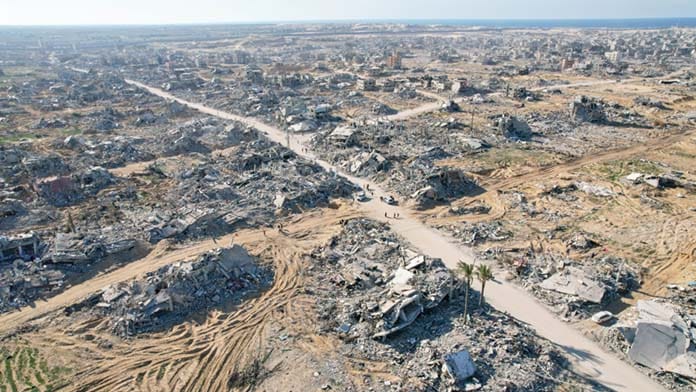
Today people are shocked by Israel’s genocidal violence in Gaza and the continuing ethnic cleansing in the West Bank. But this brutality is the logical outcome of a movement that always knew establishing a “Jewish state” meant expelling the local inhabitants through ethnic cleansing.
“We shall try to spirit the penniless population across the border,” wrote Herzl. “With compulsory transfer we [would] have a vast area [for settlement],” said David Ben-Gurion, Israel’s first Prime Minister.
The Zionist project founded on the displacement of Palestinians cannot be separated from the violence and racism required to establish and maintain it.
When Israel was established in 1948, around 750,000 Palestinians were expelled or fled in what Palestinians call the Nakba (catastrophe). Hundreds of villages were destroyed and the descendants of those who fled remain refugees, denied the right to return.
The dispossession has never stopped. Israel’s occupation of the West Bank, the expansion of settlements, the siege of Gaza and repeated military assaults are all part of an ongoing system of domination.
Israel today is a racist apartheid state no better than the old South Africa or the segregationist states in the US south during the era of Jim Crow.
This basic fact is accepted by practically every major human rights organisation, including Human Rights Watch and Amnesty International.
Not only is there a very high level of anti-Arab racism among Israel’s population, Israel is thoroughly racist institutionally.
The Palestinian population of the West Bank, Gaza and East Jerusalem have lived under military occupation since 1967. They have no citizenship or legal rights and are being driven from their land to allow the expansion of Israeli settlements.
Palestinians inside Israel’s 1948 borders who are citizens (the 20 per cent of the population who were not ethnically cleansed out of Israel in 1948) also face systematic racist discrimination.
Israel’s Basic Law, “Israel is the Nation-State of the Jewish People”, explicitly enshrines a hierarchy, consigning non-Jewish citizens to second-class status.
Israel’s 1950 Law of Return allows any Jewish person in the world to immigrate and automatically receive citizenship while Palestinian refugees are barred from entry.
Furthermore, Israel’s Jewish National Fund controls 93 per cent of the land inside Israel and legally restricts its use for Jewish settlement, systematically barring Arab citizens from leasing or buying homes.
The Greens are right to reject the two-state solution, which has been the official position of Western governments for decades.
Not only is it a complete utopia given Israel’s continuous settlement expansion on land meant for a future Palestinian state, it is wrong in principle.
A Palestinian state alongside Israel would not mean justice. It would not address historic crimes and the millions of descendants of the 1948 ethnic cleansing would still be denied entry.
It would also reward aggression and colonisation. Israel would control at least 78 per cent of the land even though the Jewish population was only about 7 per cent when the British took control.
The two-state solution would also leave in place a racist, colonial state armed to the teeth by US imperialism dominating a much weaker neighbour.
Western governments continue to invoke the two-state solution because it allows them to appear concerned about Palestinian rights while at the same time ensuring the highly armed racist Israeli state continues to serve their interests in this oil-rich part of the world.
No retreat
The pressure on UK Greens leader Zack Polanski is considerable. Like Jeremy Corbyn, the former British Labour leader who faced years of attacks over his support for Palestinian rights, he is being pressed to distance himself from a position adopted by party members.
Polanski needs to learn from Corbyn’s experience and not buckle. Corbyn tried to placate the smears against him by making concessions but this only demoralised his support base and emboldened the right.
The Greens’ party membership has grown sensationally in the last year, surging from 68,000 in September 2025 to over 213,000 today.
Deep disillusionment with the previous right-wing Labour government led by Keir Starmer fuelled this growth.
Under Polanski, who took over the leadership in September 2025, the Greens have shifted from a purely environmental focus to stridently attack Labour from the left.
The Greens have become more vocal in their criticism of Labour’s record on Gaza, refugees and the cost-of-living crisis. They have also advocated wealth taxes, rent controls and public ownership of essential services.
That shift has helped the Greens attract people looking for a radical alternative to the established parties.
Serious inroads into Labour’s support base were made. More than 50 Labour councillors defected to the Greens and, for a brief moment before the removal of Starmer, the Greens were outpolling Labour by 21 per cent to 16 per cent.
If Polanski, for the sake of party unity, were to follow Labour and start placating the right, it would be a tragic strategic blunder.
Building the movement
The Greens would not have adopted this position without the movement for Palestine that has grown internationally because of the Gaza genocide and which has refused to be intimidated by smears or state repression.
The movement has rightly called for a free Palestine “from the river to the sea”, which means equal rights, freedom and justice for everyone living in historic Palestine.
It means rejecting a future built on permanent inequality and recognising the right of Palestinian refugees to return.
The UK Greens’ vote shows that these arguments can reach well beyond established activist circles. The challenge now is to keep building that movement, resist the pressure to retreat and build wider support for Palestinian liberation in Australia and internationally.