
James Supple looks at what socialist mayor of New York Zohran Mamdani has achieved in his first year in office and what it shows about the problems with socialist electoralism
The mid-term elections delivered a historic wave of Democratic victories and a decisive repudiation of Donald Trump, not just over the cost of living and his war on Iran but his brutal ICE raids, racism and support for the tech billionaires.
The result, flipping control of the House of Representatives and the Senate, turns him into a lame duck President, unable to get anything through Congress.
There has also been another crop of Democratic socialists elected, alongside others who ran promising to tax the rich and stand up to the billionaires, including Abdul El-Sayed in Michigan and James Talarico in Texas.
This began when Alexandria Ocasio-Cortez and a series of other radical left figures entered Congress in 2018. It followed Bernie Sanders’ first Presidential primary campaign promising a “political revolution” against the power of the billionaires.
Zohran Mamdani’s election as Mayor of New York City last year created another shockwave. Mamdani not only identifies as a socialist but is a member of the Democratic Socialists of America (DSA), which now claims over 100,000 members.
The DSA backed Mamdani’s campaign and has helped draw thousands of activists into electoral campaigns across the US, based on the hope that serious change can be won through putting insurgent left-wing figures into the Democratic Party.
Mamdani’s win is also a serious test for this socialist electoral strategy, since he now has real power over a city budget of $170 billion and 300,000 staff.
However, after almost a year in office, Mamdani’s efforts reveal the limits of his brand of socialism and the possibilities of change through capitalist parliamentary institutions.
Mamdani swept to office through promising to tax the rich and deliver action on the cost-of-living crisis for the city’s working class through funding free buses, universal free childcare, rent freezes and affordable housing.
But this faces a series of major obstacles. The most obvious is the power of capitalists and the major corporations. New York has more billionaires than any city in the world and is home to Wall Street, the symbolic heart of US capitalism.
Although the rich failed to stop Mamdani’s election, after spending $40 million on the campaign, they have many other means to tame or destroy governments.
Early on, there were hints that businesses and millionaire residents could exit the city, threatening the jobs of thousands of New Yorkers and depriving it of tax revenue.
More directly, corporate-backed politicians in the mainstream Democratic Party still have significant power over Mamdani—including the Governor of New York state, Democrat Kathy Hochul, and the state congress the party controls.
The Democratic Party is one of the central political institutions of US capitalism, with the backing of numerous billionaire donors.
Mamdani campaigned that he would pay for his agenda by raising $10 billion by taxing the rich. Any tax increases in New York City require approval from the state legislature and governor. So taxing the rich to fund Mamdani’s program requires piling political pressure on the state Democratic Party—and fighting the capitalist interests behind them.
Instead Mamandi has sought to reassure capitalists and CEOs about his willingness to listen to them and compromise—organising a meeting with over 100 big business CEOs as soon as it looked like he would win the election.
Once in office he set up a Business Advisory Council that includes prominent banking and real estate figures including four billionaires, saying that, “The doors of City Hall are always open to New York’s business leaders, and I look forward to welcoming their experience and strategic guidance.”
Working within the system
Rather than confront the rich, Mamdani has relied on negotiations and deal-making inside the Democratic Party to try to gain concessions within the constraints of the status quo.
His first annual budget in May did deliver $2 billion in funding to expand free childcare and kindergarten programs, assisting parents unable to afford private childcare services. But this is still far from the universal free childcare that he promised. And there was no funding to deliver free buses or affordable housing.
Mamdani had to plug a $12 billion deficit for existing programs. He managed to extract an extra $2 billion in funding from Governor Hochul. But the only effort to tax the rich she agreed to was a charge on luxury second homes in the city, estimated to raise just $500 million.
This followed Mamdani’s endorsement of Hochul in her re-election campaign this year, undercutting a challenge from the left by Antonio Delgado.
He balanced the budget through cuts across city agencies and postponing payments into city pension funds to future budgets.
The governor has already indicated that further budget help is unlikely to be forthcoming, saying that in next year’s budget Mamdani should look at making more cuts and that, “They manage their budget now.”
Instead of leading an insurgent movement to challenge capitalism and the Democratic Party bosses, Mamdani has resorted to public relations spin designed to present himself as a competent manager.
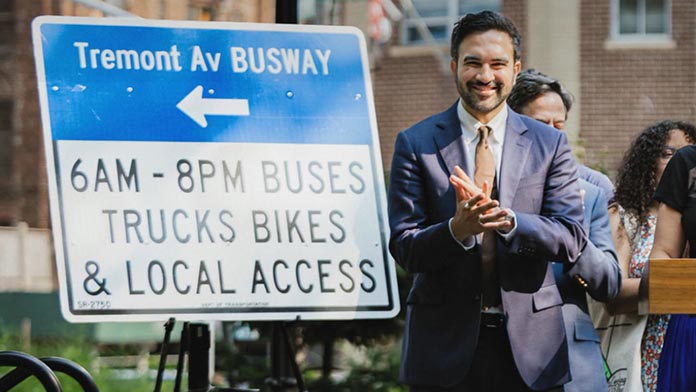
He has talked up faster buses instead of the free buses he promised, declaring he had sped up 175 routes by “up to six minutes” a trip. In September he personally helped patch what he said was the city’s 200,000th pothole for the year, declaring, “It’s the little things that say a lot about whether government is delivering for New Yorkers.”
It was hardly a historic socialist achievement. Former Mayor Michael Bloomberg repaired 400,000 in a single year, he claimed.
Capitalist state
Another obstacle for anyone elected that wants to deliver radical change is the state bureaucracy. Whether at national, state or city-wide level, the state departments that run governments and deliver services do not simply follow the wishes of democratically elected leaders. They are run by public service bosses who see their role as working to support corporations and the status quo.
This is particularly true of the repressive arms of the state, including the police, courts and the army.
Instead of seeking to challenge them, Mamdani has capitulated to conservative resistance to change. This is most glaring in his approach to the New York Police Department.
One of the first demands on him from corporate interests was to retain Jessica Tisch as head of the NYPD. Tisch, a billionaire heiress and friend of Ivanka Trump, was appointed by previous mayor Eric Adams to implement plans to flood the city with extra cops and ramp up arrests to “crack down on crime”. She also describes herself as a “proud Zionist”.
Mamdani kept her in place and has done little to challenge the notoriously brutal NYPD.
When he ran for state assembly in 2020 following the Black Lives Matter movement, Mamdani backed defunding the police. While campaigning for mayor he backflipped and apologised for calling the NYPD racist.
During his campaign he promised to disband the police Strategic Reponse Group that is used against protests—something he has so far failed to deliver.
Instead it continues to violently attack protesters. During a demonstration against Israeli President Benjamin Netanayhu’s visit to New York for the UN in September, the NYPD arrested over 100 people, including DSA members who are elected city councillors and congressional candidate Avila Chevalier.
Mamdani had pledged to arrest Netanyahu for war crimes if he set foot in the city. Once elected he backed down, claiming the city lacked the legal authority to do so. He then let the NYPD give Netanyahu a police escort and attack the protest against him, even claiming, “To New Yorkers, I have never encouraged them to protest.”
Then, when ICE officers shot 28-year-old Oscar Belgal, who was driving with his five-year-old son in the car, NYPD officers arrested and assaulted anti-ICE protesters who mobilised in response. DSA responded by calling on Mamdani to sack Tisch, saying the NYPD had failed to help “drive ICE out of New York City”.
Mamdani, however, replied that he had “no plans” to remove her and instead praised Tisch for “uprooting corruption” and “lowering crime across our city”.
Mamdani’s strong support for Palestine was another major feature of his campaign for mayor, as he steadfastly called Israel’s actions in Gaza “genocide” and supported the BDS campaign. But he began to moderate his position, disowning the chant “Globalise the Intifada”.
This year on 7 October, he chose to attend a vigil organised by the group Israeli Voices for Peace. The group opposes Israel’s occupation of the West Bank and Gaza but supports Israel’s existence as a Zionist state. Other Palestinian activists condemned this as assisting the normalisation of Israel.
Mamdani’s compromises and backflips are a result of his reformist political strategy—trying to bring change through winning control of the existing parliamentary and state institutions.
As his experience already shows, this results in junking promises of sweeping change to accept whatever small gains are possible within the existing capitalist framework. It means collaborating with the corporations and the rich who the political system is designed to serve.
The real power to deliver change lies in building mass movements to fight for change outside parliament. The movement that got Mamdani elected could have been the basis for beginning to mobilise this kind of power on the streets and in the workplaces. His campaign organised 104,000 volunteers to door-knock and get the vote out.
New York City also has the strongest DSA presence in the country, with over 15,000 members.
But Mamdani has made no effort to call protests or to mobilise his supporters to fight the system. When the DSA started to organise campaign events earlier this year to tax the rich, “the mayor made it clear that he himself would not be taking part”, Mel Bienenfeld wrote in Tempest.
As the revolt in France shows, mass protests, and most importantly workers’ strike action, has the power to shut down business as usual and put serious change on the agenda. Socialists need to put building struggle at the centre of our strategy for change, not look to the dead end of electoralism and parliamentary politics.