

Erima Dall looks at the impact of AI, including in the workplace, and the consequences of its use in the service of profit
Artificial intelligence (AI) has grown exponentially since ChatGPT was launched by OpenAI at the end of 2022.
Already AI has been incorporated into search engines, the public service, the military, surveillance, banking and scientific research.
Governments are positioning themselves to capitalise on the promise of the next big productivity leap. Donald Trump put tech CEOs in the front row of his inauguration last year and even appointed Elon Musk to lead the newly created Department of Government Efficiency (DOGE).
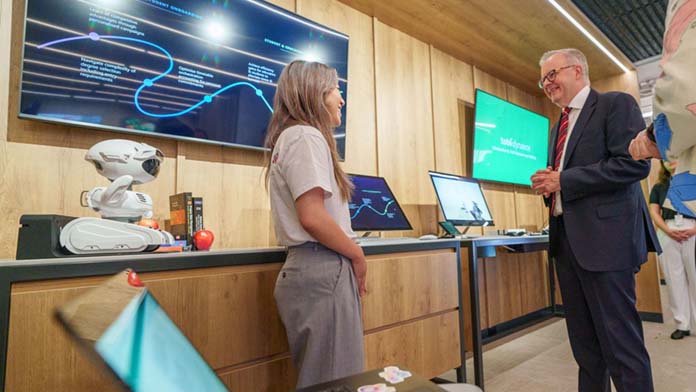
In Australia, the Labor government has declared the country “open for business” with AI. Prime Minister Anthony Albanese signed a memorandum of understanding (MOU) with Anthropic’s CEO Dario Amadei in April.
But AI is anything but popular. A clip of students booing AI at the University of Central Florida graduation ceremony went viral.
The idea that AI will lead to a world freed from the drudgery of repetitive, poorly paid labour is a naïve fantasy, perpetuated for profit. Just as microwaves did not liberate us from sexism, there is nothing inevitable about this technology leading to shorter working weeks or fewer mundane tasks.
In fact, the history of capitalism shows the opposite.
But succumbing to the idea that AI will lead to dystopia is also a mistake. The image of a world taken over by robots where human labour is no longer required has no basis in science or history and serves only to make us passive in the face of change.
Both the utopian and dystopian visions of AI underplay our hands as agents in our own future and bolster the myth that AI is all-powerful. The beneficiaries of this myth are the big tech corporations.
Capitalists want to use AI for their own interests. But workers can resist this.
Threat
AI poses many threats. Most obviously, as a jobs killer. White-collar jobs such as paralegals, coders and data analysis are most at risk.
Already, Atlassian has cut 1600 jobs, Amazon laid off 14,000 people and Meta is planning to reduce its workforce by 20 per cent, all citing a pivot to AI.
But with AI increasingly integrated into robotics technology and motor vehicles, blue-collar work and jobs like food delivery are also in the firing line.
The deskilling of creative work such as graphic design and video editing also puts many jobs at risk. Entire AI-generated bands have appeared on Spotify.
AI will also increase workplace surveillance, with tools like facial recognition and moment-by-moment location monitoring of workers.
The explosion of AI-generated sexual content including “deep fake” images and voice imitation is alarming.
In the military sphere, the Iran War has been referred to as the first “AI war”. In the first 24 hours of the US attack on Iran, 1000 targets were auto-generated by Palantir and Anthropic.
And AI is posing existential questions about our humanity, relationships and mental health. An alarming number of people are in, or have had, romantic relationships with an AI bot. The calls for government regulation of AI are rising.
But governments will not want to place too many limits on AI, more concerned with the potential profits companies and wealthy investors claim are possible for those that lead the race.
The extraordinary growth of AI is fuelling a surge in investment in data centres. The six biggest firms pouring money into AI are projected to spend $750 billion this year alone—more than the GDP of Ireland.
AI investments accounted for 60 per cent of all venture capital investment in 2025 and 80 per cent of growth in the stock market in 2025.
All this could be a bubble waiting to burst if these investments do not generate their expected profits.
It’s been estimated that up to $2 trillion in revenue will be needed to cover the investment to pay for all these data centres—yet most AI firms have yet to make a profit. The hype around AI is based on projected potential, not current reality.
The drive to develop artificial general intelligence (AGI) is the promise of creating a “do everything” machine that exceeds the intelligence of humans.
But a survey of experts in the field showed a majority think this is still a very long way off and many think it can never be achieved.
AI is essentially a very advanced probabilities machine, with large language models (LLMs) like ChatGPT being likened to predictive text on steroids.
Cory Doctorow, author of Enshitification, says it is more accurate to compare AI to plug-ins. It can certainly do exciting things but it is not as novel as we are led to believe.
It is entirely possible that the anarchic rush to invest in AI infrastructure will create a glut—where more is built than is needed. This is how a boom turns into a bust.
Contest
AI does not just exist in the cloud. Data centres—huge complexes that generate the computing power needed to run AI—pose an extraordinary threat to our water resources and will intensify energy consumption.
In Memphis, the community of Boxtown is fighting against Elon Musk’s super computer “Colossus” powered by 35 gas-powered turbines that are poisoning the air and creating respiratory problems in a predominately Black community.
In Australia, 200 residents of Moss Vale held a protest against a new gas-fired power station to service data centres in NSW, where 15 new data centres have been fast-tracked, worth $52 billion.
Behind AI also sits an army of poorly paid content moderation workers who must sift through traumatising content and categorise it for user safety.
It is not true that AI simply “learns” through interaction—it is also taught by millions of workers called data labellers, for example in how to identify objects or write in different styles.
Data labellers in India, Venezuela and Kenya are paid less than $3.50 per hour—in an industry worth $300 billion. The World Bank estimates there are between 150 and 430 million data labourers.
This is a new source of immense potential power, which is slowly being organised. In February 2025, Kenyan workers formed the Data Labellers Association to “empower the invisible architects of AI”, including advocating for workplace mental health support.
Workplace transformation
AI is part of a broader trend of automation.
Productivity increases from automation have never been shared equally or put back into the social good.
Bosses don’t say, “That’s great, we made 100 extra cars this week—why don’t you all take Friday off!” They work us all just as hard and get Friday’s cars as free profit, or sack people to reduce their wages bill.
Under capitalism, technological development seems to have a life of its own.
We are “slaves to the machine” even though the machines were designed and built by people.
Marx called this alienation. We feel alienated and powerless in the face of technology because there is no democratic control over it. It is in the hands of a tiny rich minority, driven by profit.
There are plenty of useful things AI can do, like assist in early cancer or dementia detection, track the path of cyclones, find people trapped under rubble using sound mapping and revive dead or endangered languages.
One Te Reo Māori radio station in New Zealand is working with local elders to integrate AI language learning tools into their programming.
Many of these specialised uses of AI don’t require enormous data centres but can be trained off smaller mobile devices like specialised laptops. But this is not where most funding is going.
Battleground
AI is a new battleground for unions and workers. The Screen Writers of America went on a 148-day strike in 2023 and secured a contract that established controls against the misuse of artificial intelligence in Hollywood, including that AI cannot be a “writer” and writers cannot be forced to use it.
The Maritime Union of Australia (MUA) is fighting AI-driven automation at DP World ports, and is developing broader demands for controls around AI in workplaces such as granting unions a “digital right of entry”, banning the collection of workers’ biometric data and ensuring technologies will not be used for surveillance and time management.
Historically unions have fought for shorter working weeks, no increase in work intensity and no reduction in jobs to counter the impacts of automation. Productivity gains should be shared and benefit working people.
The Victorian Trades Hall Council and the ACTU have also released reports on AI and workers’ rights. But defending our rights will require more—strong fighting unions and workers taking industrial action at the point of implementation.
Leaps in technology should be a benefit to society. Ultimately AI won’t be used for good under capitalism but it’s not the technology that is inherently bad. We need to fight for control over it.
We need to take control off those who want to use AI to kill more people in Palestine, Iran and Lebanon so we can decide whether we want AI, what kind of sustainable energy sources can fuel it and how the labour force behind it is treated and compensated.
Ultimately this means we need to uproot the system that puts profit over people and treats technology as something to be imposed on us to make profit for corporations, rather than something which we created, and which is an extension of our own creativity, intelligence and human potential.