
Stop work action by Victorian public mental health workers has forced the Victorian Labor government to sign off on a statewide enterprise agreement.
The campaign by Health and Community Services Union (HACSU) members won some concessions and a pay rise but fell short of what could have been achieved.
The agreement expired nearly two years ago in June 2020. This coincided with the first serious COVID-19 community transmission in Victoria and enormous strain on health and community services.
Mental health workers have worked all through pandemic with worsening conditions and pay rises below the increasing cost of living but have also been taking industrial action to fight back for workers and service users.
Three months after the EBA expired, HACSU filed to hold a protected action vote, which was endorsed by the majority of union members across Victoria.
Many of the bans implemented at the beginning of protected action were designed to frustrate management, make things easier for workers and not adversely impact service users, for example bans on logging contact hours, non-clinical meetings and paperwork.
These bans were popular among workers and effective but after several months of negotiations key claims hadn’t progressed and people began calling for a step up of industrial action through statewide stop work action.
Excuse
Government officials and the bosses’ union used COVID as an excuse to stall negotiations. They also asked the union to drop key demands and industrial action until the Mental Health Royal Commission recommendations were handed down, arguing that they would improve the sector. This process also took for ever and the union pushed back against this technocratic approach.
Many workers have worked overtime to fill big holes in service delivery and staffing shortfalls, which is a way the system increases overall exploitation of the workforce.
This is a particular challenge in more feminised industries when the product of our labour is human health and wellbeing—we feel the pressure to fill the gaps because we want to support our colleagues and service users who may be placed at increased risk without adequate staffing cover.
Healthcare employers struggle to retain and recruit new staff because of over-work and underpay, relying on goodwill and the “hero narrative” to celebrate healthcare workers without providing them with wages and conditions that support workers on the job and outside of it.
The health system has become so reliant on overtime that some workers who have difficulty making ends meet take on extra shifts, which only exacerbates burnout.
Mental health clinicians who had been around in the 1986 nurses’ strike and periods of broader union militancy called for statewide stop work actions.
HACSU issued a 12-hour stop work and people were planning to come from all across Victoria on the 26 May 2021 until another COVID wave led the Andrews government to ban large outdoor gatherings.
This happened again on 4 April and many unionists joked that COVID-19 was a conspiracy to stall the EBA.
While stop work actions still took place at localised clinics and hospitals this made it difficult for unionists across the state to connect with each other, share strategies and a broader vision for a better mental health system. Zoom organising was also difficult.
While COVID was a very real threat, governments also leveraged the crisis to restrict organising. Black Lives Matter demonstrated it was possible to hold powerful and safe rallies with tens of thousands of people during the pandemic.
Gains
While a range of strategies were used to get the EBA over the line it’s telling that it was only in-person industrial action which finalised the agreement.
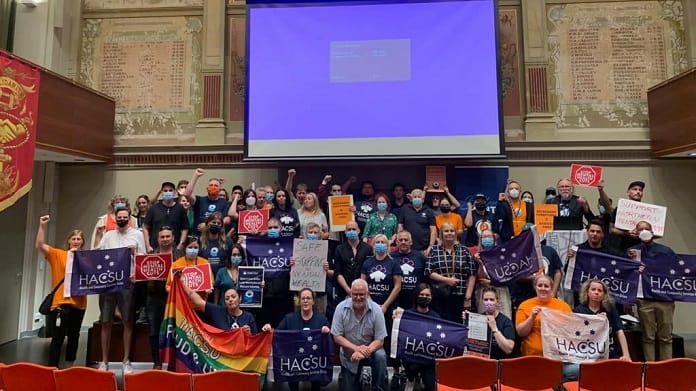
The union put on hold industrial action when a draft agreement was reached and endorsed by the majority of members in November 2021. Then nothing happened for another four months as the government continued to stall and delay. It was only when another stop work action on 17 March 2021 was held in person at Victorian Trades Hall that the agreement was finalised.
There were some gains in this EBA including extended leave for child rearing, emergency management and disaster relief (timely in the current and future climate), and improvements in career structure for the growing lived experience workforce.
In terms of wages, nurses were able to secure a 3 per cent increase in wages each year but unfortunately the government has split the workforce by only offering 2 per cent a year to allied health (social work and occupational therapy), the lived experience workforce and administration.
This is in line with Labor’s commitment to the public sector wage cap, which is repressing wages below inflation, contributing to a cost-of-living squeeze on public sector workers.
Workers did fight back against this and were able to secure backpay for the two years of backsliding in wages and living costs and a modest $1500-$2000 lump sum “retention bonus” each year to stay in the sector.
These gains barely keep up with the cost of living in the harsh industrial and inflationary environment of the last two years but could also only be achieved through withholding labour and industrial struggle.
It will take more of this for workers to begin to claw back some control, particularly in industries like healthcare, disability and social services where work is consistently undervalued and under enormous systemic strain.
By a HACSU member