
Solidarity spoke to Dr Albert Palazzo, Adjunct Professor UNSW Canberra and author of The Big Fix: Rebuilding Australia’s National Security about the AUKUS deal and the expansion of US bases across this continent
There’s been a lot of discussion that Australia may never get the Virginia class nuclear submarines promised under the AUKUS deal. What does the US get out of the deal?
AUKUS is a very one-sided deal. The benefits are almost all to the US. They get billions of dollars to support their nuclear submarine building industry. Somewhere between $6 and $9 billion will be transferred to the US and also to the UK.
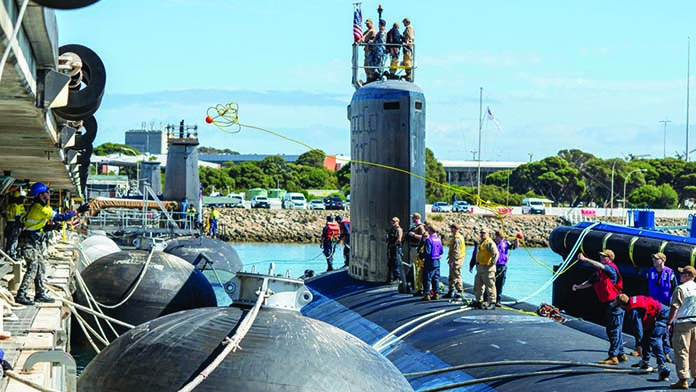
Then the US get bases. The government won’t call them American bases, but they are a foreign base in all but name, such as the submarine base at Stirling [in WA].
The reason it’s useful to the Americans is that it gives them a naval base on the Indian Ocean. They don’t currently have one able to operate submarines, to repair submarines and which has facilities for housing military personnel and their families. We’re building housing for 2000 American citizens they’ll be putting there.

It’s a very geographically convenient location if you want to sever China’s sea lanes of communication across the Indian Ocean and also to get into the South China Sea.
Tindal [airforce base] is going to host B-52 bombers and we’re building [new facilities there] for the Americans to use at our expense. They also get access to Amberley [airforce base], from which they’ve launched an offensive bombing run against Yemen. So we’re having a large and growing presence of American military personnel and American weapons systems.
Why are the Americans doing this? The answer is because the US is intent on maintaining its primacy in the Indo-Pacific.
Australia has now become a launching pad for the US to project military force against China. It’s basically assuring that Australia will be involved in a war between the US and China if one was to happen.
Without Australia, if there’s a war, US operations will be from China’s east out of Guam, out of Japan, even as far away as Pearl Harbor. But with Tindal and Stirling, the US will be able to operate against China from the south.
How does this shape the role of the Australian military?
The Australian Defence Force is not designed to defend Australia.
It’s designed to be a supplement to the US military. Our air force will basically be a wing of the US Air Force. Our navy will join an American task force. And our army is very comfortable working under the command of an American general. It’s driving what Richard Marles, the Minister for Defence, called not just US interoperability, he called it interchangeability.
A lot of the justification given for AUKUS is that it’s necessary because China poses a threat to Australia. What do you think of that?
I don’t see China as a threat to Australia. The Chinese have never said anything about attacking Australia. Invading Australia’s a ridiculous suggestion. But Australia has a long history of fearing invasion from peoples to the north of us. This goes back really to the founding of the country.
What China wants to do is become a great power. Great powers do whatever they feel like.
The US is a great power, and it recently started a war with Iran. Could anybody stop that? No, because as a great power, they do whatever they feel like. The rules don’t apply to great powers.
So we will have a China that is more assertive and will want to make the rules to its own benefit, as the US did. But those issues do not have a military solution. It’s laughable to think that Australia can militarily intimidate China.
China is a nuclear-armed power. You cannot rattle a sabre at a nuclear-armed power. You cannot go to war with a nuclear-armed power. And yet people today talk about war with China and neglect to mention that there are enough nuclear weapons here to exterminate life on this planet.